 loading...


AUDIO

Visit ThisIsYourBible.com

|
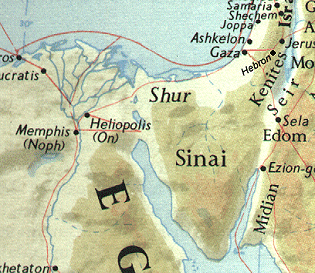
47v.30 I thought a map might give a clue about the sort of effort involved in all the movement backwards and forwards between Canaan and Egypt. Now at the end of Jacob's life, a further journey presents to take him back to Machpelah before Mamre, which is Hebron (Gen.23:19), which I've marked on the map. Sarah was buried there - 23:19 - so was Abraham - 25:9 - so were Isaac and Rebekah and Leah - 49:31 and now Jacob wishes to join them and wait for the Kingdom of God, where we hope to meet him. Matt.22:32 |
 |
Peter [UK] Comment added in 2001 Reply to Peter
46 v.2 - The phrase 'Here am I' seems to carry with it more than simply telling another of your physical presence. It is used 16 times and each time it is in the context of a person giving their service to another - here to God. It suggests an absolute willingness - a characteristic we do well to develop! - Gen. 22:7,11, 31:1, 37:13, Exo.3:4, 1Sam 3:4-8, Isa.6:8
Peter [UK] Comment added in 2002 Reply to Peter
ch 46 - Notice the way in which Jacob / Israel is used in this chapter
Israel :1, 2 , 29, 30.
Jacob :2, 5.
It is as if, against the news that Joseph is alive, Jacob oscillates between struggling with the news and rejoicing that it is true.
47:27 The way that Israel multiplied in Goshen is setting the scene for the affliction which was to follow which was, in itself, the process that would bring abut the Exodus. God is still at work!
Peter Forbes [Mountsorrel (UK)] Comment added in 2002 Reply to Peter
46:34 We have another piece of language which is used in Zechariah 13. 'trade … youth' is found in Zechariah 13:5 - we should build up the links between different parts of Scripture so that we can then let Scripture expound itself.
47:28 Joseph was 17 when he was sold into Egypt (Genesis 37:2) and he spends 17 years with his father in Egypt. So Joseph has two 17 year periods with his father.
Peter Forbes [Mountsorrel (UK)] Comment added in 2003 Reply to Peter
Genesis 46:30 - "And Israel said unto Joseph, Now let me die, since I have seen thy face" - What was Joseph's Egyptian title again? "Saviour of the World" - Jacob, having laid his eyes once more on the Son of his love, the one who was named by him "Increaser," who was sent before his face to preserve life in Egypt (World) - John 3:16 - is now content to go to his grave in God's good time. Jacob actually lived a further 17yrs in the land of Goshen, matching the number of years that Joseph had spent in the family compound in the land, before being cruelly sold off into slavery as a mere lad. Was Simeon, many years later, thinking of this incident recorded here in Jacob's life as he took the infant Jesus into his arms? - Luke 2:30. And if so, why?
Genesis 47:9 - "And Jacob said unto Pharaoh, The days of the years of my pilgrimage are a hundred and thirty years: few and evil have the days of the years of my life been" - There are those who imagine that if only they could live longer, perhaps they might achieve a better standing before God. Though Jacob lived twice the life span most of us might expect today, his own summary of his days is that they were "few and evil." It is a blessing that 70yrs is our allotted span, and in that time is more than enough opportunity to sufficiently come to grips with the awesome Grace of God, and to embrace His righteousness with an attitude of gratitude.
Cliff York [Pine Rivers (Aus)] Comment added in 2003 Reply to Cliff
Gen 46.28 - 'And he sent Judah before him' - Why? because Judah has overcome and shown clearly to his father his is now a new man, and he is worthy to lead the family. Is he then, not worthy of the title of having 'prevailed above his brethren' (1 Chron 5.2) and to be the father of the chief ruler - Christ (ch 49:10)
Jared Schipper [Perth Ascot (Aus)] Comment added in 2003 Reply to Jared
46:4 Jacob’s concern about going down to Egypt is allayed by God who reminds him of the promise to Abram ‘bring thee up again’ quoting Gen 15:16
47:9 In saying that he was 130 years old he would doubtless have surprised Pharaoh as the average life expectancy in Egypt at this time was only around 60 years.
Peter Forbes [Mountsorrel (UK)] Comment added in 2004 Reply to Peter
God says different things to different people. Jacob was told to go into Egypt Gen 46:3,4 but his father Isaac had been told not to go there Gen 26:2. This is a useful principle. Perhaps The Lord has richly blessed us, say, in building a Meeting Room, or personally in getting a job, but it doesn't always follow that we shouldn't move in the future. (The difficulty is obviously working out what God wants us to do. We need faith AND works.)
David Simpson [Worcester (UK)] Comment added in 2004 Reply to David
Gen 46:2 "Here am I." This is more than a physical willingness. It suggests an absolute willingness to give complete service to God.
|
AbrAHAM
|
|
|
JOSEPH
|
|
|
MOSES
|
|
|
SAMUEL
|
|
|
ISAIAH
|
John Wilson [Toronto West (Can)] Comment added in 2004 Reply to John
46:27 It is stated that seventy people came to Israel. Actually, it was sixty-six, but if you add Jacob (as head of Israel), plus Joseph and his two sons Ephraim and Manasseh, who were counted as sons by Jacob (48:5). That totals seventy. But, Stephen counts seventy-five (Acts 7:14). Stephen is accounting for the two sons of Manasseh, and the three sons of Ephraim who were born in Egypt (1Chron 7:14-20). All these were included in the nation of Israel.
Michael Parry [Montreal (Can)] Comment added in 2004 Reply to Michael
46:1 Beer-sheba which means"well of an oath" was in his direct route to Egypt. It had been an encampment of Abraham (Gen 21:33) and of Isaac (Gen 26:25) and was memorable for their experience of the Divine goodness. Jacob appears to have deferred his devotions till he had reached a spot so consecrated by covenant to his God and the God of his fathers. It was here that we see a virtual renewal of the covenant that had been made to both Abraham and Isaac. (V.2)
John Wilson [Toronto West (Can)] Comment added in 2005 Reply to John
46:3 - Here we see God reassuring Jacob that this time it is OK to go to Egypt, as this time it is God's plan that he should do this. Abraham did this, and it seems it was probably his own decision, and it caused him grief. It seems, from this answer of God's, that this was the reason for the sacrifices of v.1, that God might answer his anxiety.
Peter [UK] Comment added in 2005 Reply to Peter
47:19 - If we don't follow Christ we will perish. Believers lives are not their own to do with as they please, our lives and the land we hope to live eternally in was bought by Christ. We are to be slaves to Christ who nourishes us. We owe Christ everything.
Charles Link, Jr. [Moorestown, (NJ, USA)] Comment added in 2005 Reply to Charles
46:8-27 This section is, it might seem, superfluous to the narrative. One point that flows from the list of names is the degree to which God had already blessed Jacob in line with the promises that God had made to Abraham and his seed that he would multiply them - Gen 17:2 for example.
47:2 I wonder which five brethren Joseph presented to Pharaoh. Any Biblically supported suggestions?
Peter Forbes [Mountsorrel (UK)] Comment added in 2005 Reply to Peter
FOOD
It was all about food. The Egyptians needed food to survive. When it comes down to the line, there is nothing more important for life than food. Without food our days are numbered, and in death anything else we own - our lands, possessions and riches - have no use at all to us. While we detest paying a high price for food, we will pay all we have got for this valuable resource.
The famine in Egypt was so severe that the Egyptians completely ran out of food. They came to Joseph and spent first their money, then their livestock, then their lands and their lives on food just to keep themselves alive. In those seven years of famine they must have had some very expensive meals!
Like the Egyptians, we cannot do without food. If we were in the same situation everything we owned would seem small in value compared to having something to eat.
Food is one aspect, but to truly live we also need spiritual food. Spiritual food is made up of listening to God by reading his word and meditating on it, talking to him in prayer and by putting his instructions into practice in our lives. But how much do we crave spiritual food? Would we give our all for it? Would we sell all we have to keep hold of it, or to have another spiritual meal? Spiritual food will save us for eternal life. Let's consider it precious.
Robert Prins [Auckland - Pakuranga - (NZ)] Comment added in 2006 Reply to Robert
47:9 Jacob describes his life as being of days which were ‘few and evil’ however when he blessed Joseph’s sons he seems to have a different thing to say – Gen 48:15 – ‘the angel which redeemed me …’ Maybe by the time he came to bless the lads he appreciated more fully how God had been working in his life.
Peter Forbes [Mountsorrel (UK)] Comment added in 2007 Reply to Peter
46:30 Israel here is seen to have been harbouring the hope that Joseph was still alive all these years – so maybe he never actually believed the story that his other sons brought to him.
Peter Forbes [Mountsorrel (UK)] Comment added in 2008 Reply to Peter
The Israelites settled in Goshen where the city of Rameses was located (47:11). Later, when the Israelites became slaves, they were forced to build Rameses as a store city (Exo 1:11).
Michael Parry [Montreal (Can)] Comment added in 2008 Reply to Michael
46:34 'for every shepherd is an abomination unto the Egyptians', shepherds were an abomination to the general Egyptian populous as they were a reminder to who really ruled their kingdom (the Hyksos shepherd kings). We and our families should be proclaiming ourselves as shepherds in the sight of Egypt (the world) as reminders that God rules in the kingdoms of men. This will make us an abomination to those who do not want to be reminded that it is indeed God who rules over the kingdoms and man is not in control to do as he wishes, but this in itself helps to separate us and our families from the world.
Pete Barrett [Milnsbridge UK] Comment added in 2008 Reply to Pete
46:3 I will make of thee a great nation encouraged Jacob with the words that God spoke to Abram – Gen 12:2
Peter Forbes [Mountsorrel (UK)] Comment added in 2009 Reply to Peter
47:24 The Egyptians were to pay one-fifth of their crop yield to Pharaoh their landowner. One-fifth became a supplement under the Law of Moses (e.g. Lev 6:5; 22:14; 27:15 etc.).
Michael Parry [Montreal (Can)] Comment added in 2009 Reply to Michael
First Principles>Kingdom of God>Existed in the past
6. 12 tribes of Israel descended from the 12 sons of Israel. They remained in Egypt until the 400 years expired. Gen 15:13 Gen 47:27-31 Exo 1
Go to Gen 12:1-5 for more about First Principles>Kingdom of God>Existed in the past
Roger Turner [Lichfield (UK)] Comment added in 2009 Reply to Roger
46:34 It seems to be a comment upon the way that Egypt was that "every shepherd is an abomination unto the Egyptians" however it highlights a fundamental feature of the works of darkness – for that is what Egypt was. The God of Israel shepherded His people. His son was the ‘good shepherd’ – John 10:11 - The care that God and His son have for the children of God is the exact opposite of the influence of ‘Egypt’ upon those children. So even though the picture we see now is one of generosity towards Israel we will see in due course that ‘Egypt’ persecuted the children of God. As it was then so it is now.
Peter Forbes [Mountsorrel (UK)] Comment added in 2010 Reply to Peter
46:34 To add to brother Peter's recent comment: Moses was undoubtedly an abomination (Strong's: an abhorrence) to Egypt and Exo 3:1 reminds us that Moses was literally a shepherd. In fact, Moses tried to avoid being an abomination to the Egyptians: Exo 8:26. Israel were an even greater abomination after the events of Exo 9:1-7 when the Egyptians' sheep were destroyed and Israel's were not.
Ken Trelfer [Rockingham Forest, UK] Comment added in 2010 Reply to Ken
The Capabilities of the Soul as Mentioned in the Bible
The word "soul" is used variously in Scripture to describe the actual person, the mind, disposition, life - subject to the principle of mortality. The word is from the Hebrew "nephesh" in the Old Testament, and the Greek "psuche" in the New Testament. Some of its usages indicate that the soul:
Is born (Gen 46:18,27), can eat (Exo 12:16 note margin;Deut 12:20;Lev 17:10-12;Luke 12:19), eats bread (Hos 9:4), must die (Psa 22:29), has a mouth (Psa 103:2-5), has lips (Lev 5:4), has blood (Jer 2:34), can thirst (Psa 42:2), can be idle (Prov 19:15), weeps (Jer 13:17), can touch (Lev 5:2), can be touched (Num 19:11 note margin), can die (Josh 11:11;Eze 18:4), can be smitten with the sword (Josh 11:11), can be pierced (Luke 2:35), can be put in a pit (Job 33:18;Isa 38:17), goes into the grave (Psa 86:13;Psa 56:13), needs redemption (Psa 49:15), needs a resurrection (Psa 89:48;Psa 49:15)
Thus the Bible clearly teaches that man is mortal; that his existence is limited (Psa 144:3-4), and is destined to death (Psa 89:48). His only hope of a future existence is through a resurrection (1Cor 15:50), and a change to divine nature by the miraculous and singular work of Jesus Christ (Phil 3:21) when he returns from heaven.
The above from The Story of the Bible by G.E Mansfield, V.3, P.272.
Charles Link, Jr. [Moorestown, (NJ, USA)] Comment added in 2010 Reply to Charles
47:29 So Jacob calls for Joseph to ensure that his body is buried in Canaan. But Joseph was not the firstborn. Reuben, by normal expectations, being the firstborn would have been the one who would ensure that the father’s dying wishes were performed. But no, Joseph is the one to ensure that the last wishes of Jacob are fulfilled. Thus we see it is not in the general nation of Israel that we are to look for the fulfilling of promises. It is in the word of the one ‘sent to preserve life’ that promises will be fulfilled. That is in Jesus.
Peter Forbes [Mountsorrel (UK)] Comment added in 2010 Reply to Peter
The Mystery of the Missing Traveller
Have you ever gone on a long walk with a large group of children? You count them up at the beginning, and at each gate in the road you count them again, just to be sure? Jacob did this. He counted 67 persons in his travel party (add up Gen 46:15,18,22,24 and subtract 3 for Joseph and his sons, gives 67). This tallies with v27, 70 persons and 3 were already in Egypt, gives 67. So far, so good. But in v26 they've suddenly reduced to 66. One person is missing!
Who is the missing traveller, and what happened to them?
Rob de Jongh [Mountsorrel (UK)] Comment added in 2011 Reply to Rob
46:31-34 The fact that shepherds were an abomination to the Egyptians causes Joseph some concern, even though Pharaoh has welcomed them into the land. This is the beginning of the contrasts which eventually lead to Israel being slaves in Egypt.
Peter Forbes [Mountsorrel (UK)] Comment added in 2012 Reply to Peter
47:4 Notice that the sons of Jacob had come to “sojourn” in Egypt. Despite their problems they did not view Egypt as their home. Maybe the words of Gen 15:13-14 were in their minds as the way that the purpose of God was becoming clear to them.
Peter Forbes [Mountsorrel (UK)] Comment added in 2013 Reply to Peter
Gen 46:2,3,4,34. A couple today -
1. vv. 2-4. What did God intend for Jacob to take from his statement that He would bring him up again (i.e. from Egypt)?
2. v. 34. Here Joseph says that "every shepherd is an abomination unto the Egyptians". Why would this be?
1. Due to the last phrase of v. 4 - "And Joseph's own hand will close your eyes" - the primary meaning would be that he would die in Egypt, but only after his great wish was fulfilled in seeing his beloved son. (Apparently the closing of the just deceased's eyes by a family member was a custom then, as it has remained into modern times. This along with a parting kiss to the corpse - see Gen 50:1.) There may be a couple of additional meanings as well. One could be that Jacob's nation - Israel - would leave the land of Egypt and return to Canaan. See the original promise of this to Abraham in Gen 15:13,14. And then too there may have been the idea of God's bringing up of Jacob from the dead - i.e. his resurrection to eternal life to receive the land promised to him (see Gen 28:4).
2. Apparently, according to various historical records of this time period in Egypt, the country was ruled by what were called the "Shepherd kings" who had come in from adjoining Eastern countries and imposed their rule on Egypt. So the native Egyptians would not look highly upon shepherds, since they did not like being ruled over by non-Egyptians with the same occupation. This very fact - that Joseph's brethren were shepherds - would help to keep them a separate people while in Egypt due to the Egyptians' attitudes toward any shepherds. Joseph appears to foresee the benefits to this separation and encourages his brethren to make sure the Pharaoh knew this so that this separation could come to pass in their living conditions.
Wes Booker [South Austin Texas USA] Comment added in 2013 Reply to Wes
46:4 Of course Jacob did not return to the land of Israel whilst he was alive. His dead body was brought back. However God has not broken His promise. The promise to Abraham in Gen 15:16 – was looking further than Israel’s time in Egypt. When God spoke to Abraham in the promises in Gen 15 He was looking to the time of the resurrection.
Peter Forbes [Mountsorrel (UK)] Comment added in 2014 Reply to Peter
47:11-12 All started well for Jacob and his sons. Given privileges by Pharaoh. Some 200 years later things had changed dramatically and Israel were serving Egypt as slaves. But it was all prophesied in Gen 15:13-15 though doubtless no one at this time appreciated what was going to happen.
Peter Forbes [Mountsorrel (UK)] Comment added in 2015 Reply to Peter
47:29-31 We saw in the previous chapter the play on the two names of Jacob – Jacob and Israel. But now, when he is showing his faith in the promises of God we read of “Israel” on both occasions when he is named.
Peter Forbes [Mountsorrel (UK)] Comment added in 2016 Reply to Peter
47:8 We might think it not good manners to ask a stranger their age. However Pharaoh knew Jacob has 12 sons and would have had an idea, at least, of Joseph’s age and doubtless learnt that he was the youngest of the twelve sons. So maybe it was incredulity of Jacob’s health.
Peter Forbes [Mountsorrel (UK)] Comment added in 2017 Reply to Peter
46:2 This is the only time that God speaks to Jacob repeating his name = “Jacob Jacob”. Similarly, and only once, do we find God speaking to Abraham similarly calling “Abraham Abraham” –Gen 22:11. On both occasions there was an urgency. On both occasions the promises were presented.
Peter Forbes [Mountsorrel (UK)] Comment added in 2018 Reply to Peter
Peter Forbes [Mountsorrel (UK)] Comment added in 2019 Reply to Peter
Gen 47:2-3 The question has been asked before. Of Joseph’s brethren, who were the five men chosen by Joseph to present them to Pharaoh? Based on some Biblical clues, I offer this suggestion as to the identity of four of the five brethren,
Pharaoh asked them, “What is your occupation?”,their response was, “They servants are shepherds…” Therefore five of Jacob’s sons identified themselves as shepherds in Gen 37:3. Joseph and the sons of handmaids Bilhah and Zilpah are identified as shepherds looking after their father’s flock. The sons Zilpah were Dan and Naphtali (Gen 30:11-13) and the sons of Bilhah were Gad and Asher (Gen 30:5-8), so these four were practicing shepherds.
As it is Joseph who presents five of his brethren to Pharaoh he cannot be counted as one of the five.
The fifth member of the company of presented to Pharaoh remains an open question?
We do know the Lord Jesus Christ says of himself, “I am the good shepherd, and know my sheep, and am known of mine.
As the Father knoweth me, even so know I the Father: and I lay down my life for the sheep.
And other sheep I have, which are not of this fold: them also I must bring, and they shall hear my voice; and there shall be one fold, and one shepherd.”(John 10:14-16). May the great shepherd of the sheep come soon soon to unite faithful Jews and Gentiles into one fold.
Peter Moore [Erith, UK] Comment added in 2019 Reply to Peter
46:5-6 How little did Jacob and Joseph think how the generosity of Pharaoh would change when another Pharaoh came onto the scene! In like manner we do not know how things will turn out in our lives in the near future. We must live today without worrying how circumstances might change as time progresses. If we can be like Joseph we will have the confidence to believe that God’s good plan will eventually be fulfilled ad the problems of this life will then be seen as insignificant.
Peter Forbes [Mountsorrel (UK)] Comment added in 2020 Reply to Peter
47:4 No doubt Jacob and his sons had no idea how long they would be in Egypt. Maybe they thought they would return to Canaan as soon as the famine was over. Isn’t it wonderful that we cannot see into the future when thinking about the details of our lives? To know that you were never going to see the land again would have been a terrible blow to Jacob and his sons. They could have worked out from what God said to Abraham – Gen 15:16 – but we presume they did not.
Peter Forbes [Mountsorrel (UK)] Comment added in 2021 Reply to Peter
46:3 the promise “I will … make thee a great nation” reminds Jacob of the promise made to Abram – Gen 12:2.
Peter Forbes [Mountsorrel (UK)] Comment added in 2022 Reply to Peter
47:13-19 the repeated words “bread” and “money” along with the acknowledgement that they would not hide their dilemma from Joseph is a picture of a people who, having thought that they could work their way out of a problem now acknowledge that God’s representative is the only solution.
Have we arrived at that point yet?
Peter Forbes [Mountsorrel (UK)] Comment added in 2023 Reply to Peter
47:6 How different to events a couple of hundred years later when a Pharaoh arose who did not acknowledge Joseph in – Exo 1:8. The “good times” were to end in order that the promise to Abram could be fulfilled – Genesis 15:14.
Peter Forbes [Mountsorrel (UK)] Comment added in 2024 Reply to Peter
v.2 - Here we have a number of rare words - perfection (miklal - 04359) is only here, but its root word is used in similar circumstances in Eze. 27:4,11 (and nowhere else). The word for beauty (yophiy - 03308) only has 19 occurrences eg. Ps.45:11, Est.1:11, Prov.6:25, and shined is a special word too (yapha` - 03313) only 8 times in scripture eg. Deut 33:2, Ps.80:1, Ps.94:1(show). Of course we realise in retrospect that it is the work of Christ through which God will shine. 2Cor.4:6
Peter [UK] Comment added in 2001 Reply to Peter
v.5 - Matt.24:31 - When we receive our calling will we too hold the misunderstanding Bro. Peter mentions below? It seems that this is the major lesson of this Psalm, that we might worship and praise the Lord out of a recognition not of His need for praise or sacrifice, but of our own need, that He has seen fit to show us, to achieve that humble and contrite spirit He seeks.
Peter [UK] Comment added in 2002 Reply to Peter
:8-13 Israel had a serious misconception. They thought that God needed their animal sacrifices. The Psalmist is correcting this misunderstanding saying that what God wants is our praise :14. We need to understand that our worship of God and attendance at the meetings is not for God's benefit. It is for ours and we should praise Him for this.
Peter Forbes [Mountsorrel (UK)] Comment added in 2003 Reply to Peter
Psalm 50 - "A Psalm of Asaph" - are the first words of this Psalm. "Asaph" means 'to gather, or collect.' The theme of this Psalm is the gathering of God's children before Him for Judgement. Thus the language used is universal, and not limited to Israel in the land - "called the earth from the rising of the sun unto the going down thereof" - All the inhabitants of the earth, from one end to the other: whom El Elohim Yahweh [to use the titles of God here given] summons to be witnesses of His proceedings in this solemn judgment, between Him and His people, which is here poetically represented. For here is a tribunal erected, the judge coming to it, the witnesses and delinquents summoned, and at last the sentence given.
v17 - "Seeing thou hatest instruction, and castest my words behind thee" - This will undoubtedly be manifest as one of the great issues of the ages. It started in the garden of Eden when Adam failed to keep God's words before him. And it is alluded to in the picture of judgement given in Matthew 25: 1-12 where the foolish virgins are exposed as they who have not sufficient oil [God's word] in their lamps [active lives]. Hypocrisy is wickedness, which God will soon judge. And it is sadly too common, for those who declare the Lord's statutes to others, to live in disobedience to them themselves.
Cliff York [Pine Rivers (Aus)] Comment added in 2003 Reply to Cliff
50:2 Whilst Zion was ‘the perfection of beauty’ that beauty was spoiled (Lam 2:15) through the unwillingness of Israel to appreciate the message of this Psalm.
Peter Forbes [Mountsorrel (UK)] Comment added in 2004 Reply to Peter
Psalm 50 The theme of this Psalm is the gathering of them before God for judgement. The key words are "call" V.1, 4, 15. and "gather" V.5.
The headings of the Psalm "the pleasure of God is not in ceremonies." and "but in sincerity of obedience" bring back to mind the words of Samuel to Saul. "Behold, to obey is better than sacrifice and to hearken than the fat of rams" 1Sam 15:22
John Wilson [Toronto West (Can)] Comment added in 2004 Reply to John
THANK OFFERINGS
I heard an advertisement on Christian radio yesterday inviting people to a seminar on prayer. It's focus was on making your prayers powerful - no longer wondering if God would answer your prayers but putting power into your prayers to make things happen. But there was something missing in the definition of prayer that was put forward. Prayer was said to be a time to ask God for help and to get him working for you. But prayer is not just a time to ask and to get God to do what we want him to do. He is not our servant. We are his servants put here on earth to give him glory. It is not God that should be helping with our plans, it should be us doing our best to do what he wants us to do.
Power in prayer has its place if we are working for God, but the part that is missing is that prayer must also be a time of giving thanks and praise for all the blessings God has already given us. Giving thanks is often lacking in our prayers. With all that God has done for us, we should be the most thankful people in the world! Praise and thanks should be constantly on our lips. Are they?
The one offering that God specifically asks for in this psalm is the thank offering. "Sacrifice thank offerings to God, fulfil your vows to the Most High." (Psa 50:14) And, "He who sacrifices thank offerings honours me." (v.23) Then, God says, he will deliver us and show us salvation. Let's offer him our thanks right now!
Robert Prins [Auckland - Pakuranga - (NZ)] Comment added in 2004 Reply to Robert
In v.7 God says He will testify against them, and yet in Psa 81:8 He says He will testify for them. All it takes is a humbling of our attitude for God to turn around and cover our sins.
Peter [UK] Comment added in 2005 Reply to Peter
God owns the world. Can I suggest that the next time you see a cow, just stop and remember today's Psalm. "The cattle upon a thousand hills" are God's. (Psa 50:10).
David Simpson [Worcester (UK)] Comment added in 2005 Reply to David
Charles Link, Jr. [Moorestown, (NJ, USA)] Comment added in 2005 Reply to Charles
50:14,23 The Psalmist associates the way we live with the things we say to God in prayer and praise. He indicates that the two must be in harmony with each other.
Peter Forbes [Mountsorrel (UK)] Comment added in 2005 Reply to Peter
50:1 ‘from the rising of the sun … going down thereof’ is actually quoted – Mal 1:11 – to speak of the way in which God will be made known throughout all the world. That is also the context here in the Psalm.
Peter Forbes [Mountsorrel (UK)] Comment added in 2007 Reply to Peter
Even though the Psalm is written with God as its subject. (note "Himself" Psa 50:6), it does not cloud our understanding of God manifestation, and from the teaching of scripture we know that it is Christ, not God, who will return to the earth to judge it, and to establish the kingdom. John 5:22 clearly shows that God has committed this work to His Son.
John Wilson [Toronto West (Can)] Comment added in 2007 Reply to John
50:5 The sacrifice that the ‘saints’ have made – or should have made – is their willing sacrifice – Rom 12:1 – because of the redemption that is in Christ.
Peter Forbes [Mountsorrel (UK)] Comment added in 2008 Reply to Peter
50:14 In saying ‘pay thy vows ...’ the Psalmist is contrasting that with Israel’s attitude to their sacrifices. Whereas they thought the animal sacrifices were because of some need that God had they should realise that they were to be offered because of a need that the offerer had.
Peter Forbes [Mountsorrel (UK)] Comment added in 2009 Reply to Peter
Asaph (collector) was responsible for producing Psalms 50; 73-83. He was the leader of David's choir (1Chron 6:19). He is also mentioned, alongside David, as being a skilled musician (2Chron 29:30).
Michael Parry [Montreal (Can)] Comment added in 2009 Reply to Michael
Peter Forbes [Mountsorrel (UK)] Comment added in 2010 Reply to Peter
Jesus' New Testament teaching can all be derived from the Old Testament.
For example, there are two parties in this chapter who go to court to accuse someone. In v4-8 God accuses His people. And the reason for his accusation is that they are an unmerciful people, condemning even their own family members (v19-20). Was Jesus thinking about this psalm when he said "Judge not, that you be not judged"? (Matt 7:1-3). Can you think of any other teaching he may have derived from this psalm?
Rob de Jongh [Mountsorrel (UK)] Comment added in 2010 Reply to Rob
50:1 What great emphasis in the phrase, "The mighty God, the LORD." Literally translated, it's El Elohim, Jehovah. The phrase occurs in only one other part of Scripture: Josh 22:22.
Ken Trelfer [Rockingham Forest, UK] Comment added in 2010 Reply to Ken
50:18 The idea that Israel consented with those that did evil is picked up by Paul – Rom 1:32 – highlighting that the Psalmist is making a point which is generally true of Israel.
Peter Forbes [Mountsorrel (UK)] Comment added in 2010 Reply to Peter
50:16-23 Having catalogued the things that wicked men do with their lips the Psalmist speaks of the effect of praise. There are, in reality, only two option. We speak things which undermine the glory of God or we elevate His glory by the things we say.
Peter Forbes [Mountsorrel (UK)] Comment added in 2012 Reply to Peter
"The mighty (El) God (Elohim), even the LORD (Yahweh), hath spoken."
This verse reads thus: "The strength of the mighty ones of the one who will be manifested, hath spoken." It is referencing the multitudinous body of Christ when he returns.
Valerie Mello [in isolation, TN, USA] Comment added in 2012 Reply to Valerie
Psalm 50 - a psalm of Asaph (1Chron 15:16-19;16:37;2Chron 29:30).
Psa 50:1-6 - God's people and the world to be judged - Jesus Christ, the Son of God who manifests his Father God, will return to earth (Psa 50:3;Acts 1:9-11;Matt 24:27) and will judge his people (John 5:22).
Psa 50:7-15 - God exhorts and will deliver His people (ultimately His people will be delivered from sin and death - Rom 3:23;6:23;8:1-13) - "call upon me in the day of trouble: I will deliver thee, and thous shalt glorify me" (Psa 50:15).
Psa 50:16-23 - God exhorts the wicked.
Charles Link, Jr. [Moorestown, (NJ, USA)] Comment added in 2012 Reply to Charles
50:3 The way in which God will not be silent is quoted, along with Psa 79:10, in Isa 65:6 when speaking of the blessings upon Israel.
Peter Forbes [Mountsorrel (UK)] Comment added in 2013 Reply to Peter
50:6 The link between the heavens declaring God’s righteousness and Him being judge Himself is because of His creative powers. Because he created the heavens He is in a position to judge.
Peter Forbes [Mountsorrel (UK)] Comment added in 2014 Reply to Peter
“And call upon me in the day of trouble: I will deliver thee, and thou shalt glorify me.”
In this Psalm, the people had a wrong view of God, which lead to a wrong way of sacrificing to God.
The Israel of God in the wilderness today must be fed with the manna that came down from heaven, and drink from the water that comes from the Rock smitten by the rod of God (John 6:53-55).
God tells us throughout Scripture that He does answer prayer (cf. John 16:24), yet when we ask, we do not always receive an answer. Why is that? While God says He will answer our prayers, He also lays down certain conditions for effective prayer. Here are some reasons why certain prayers are not answered: if prayer is not mixed with faith (James 1:6-8 cp. Matt 21:22); if our motive is wrong (James 4:2,3); unconfessed sin separates us from God and He will not hear us (Isa 59:1,2); if we set up idols in our heart (Eze 14:3); if we do not help those who cry out for help (Deut 15:7-9; Prov 21:13); if we are unforgiving (Matt 6:15); if we have iniquity in our heart (Psa 66:18); if we don’t remain in God, if God’s Word doesn’t remain in us (cf. John 15:7).
In these perilous days, we need to be very vigilant and pray we be delivered from the day of trouble (Luke 21:36). We need to be energized, mobilized and organized! We pray for a lot of different things, but do we pray daily for God to guide us, lead us, teach us, instruct us, and deliver us through troubles that we may continue to serve Him better to His honour and to His glory? When things are going well for us, it is so easy to get complacent.
Prayer will keep us in check, continuously realizing the seductive power of sin that we do not compromise. We learn to rely on God’s protective power. Whatever power we have is the power of God in us. We do not produce the power, we release the power. We cannot walk in our own strength, but in His and through Christ (Phil 4:13).This is how we fight sin and stay in the right way.
How can we pray effectively and receive answers to our prayers? In just one sentence: When our reason for asking and God’s reason for answering is the same, He will answer us. God wants to be glorified (cf. Lev 10:3) and He cannot be glorified in any other way. Regardless the circumstances around us, no matter how hard the challenges before us, we must remain obedient. Praise is a vital part of a life surrendered to God, who is worthy to be praised for all that He has done and continues to do for us (Psa 107:8). Such a life lived, honours and glorifies God (Psa 50:23).
Valerie Mello [in isolation, TN, USA] Comment added in 2014 Reply to Valerie
50:14 Israel were in covenant relationship with God. They had committed themselves to serving Him. That was the “vow” that they had to pay. They were in danger of being like Solomon would later say Ecc 5:5. Whilst we have not made a “vow” to serve God we have committed ourselves to serve Him in our lives. Let us not think that we can simply give material things such as money things to Him as our total service to Him.
Peter Forbes [Mountsorrel (UK)] Comment added in 2015 Reply to Peter
50:13 The Psalmist returns to the way that the people thought about sacrifices – as if they were providing food for God.
Peter Forbes [Mountsorrel (UK)] Comment added in 2016 Reply to Peter
Nick Kendall [In Isolation] Comment added in 2016 Reply to Nick
Peter Forbes [Mountsorrel (UK)] Comment added in 2017 Reply to Peter
50:20-21 These word could easily speak of the way Jesus’ half brothers spoke of him and to him. We should not imagine that Jesus had an easy family life. After all his brothers did not believe in him – John 7:5
Peter Forbes [Mountsorrel (UK)] Comment added in 2018 Reply to Peter
50:4 The “heaven” and “earth” that God will call to is the rulers and the people of the earth.
Peter Forbes [Mountsorrel (UK)] Comment added in 2019 Reply to Peter
“THE WICKED”
“THE wicked are to a great extent very pious and religious people. They have ‘a zeal of God, but not according to knowledge.’ Being ignorant of God’s righteousness they go about with great diligence and at enormous cost, to establish their own righteousness, not having submitted to God’s. They compass sea and land to make proselytes; they make long prayers; sing with the sweetest music, the praises of Him they profess to worship. The world is full of their piety; for it is fashionable to be religious, or rather to ‘profess religion’; so that Christianity is thought to be habited in ‘fine linen, purple, silk and scarlet’; to walk in silver sandals; and to be ‘adorned with pearls and precious stones’ (Rev 18:12). But, be this as it may, there is a characteristic of wickedness which no sect, party, name, or denomination, regarded as ‘orthodox’, can repudiate as inapplicable to itself.
That characteristic is, ‘THOU CASTETH MY WORDS BEHIND THEE,’ saith God. No man, sect, or party, can offer a greater insult to Jehovah than this; for it is testified, that He hath magnified His word above all the attributes of His name (Psa 138:4); and it was foretold in commendation of Messiah, that when he should be revealed, he would ‘magnify the law and make it honorable’ (Isa 42:21). ‘I came not,’ said he, ‘to destroy the law and the prophets, but to fulfil; for the heaven and the earth may pass away, but not one jot or tittle shall pass from the law, till all be fulfilled.’ He continually impressed upon his hearers the necessity of believing the words of God and of doing His commands; and never ceased to make ‘the obedience of faith’ the test of men’s devotion and affection for him (John 14:15; Rom 13:10)."
Brother Dr. John Thomas, Eureka, Vol 1
Highlights added
Valerie Mello [in isolation, TN, USA] Comment added in 2019 Reply to Valerie
50:23-24 Praising God and an ordered conversation (way of life) are closely related. There is no value in saying the right things if one’s life is astray from God.
Peter Forbes [Mountsorrel (UK)] Comment added in 2020 Reply to Peter
50:3 some might think that God is not concerned with what is happening in the world. We must be careful that we do not think in such a way. It is because our God is merciful and longsuffering that He has not yet intervened in world events by sending His son back. However He will in His appointed time –2Pet 3:9-10
Peter Forbes [Mountsorrel (UK)] Comment added in 2021 Reply to Peter
50:9-13 Men make gods in their own image and then behave as if their god is dependent upon those that have made them. Israel suffered from that wrong attitude also. Like the idol worshippers they seem to have thought that their sacrifices sustained God. The Creator of everything is “God, even God” (50:7) and all that entailed.
If we are not careful we might think that God needs us missing the point that we are dependent on Him. It is the offering of praise – not animals – that glorify God (50:23) because praise highlights our recognition of our need and His supremacy.
Peter Forbes [Mountsorrel (UK)] Comment added in 2022 Reply to Peter
50:6 this sentiment is expressed again – Psa 97:6 – but expressed slightly differently – Psa 19:1. God’s glory is seen in the fact that he is righteous. Righteousness is a virtue that we should eek to emulate – by believing what God had revealed to us.
Peter Forbes [Mountsorrel (UK)] Comment added in 2023 Reply to Peter
50:10 Israel offered animal sacrifices to Yahweh according to His instruction. We commit our lives to Him as our “sacrifice” however all that we are giving back to God, as were Israel, is that which is His already! Israel were bought by God when they came out of Egypt. We have been bought by God through the blood of His son.
Peter Forbes [Mountsorrel (UK)] Comment added in 2024 Reply to Peter
3 v.2 - "Unto them were committed the oracles of God" Deut.4:7,8, Neh.9:13,14, Psalm 78:4-7. What a privilege they spurned. It is from this that we must learn. It is so clear in Ezekiel 20 - v.11,12 restate just what we have seen in the other passages but then v. 13 shows us their rebellion, which led to God's anger. It is the same God that we worship now.
Peter [UK] Comment added in 2001 Reply to Peter
3:4 The quotation 'that thou mightest be justified ...' from Psalm 51:4 marks the beginning of an appeal to the repentance of David after his adultery with Bathsheba - see the title of the Psalm. This incident in David's life, as terrible as it was, marks the magnitude of the Father's forgiveness towards a repentant sinner. More notes on this in Romans 4.
3:23,24 These adjacent verses are at the opposite ends of the spectrum as far as the mind of man is concerned. One has to recognise the situation outlined in v 23 before one can be in the state described in v 24. Justification is only available to those who recognise their own personal need for salvation.
4:3 'Abraham believed God ...' the quotation is from Gen. 15:6. Righteousness is imputed by God on the basis of faith, not works of the law. Gen. 15 predates the giving of the law. This is the thrust of the argument in verses 4:4,5 and circumcision - the implications of this are developed in Rom.4:9-13.
4:6-8 The appeal to Psalm 32:1-2 which is a Psalm that David wrote after Nathan had spoken of God's forgiveness for David's adultery [2 Sam.12:13] continues the theme of forgiveness from ch. 3:4 We should take great comfort from the fact that God was willing to forgive the repentant David.
4:18 'against hope believed in hope' tells us that Abraham had to have faith in the promise of the seed as it was humanly speaking impossible.
4:23 The implication from 'now it was not written for his sake alone ...' is that Abraham had a written copy of the promise.
Peter Forbes [Mountsorrel (UK)] Comment added in 2002 Reply to Peter
3:1 'What advantage then hath the Jew' is asked by Paul because in Chapter 1 & 2 he has powerfully demonstrated that the history of Israel's behaviour shows that they were sinful. Against that background a gentile might well think that there was no value in being Jewish which would undermine the clear Biblical teaching that the Jews are God's special people. Paul goes on to develop his argument to show that the benefit of being a Jew comes only from believing the things that God has said.
4:23 In saying 'it was not written …' Paul is indicating that Abraham had his own written copy of the promise contained in Genesis 15.
Peter Forbes [Mountsorrel (UK)] Comment added in 2003 Reply to Peter
Romans 3:9 - "for we have before proved both Jews and Gentiles, that they are all under sin" - in chapters one and two. Paul painted a word picture, first of the Gentile world - Romans 1 - then the Jewish world, which was even worse, for they had access to God's righteousness - Romans 2.
v12-18 - Paul describes the cadaver of sin. As Paul's scalpel opens up the body of sin, first the throat, then the tongue, lips, mouth, feet, and eyes are laid bare and examined - Hebrews 4:12-13. And Paul's conclusion is given in v23 - "For all have sinned, and come short of the glory of God." What does this tell us? We all need Jesus Christ. No-one will be in God's Kingdom who has not entrusted his life and his salvation to the only name given among men whereby they might be saved - Acts 4:12.
Romans 4 - To meet the views of the Jews, the apostle first refers to the example of Abraham, in whom the Jews gloried as their most renowned forefather. However exalted in various respects, he had nothing to boast in the presence of God, for he too was saved by grace, through faith, even as others. Without noticing the years which passed before his call, and the failures at times in his obedience, and even in his faith, it was expressly stated in the Scripture that "he believed God, and it was counted to him for righteousness," Genesis 15:6. From this example it is observed, that if any man could work the full measure required by the law, the reward must then be reckoned as a debt, which evidently was not the case even of Abraham, seeing faith was reckoned to him for righteousness.
It is clear from the Scripture, that Abraham was justified several years before his circumcision. This then is Paul's point to those who prided themselves on their pedigree and/or on the very private mark they received in their flesh whilst they were too young to effectively protest otherwise. It is, therefore, plain that this circumcision was not necessary in order to that justification which is by faith.
___________________________________________________
It is truly fascinating to reflect on the great wisdom of the Father as one reads the 3 portions of Scripture each day, and often there runs a "Golden Thread" through them all. For example, one of the Golden Threads evident today, is the concept, that we can only be Justified by the Grace of God. Paul deals in great detail with the subject, of course, in Romans, Joseph in his life revealed how great a force faith in God is the life of each of His saints - Genesis 47:12, and the Psalmist captured the same beautifully in the closing verse of Psalm 50 - "Whoso offers praise glorifies me: and to him that orders his conversation aright, will I show the salvation of God."
Cliff York [Pine Rivers (Aus)] Comment added in 2003 Reply to Cliff
3:3 Paul (2Tim 2:13) develops the principles of this verse for the benefit of Timothy. - We have noted before that David’s Psalm (32) is used by Paul to speak of the way in which God forgives. Reflecting on what David had done – committed adultery and murdered a man – we probably cannot think of two more evil crimes. But it is these two crimes which God forgave which forms the basis of Paul’s encouragement to us.
Peter Forbes [Mountsorrel (UK)] Comment added in 2004 Reply to Peter
Rom 3:25 "to declare his righteousness." Christ, the bearer of the sins of the people. NOT that Christ might be punished for others, but that God's righteousness might be declared for others to see that they might be forgiven.
Rom 4:7 As we read from Psa 32 the other day, and as we read from Psa 51 tomorrow, we can clearly see, and appreciate that the confession of sin is not seeking forgiveness, it acknowledges the righteousness of our Heavenly Father. We must also be aware of the fact, that our failings can not be forgiven unless we are prepared to acknowledge them.
Rom 4:17 "I have made thee a father of many nations." Paul is quoting from Gen 17:5 Sarah was still barren at this time, but we see that this is written in the past tense. This was foreordained. There is a difference between pre-existence and being foreordained. The seed of Abraham, both Isaac and Christ were foreordained.
John Wilson [Toronto West (Can)] Comment added in 2004 Reply to John
Paul; the writer to the Hebrews; James; and Peter all talk about Abraham. He was the patriarch of the physical Jewish nation and also father of the faithful (4:16).
He was given the promises before the Law (Gen 17:5-8) - even before his circumcision (Gen 17:24). The particular seed of his promise was Christ who fulfilled the Law (Matt 5:17, Gal 3:16). However, God still has a covenant with the Jewish nation and the land of Israel even though they have not (yet) accepted Christ. It is a mistake to believe, as some groups do, that any prophetical reference or future application concerning the Land and people of Israel is purely spiritual and not physical.
Michael Parry [Montreal (Can)] Comment added in 2004 Reply to Michael
3:4 - Here we see a principle that we cannot ignore. Let God be true is a clear instruction to us not to make God into what we think He should be - not to impose on Him what we feel are the qualities of a god, but instead to open our minds to let Him show us what he really is in truth. We are still on the theme from the previous chapters which tell us how to avoid being like those whose worship is distorted. Let us take heed, as through this we can be justified by faith, as we are being prepared to learn next.
Peter [UK] Comment added in 2004 Reply to Peter
3:20 tells us that the law can't save because by it there is knowledge of sin. This shows us that the law is inextricably tied up with the original curse - that we should know good and evil. At the end this curse will be removed and we will know only good. We do well to remember that this knowledge of good and evil is a curse, not a privilege. One day, those who are saved, will leave it far behind. One could argue that by God's grace, we already have - 5:21, 6:7 - but in that day it will be actual. Evil will no longer be remembered or contemplated or come into mind. We must ask ourselves: Are we ready to leave behind the choice to do evil, without looking back, or do we still consider it a privilege?
Peter [UK] Comment added in 2005 Reply to Peter
3:2 If the Jews had a benefit simply because the Word of God was committed to them how do we view that same word? Do we feel privileged simply because we can read Scripture freely in our own tongue?
4:11 Whilst Israel seemed to see circumcision as the ultimate test of Jewishness Paul clearly says here that it is a sign of what has already been seen in Abraham – that is his faith in God which was counted for righteousness.
Peter Forbes [Mountsorrel (UK)] Comment added in 2006 Reply to Peter
4:21 All promises that have been made by God, he is able to perform, certainly different from promises made by man. God never forgets a promise, while man frequently forgets, God's promises are priceless, while promises of man are often times useless, God's promises are always right, while mans are often wrong.
John Wilson [Toronto West (Can)] Comment added in 2006 Reply to John
Rom 3:9-20 has at least 7 quotations from the Psalms, and one from Isaiah. Then in Rom 4 we can find 7 times when Abraham’s name is written. There is no doubt, is there, where the Gospel’s foundation is laid?
David Simpson [Worcester (UK)] Comment added in 2006 Reply to David
3:5 This is the first of a number of occasions when Paul asks a question which he then answers himself. The others are Rom 4:1, 6:1, 7:7
Peter Forbes [Mountsorrel (UK)] Comment added in 2007 Reply to Peter
4:2 In questioning Abraham’s righteousness Paul develops the point that he made in Rom 2:13 showing that the law does not bring righteousness.
Peter Forbes [Mountsorrel (UK)] Comment added in 2008 Reply to Peter
3:4‘that thou … art judged’ is a quotation from Psa 51:4 That Psalm is a Psalm speaking specifically of David’s sin with Bathsheba. Paul highlights that the Psalm, though specifically speaking to David, actually has a general application to all.
Peter Forbes [Mountsorrel (UK)] Comment added in 2009 Reply to Peter
For many of us the intricate arguments of scripture are too much to grasp. That's why we're given Abraham as an example. All we need to do is read about his life, emulate what we see, and we will obtain the same promises as him. Rom 4:3, 11-12, 16, 20-25.
Rob de Jongh [Mountsorrel (UK)] Comment added in 2009 Reply to Rob
3:19 The phrase ‘every mouth may be stopped’ echoes the sentiments of Psa 107:42 thus demonstrating that the teaching that all men are sinners is not confined to the New Testament but is a clear Old Testament teaching.
Peter Forbes [Mountsorrel (UK)] Comment added in 2010 Reply to Peter
3:9 The teaching of Paul that we ‘are all under sin’ is quoted by Paul later – Gal 3:22–This is one of many times where Paul quotes elements of this letter to the Romans to other churches. Thus we see that Romans seems to be a letter that many of the other churches were aware of.
Peter Forbes [Mountsorrel (UK)] Comment added in 2011 Reply to Peter
3:31 To the Jew the idea that the Law of Moses was no longer the route to pleasing God (if it ever was) was a major problem. So they needed to know that ‘faith’ did not remove the need for obedience
Peter Forbes [Mountsorrel (UK)] Comment added in 2012 Reply to Peter
4:7 Notice the subtle but important difference between the language of Psa 32:1 – and Paul’s words here. Whilst the Psalm has ‘he’ whereas Paul here says ‘they’. Paul generalises from the Psalm. The Psalm has specific relevance to David’s situation. Paul says that specific application of forgiveness actually extends to all who follow David’s example of repentance.
Peter Forbes [Mountsorrel (UK)] Comment added in 2013 Reply to Peter
3:7-8 The “lie” that Paul is thinking about is the charge laid on him by others that he said “Let us do evil that good may come”.
Peter Forbes [Mountsorrel (UK)] Comment added in 2014 Reply to Peter
"For all have sinned, and come short of the glory of God."
A reader writes: “even though our Lord did not commit one single sin - even of omission, he still CAME SHORT of the glory of Yahweh - by his very mortality that he inherited by his birth of a mortal woman - meaning he had to make atonement by his death for his ‘falling short’ of the glory of Yahweh by reason of his birth by a mortal woman who, wonderful as she was, still possessed a sin-prone nature herself.”
My reply: In Rom 1, Paul pointed out mankind’s refusal to acknowledge God and God’s truth and how God gave mankind over to their lusts and the practice of sin. Then in Rom 2, Paul describes God’s judgment on both the Gentiles and the Jews. In Rom 3, Paul sums up his argument and makes it clear that all of mankind is under sin and that “every mouth will be silenced and the whole world will be held accountable to God.” With regard to God’s judgment there is no difference between Jew and Gentile, rich or poor, priest or beggar, businessmen or drunk, churchgoer and atheist, all have sinned and fall short of the glory of God. It does not say or imply that Christ because of his human nature fell short of God’s glory!
In Rom 3:22, we read that the righteousness of God is by faith in Jesus Christ to “all” – that is, mankind in general, Jews and Gentiles, “unto all and upon all that believe: for there is no difference” (cf. vv. 21,23). To fall short of the glory of God is to be in need of righteousness, a righteousness imputed to us by God through Christ (2Cor 5:21).
In Matt 5:20, we are warned that our righteousness must exceed those of the Pharisees. What Jesus is telling us is that it is not enough to submit to mere outward conformity as characterized by the Pharisees, but that it must be of both inward and outward conformity. Obeying the Law was more than just abstaining from killing, or stealing, etc., it also dealt with our inward being. So it is with us under the Law of Christ, and we can only exceed the righteousness of the Pharisees if we submit to Christ. Our own righteousness will never be good enough no matter how hard we try (cf. Isa 64:6).
Jesus was the only one who could lead a perfect life to the law of God in thought, word, and deed. Jesus’ mission was not simply to die on the cross. He had to be the Lamb without blemish, without sin. He had to live a life of perfect obedience, which he did and became the righteousness of God and, thus, could not have fallen short of God’s glory. Irrespective of Christ’s human sin-prone nature, he did not fall short, but continued in all things that were written in the book of the law to do them, otherwise, how could his righteousness be imputed to us, irrespective of our human nature (cf. 1Pet 5:10)? Christ was the perfect sacrifice and we can be made perfect only in him. We are to be Christ-like (cf. 2Cor 3:18).
Christ’s passive obedience (Isa 53:7) pays our sin debt and his active obedience of a sinless life gives us the perfection required by God if we submit (cf. Matt 5:48). What is required of us is active and passive obedience to Christ. Jesus came to undo what Adam did in committing and omitting, by which his character was tarnished and sin entered the flesh and passed on to his descendants – his sin was imputed to us (Rom 5:17-19). This was man’s fall from glory and made him in need of glory. Man was created in God's image for God’s glory (1Cor 11:7; Isa 43:7). Christ came to restore for us what Adam lost. We must have Christ’s righteousness, active and passive, transforming us from sinners who fell short of the glory of God to saints of God who fulfill the glory of God in Christ, or God will not accept us.
Valerie Mello [in isolation, TN, USA] Comment added in 2014 Reply to Valerie
Peter Forbes [Mountsorrel (UK)] Comment added in 2015 Reply to Peter
3:25-26 We should reflect carefully on the fact that God’s righteousness is seen in the death and resurrection of Jesus. Our God is not a vindictive cruel God. Rather, as shown by the way He responded to Jesus’ obedience, He is merciful – which we should appreciate anyway because of the way in which He describes Himself –Exo 34:6-7
Peter Forbes [Mountsorrel (UK)] Comment added in 2016 Reply to Peter
Nick Kendall [In Isolation] Comment added in 2016 Reply to Nick
3:1 Paul was accused - Acts 21:21 - of teaching the Jews to “forsake the law of Moses” Whilst the time in Acts is probably after the writing of the letter to the Romans we must conclude that the accusation was made repeatedly, and inaccurately, about Paul. In saying that there was benefit in being a Jew Paul is countering this false accusation.
Peter Forbes [Mountsorrel (UK)] Comment added in 2017 Reply to Peter
Nick Kendall [In Isolation] Comment added in 2017 Reply to Nick
Peter Forbes [Mountsorrel (UK)] Comment added in 2018 Reply to Peter
3:22 Whilst many modern translations have “faith in Jesus” the AV, correctly, has “faith of Jesus” We need to be careful that there are a number of occasions where we learnt salvation is due to Jesus’ faith – Rom 3:16, Gal 2:16, 3:22 Eph 3:12. Of course we do need to have faith in Jesus but such a faith in him would be of no value if Jesus himself did not have faith himself in the promises of God.
Peter Forbes [Mountsorrel (UK)] Comment added in 2019 Reply to Peter
4:24 Human nature is such that it feels satisfied when it has “done something”. That is being justified by actions. But what we are called upon to do is just “believe” – that is accept what God has said about the death and resurrection of Jesus being effective to take away our sins.
Peter Forbes [Mountsorrel (UK)] Comment added in 2020 Reply to Peter
4:4 Paul’s argument is that Abraham believed what God said. However Abraham did “work” because :19 he considered not his body now dead. Put simply because of the promise he and Sarah continued normal married relationships so that the promise could be fulfilled.
Peter Forbes [Mountsorrel (UK)] Comment added in 2021 Reply to Peter
3:8 If an allegation is made against another believer we should consider whether what is alleged is consistent with what we know about the believer being spoken against. Jumping to a conclusion based on an allegation is unwise. A careful consideration of all the evidence, including the character of the one accused must be considered before a snap decision to believe the accusation is taken
Peter Forbes [Mountsorrel (UK)] Comment added in 2022 Reply to Peter
1. Rom 3:1-2,21-24,27-31 answers what advantage has the Jew over the Gentile. God's favor was shown to Israel in choosing them to receive His Word and now the Gentiles have similarly been chosen as well. Both Jew and Gentile are under sin.
2. Rom 3:1-2 - The Old Testament includes and is validated by the New Testament; additionally it should be noted that while Jesus and others quote in the New Testament from the Old Testament, there is no quoting from the Maccabees or the Apocrypha (Rom 3:4).
3. Rom 3:4 - "justified<1344>
4. Rom 3:5 - regarding our unrighteousness, is God unjust to punish us?
5. Rom 3:9 - Jewish and Gentile believers are no "better" than condemned sinners as all are under sin -- believers are different as unbelievers have a hope and believe in God's grace and salvation (Rom 3:21-23).
6. Rom 3:9-18 - neither Jew or Gentile are better in God's sight for neither is righteous...there is no fear of God in their eyes
7. Rom 3:20 - the law reveals knowledge of sin; those who never knew God's law will not be resurrected to judgment as they aren't responsible (Rom 2:12;Psa 49:12-20).
8. Rom 3:21-22 - a righteousness made known apart from law through faith to all who believe.
9. Vs 22 "faith
10. Rom 3:23 - we can't earn salvation by works for all have sinned and fallen short of the glory of God.
11. Rom 3:24-26 - Christ paid the price and those with faith are justified by grace, and the atonement is a reconciliation or covering (1Cor 1:24; Rom 3:25-26 [righteousness]; 1John 4:10 [love]). Rom 3:25 propitiation for sins where we have the mercy seat with God showing mercy and meeting with the high priest along with the sacrificial shed blood with justification placing one in a position of grace or favor with God. Rom 3:24 "grace<5485>"; Rom 3:25 "propitiation<2435>"; Rom 3:26 "rightousness<1343>"; Rom 3:26 "just<1342>"
12. Rom 3:27-31- true believers must have faith (even an atheist can have good works).
13. Rom 3:28 - keeping the Mosaic Law is irrelevant for salvation, therefore keeping the sabbath and Mosaic Law feasts are not necessary for salvation
14. Rom 3:29 - God is a God of the Jews and the Gentiles.
15. Rom 3:30 - God will justify the Jew and the Gentile by faith.
16. Rom 3:31 - the essence and spirit of the law are confirmed in Christ (Matt 5:17); Rom 5:31 - "we establish the law" meaning we are upholding the law and giving the law its true value.
Charles Link, Jr. [Moorestown, (NJ, USA)] Comment added in 2022 Reply to Charles
17. Rom 4:1-8 - Abraham was justified by faith not works; Abraham performed no "works that "earned" him a reward, rather, he was justified by faith in God and in God's promises (James 2:21-23;Gal 3:6-9;Gen 15:6).
18. Rom 4:5 - Abraham's faith is counted for righteousness
19. Rom 4:6-8 - David described the benefits of justification by faith. Rom 4:6-8 - repentance and forgiveness (Psa 32:3-5;Eze 18:23,27,28,32;Eze 33:14-16). Rom 4:7 "iniquities<458>", "sins<266>". Rom 4:7-8 (Psa 32:1-2) - if we sincerely repent we can have a clean slate with our sins forgiven.
20. Rom 4:9-13 - righteousness through faith not circumcision. Rom 4:9-10 - the grand thing in Abraham's life was his faith not his circumcision (Heb 11:19 - Abraham had faith God could raise the dead). Rom 4:9-12 - Abraham's case proves formal circumcision isn't necessary and Abraham's justification preceeded circumcision. Rom 4:11 - Abraham was righteous before he was circumcised and circumcision was a sign and a seal authenticating the righteousness he had when uncircumcised. Rom 4:11 "sign<4592>", "seal<4973>". Rom 4:11-12 - Abraham is the father of the circumcised and the uncircumcised. Rom 4:13 - no one but Christ could fully keep the law (i.e. works) therefore no others could earn reward by works. Rom 4:13 - the promises to Abraham were that he would inherit the land of Caanan (Gen 13:12-18) but here the promises are extended to include the whole earth (Matt 5:5;Rev 5:10).
21. Rom 4:13-22 - Abraham's righteousness was independent of the Mosaic Law. Rom 4:13-17 - Abraham's justification came before the law. Rom 4:15 - where there is no law there is no transgression. Rom 4:16 - the correlation between faith and grace (Rom 3:24-25;Eph 2:8-9;James 2:14-17). Michael Parry's 2004 comments on Rom 4:16 etc. sums up quite thoughtfully -- Zech 12:8-10 is also supportive of his comments. Rom 4:17 - Abraham is a father of the Jews and of many nations/Gentiles who have faith (Rom 4:11-12,24-25). Rom 4:18 - "hope<1680>".
22. Rom 4:18-25 - Abraham's faith is an example to be emulated. Rom 4:25 - "He [Jesus] was delivered over to death for our sins and was raised to life for our justification" (NIV).
Charles Link, Jr. [Moorestown, (NJ, USA)] Comment added in 2022 Reply to Charles
3:25 That God’s righteousness is seen in the forgiveness of sins is seen again in the writings of the apostle John in 11John 1:9
Peter Forbes [Mountsorrel (UK)] Comment added in 2023 Reply to Peter
4:10-11 Continuing to speak to the Jewish element of the believers the logic of the argument is that if the promise was given before circumcision then being circumcised could not be a requirement for those who wanted to share in the promise that God made to Abraham. So the non-Jewish believers are saved on the same basis as the Jewish believers. This is another case of where the order of events in Scripture is of fundamental importance.
Peter Forbes [Mountsorrel (UK)] Comment added in 2024 Reply to Peter