 loading...


AUDIO

Visit ThisIsYourBible.com

v. 2 - This 'standard' or 'ensign' did two things for the people - it gave them a sense of belonging and it was lifted up so that everyone could see it. The same is true of Jesus, who was lifted up, just as Moses lifted up the serpent (the word for ensign is used in this context) and stands to give is a sense of belonging to God's own chosen people. Isa. 5:26, 11:12, 18:3, 62:10, Ps.60:4.
Peter [UK] Comment added in 2001 Reply to Peter
v.3 The position of the tribes around the Tabernacle.
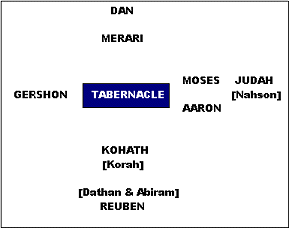
Notice the positioning of Korah, Dathan and Abiram. This provides the environment for the uprising of Num 16.
Peter Forbes [Mountsorrel (UK)] Comment added in 2001 Reply to Peter
v.34 (and 1:54) - This was clearly a time when the people did well. Shame we don't get all that many of this sort of report! What of ourselves?
Peter [UK] Comment added in 2002 Reply to Peter
Whilst chapter 2 may seem to be dealing with irrelevant things as far as we are concerned the way in which the tribes were encamped round the tabernacle should be understood because it provides explanation for some events later in the wilderness journey.
Peter Forbes [Mountsorrel (UK)] Comment added in 2002 Reply to Peter
FAMILIES WITH GOD
The way Israel camped in the wilderness is worthy of note. Right in the centre of Israel was their focus - the Tabernacle. All Israel were to camp around the Tabernacle, and, having it in their centre meant that wherever they were, it was right in front of them, directing their minds towards God and reminding them that they were God's chosen people expected to be holy and separate to him. But more than that, there was a special emphasis on the fact that they were to camp in their families. Each tribe had its particular place around the Tabernacle, and within each tribe, each clan and family were to camp and set out together.
There is powerful instruction in this for us. We as families need to work closely as a team. We need to stick together to support and encourage each other. We need families so that the older ones can teach the younger and the strong can support the weak. And most of all, as a family group, our focus needs to be on what is really important - on the LORD our God and his Son, Jesus Christ.
Israel did everything with and for their clans and families - both nuclear and extended families. Let us do the same because the road is much easier when we do it together.
Robert Prins [Auckland - Pakuranga - (NZ)] Comment added in 2002 Reply to Robert
:33 In telling us that the Levites were not numbered (in the numbering of Chapter 1) are we to conclude that they did not fall in the wilderness with their brethren?
Peter Forbes [Mountsorrel (UK)] Comment added in 2003 Reply to Peter
2:18-21 Notice Ephraim,. Benjamin and Manasseh are together on the West side of the tabernacle. That is at the back side.Psa 80:2 picks up on this group of tribes. So we see that the details in Numbers is not trivial. It helps give us an ppreciation of why things are said elsewhere in Scripture.
Peter Forbes [Mountsorrel (UK)] Comment added in 2004 Reply to Peter
The arrangement of the tribes around the tabernacle signified a unity of community. I wonder if there was a similar theme in the arrangement at the last supper. Could it be that the disciples were placed around the four-legged table (Gr. trapeza) three on each side (Luke 22:21). The Lord would be on one of the sides, of course, representative of the tabernacle in the wilderness arrangement.
Michael Parry [Montreal (Can)] Comment added in 2004 Reply to Michael
The Tabernacle was at the centre of Israelite life (or should have been). Much later, in Britain, the Parish Church was always tall enough with steeple or spire to be seen. And with us? The Truth should be the centre of our lives, the tallest thing on our horizon. "To me to live IS Christ." (Phil 1:21)
David Simpson [Worcester (UK)] Comment added in 2004 Reply to David
2 Israel were the ‘church in the wilderness’ Acts 7:38. The ordered nature of their camp and marching sets a pattern for ecclesial life. This is not to be taken as support for the idea that each of us has our own seat in the meeting room. Rather ecclesial life should be ordered and disciplined.
Peter Forbes [Mountsorrel (UK)] Comment added in 2006 Reply to Peter
GOD IN THE CENTRE
God had a determined layout for the Children of Israel as they camped and travelled together. In their camping the Tabernacle would be set up and the tribes of Israel would camp around it in a set order. The tribe of Levi camped immediately around the Tabernacle and the rest of the tribes, just outside the Levites, had set positions, three on each side of the Tabernacle. Viewed from a distance or from above, the structure of this camp must have looked awesome.
Then as Israel moved camp, they also had a specific order of travel. The first tribe that had to move and follow the pillar of cloud was Judah. Then tribe by tribe, those camped on the east and south side of the Tabernacle followed Judah. Then we read, "Then the Tent of Meeting and the camp of the Levites will set out in the middle of the camps." (Num 2:17) Following them the tribes from the west and the north of the Tabernacle all took their places in the line, with the tribe of Naphtali in the rear.
No matter where Israel camped or where they travelled it is important to see that the Tabernacle and the Levites were in the centre. For Israel, their God was in the most protected place. He was in the place of honour. And being in the centre of Israel, he was always the focus of attention.
Our God should be the same to us. Whether we are at home or travelling, let us jealously guard, honour and protect the place of God in the very centre of our lives.
Robert Prins [Auckland - Pakuranga - (NZ)] Comment added in 2006 Reply to Robert
2:33 As the Levites were not numbered they did not fall under the judgment that those between 20 and 40 would die in the wilderness. Consequently the age distribution of the Levites at the end of the wilderness journey would differ significantly from the rest of the people. That is there would be a normal population distribution in Levi with men over the age of 60 in their number.
Peter Forbes [Mountsorrel (UK)] Comment added in 2007 Reply to Peter
2:3 The word ‘standard’ actually is also translated ‘chiefest’ – Song 5:10. This helps us to appreciate the relationship between the head of the tribe and the way in which the standard highlighted his position.
Peter Forbes [Mountsorrel (UK)] Comment added in 2008 Reply to Peter
Notice how God's commandment here highlights the importance of family identity. Israel would soon be entering their own land in order to spread out across the face of it, and the family unit fostered at this early stage would be vital in those early years. From each family would come a leader, and each tribe would produce its ruler, so that this group of slaves would have a structured society immediately upon entering the land.
Rob de Jongh [Mountsorrel (UK)] Comment added in 2008 Reply to Rob
2:2 The tabernacle has been set up now for about a month – see Exo 40:17 and Num 1:1. So this is the first organisation of the tribes into camps that we read about.
Peter Forbes [Mountsorrel (UK)] Comment added in 2009 Reply to Peter
2:34 The way in which the nation were to camp in an organised way not only made for a structured journey through the wilderness but helped to engender a ‘family spirit’ in the nation in preparation for living in the land in their separate tribes.
Peter Forbes [Mountsorrel (UK)] Comment added in 2010 Reply to Peter
2:32 A good start to the journey to the land of promise. However no one mentioned or numbered here actually got to their desired destination – Num 26:64
Peter Forbes [Mountsorrel (UK)] Comment added in 2010 Reply to Peter
SIDE BY SIDE
It all started with individuals. Moses was told to take a census of the Israelites "Listing every man by name, one by one." (Num 1:2) But of course, each man camped with his family and with his clan and in his tribe. As God arranged the camping positions of the children of Israel in the wilderness, the tabernacle was in the centre, with the tribe of Levi around the outside. Then "The Israelites are to camp around the Tent of Meeting some distance from it, each man under his standard with the banners of his family." (Num 2:2)
Men were to stand side by side with their families; families were to camp side by side with their clans; clans were to camp side by side in their tribes; and each tribe had to share its side of the tabernacle with two tribes next to them. As God had Israel camped in this way, everyone, every family, clan and tribe was standing side by side someone else, all facing the tabernacle. They were united, giving strength to one another.
It should be the same for us. Individually we should support one another in our families; as families we should support other families and our congregation in Christ; and congregations should be supporting other congregations in their cities and countries; and believers on one country should support others in other places.
Side by side we can stand strong for Jesus.
Robert Prins [Auckland - Pakuranga - (NZ)] Comment added in 2011 Reply to Robert
2:34 Israel seemed to be able to do the simple organisational matters which Moses commanded – like where to camp etc: - however they were unable to keep the law which he commanded them. Maybe we, likewise, can manage the routine organisational things to do with our worship such as going to the meeting but find it more difficult to keep the precepts relating to daily living.
Peter Forbes [Mountsorrel (UK)] Comment added in 2012 Reply to Peter
The awesome armies of Israel
In this chapter we discover what the census of Israel was really for. All the tribes, numbered in chapter 1, are now issued with a formation. They are to camp "according to their armies" (v3), and you may remember that in chapter 1 the only ones who were counted were men of fighting age and capability (see Num 1:2-3). So the census was a military one.
I find this interesting. I mean, the whole idea of a nation travelling and living in tents is interesting in itself, but when you think about how the whole camp was arranged in military formation, and every single man of fighting age was enrolled in the army, one starts to wonder about the whole purpose of God bringing Israel out of Egypt. In Exodus 19 we have the famous promise to Israel, that they would be a priesthood to God, and perhaps we tend to think of Israel in that way: a people set apart to God, who would peacefully intercede for the nations. However, these chapters in numbers don't fit this view at all. Let's dig a little bit deeper and find out what's going on.
We're going to go right back to Abraham, the father of the nation of Israel. It was to Abraham that the promises of a great nation were delivered first:
Gen 12:2 I will make you a great nation; I will bless you And make your name great; And you shall be a blessing.
The fact that Israel had become a great nation was certainly true: six hundred thousand fighting men! But there is no mention in that promise about fighting men, yet here in Numbers we see that the main reason for the great numbers was to be a fearsome army.
If we go further in the life of Abraham I think we find the answer. Take a step or two further in his life, and there Abraham is, living in the land of Canaan (the promised land), yet not an owner of it. He was still living a nomadic lifestyle. Here's what God says:
Gen 15:15-17 Now as for you, you shall go to your fathers in peace; you shall be buried at a good old age. But in the fourth generation they shall return here, for the iniquity of the Amorites is not yet complete.
It's just a tiny detail: the iniquity of the Amorites is not yet complete, yet here we have the whole explanation for the reason that this great army existed, and why it had been created in a miraculously short space of time. The reason is that the people dwelling in Canaan (the Amorites and others) were wicked in God's sight, but not wicked enough to warrant Him destroying them. In His foreknowledge God knew that this time was just four generations away. I suspect this "four generations" is a measure of the Amorites, not of Israel, because Israel would have had very short generation span indeed in order for them to produce such a great population so quickly. Thus we can see that the purpose for the great size of the nation of Israel was indeed a military one, which explains why, here in Num 2, everyone is camped in military formation, family by family.
Rob de Jongh [Mountsorrel (UK)] Comment added in 2013 Reply to Rob
2:32 Having given the number of all the children of Israel (except the Levites) – Num 1:46– we are given the same number once their relative locations around the tabernacle have been specified.
Peter Forbes [Mountsorrel (UK)] Comment added in 2014 Reply to Peter
2:2 Both here and Num 1:52 teaches that Israel were to camp by “their own standard”. Moving round the camp and spending time with others in the camp was allowed. However their tribal identity had to be maintained.
Peter Forbes [Mountsorrel (UK)] Comment added in 2015 Reply to Peter
Peter Forbes [Mountsorrel (UK)] Comment added in 2016 Reply to Peter
2:32 God had said to Abraham Genesis 17:2 – that his seed would multiply him exceedingly. However when we compare the total at the end of the wilderness journey – Num 26:51 – with the number here we see that the nation has reduced in size, not grown. A testimony to the fact that the nation was disobedient to God.
Peter Forbes [Mountsorrel (UK)] Comment added in 2017 Reply to Peter
Peter Forbes [Mountsorrel (UK)] Comment added in 2018 Reply to Peter
2:10 We should remember that also on the South side were the sons of Kohath – from whom came Korah. The little details helps to explain why different individuals from tribes camping close by each other would oppose Moses’ position.
Peter Forbes [Mountsorrel (UK)] Comment added in 2019 Reply to Peter
2:33 This is the second time that we are told that the Levites were not numbered, the first is in Num 1:47. So in one sense they were without number just like the immortalised saints in the kingdom – Rev 7:9
Peter Forbes [Mountsorrel (UK)] Comment added in 2020 Reply to Peter
Num 2:2 - Israel pitched their tents “far off” (<5046>) or perhaps more accurately “front or over-against” from the Tabernacle. So Israel were to pitch their tents to the East (3), to the South (10), to the West (18) and to the North (25) of the Tabernacle. Each Household had sight of Tabernacle and were within walking distance of it. The camp was set out in meticulously order. The Israel were to be divided into 4 camps each of 3 tribes. Each camp had a lead tribe, Judah, Reuben, Ephraim and Dan each bearing a standard.
Notice, Ephraim they took precedence, over Manasseh (the first-born) and Benjamin (Num 2:18-24). The host of Ephraim numbered 40,500 (Num 2:19) the host of Manasseh numbered 32,200 (Num 2:21). Jacob’s blessing on Ephraim stated he would be greater than his brother.
Gen 48:19 “And his father refused, and said, I know it, my son, I know it: he also shall become a people, and he also shall be great: but truly his younger brother shall be greater than he, and his seed shall become a multitude of nations.”
Lesson for us
The divine plan was that every thing was done in an orderly way with the LORD at the centre of the camp of Israel.
Is obedience to the LORD central to our lives?
1Cor 14:40 “Let all things be done decently and in order.”
Peter Moore [Erith, UK] Comment added in 2020 Reply to Peter
2:2 The command that they should be “far off” from the tabernacle is something repeated a number of times. Just in case the people got excited as they went into the land Joshua charged them again – Josh 3:4 – similarly.
Peter Forbes [Mountsorrel (UK)] Comment added in 2021 Reply to Peter
2:2 There was structure in the way that Yahweh commanded His children to camp round the tabernacle in the wilderness. A structure which was to be maintained for the whole of the time the nation was in the wilderness.
It speaks of the structure that must exist amongst believers. In principle we should seek to “live” amongst those who live near to us, meeting with them rather than seeking company elsewhere amongst believers because we have some disagreement with those nearby. If there are disagreements they are to be resolved rather than avoided by seeking fellowship in another part of the community.
Peter Forbes [Mountsorrel (UK)] Comment added in 2022 Reply to Peter
2:17 When the nation move on from one place to another they obviously move in an organised way. But we notice here that the tabernacle which has been dismantled travels after the tribe of Gad, in the middle of the column of Israel moving through the wilderness.
The ark of the covenant by this time will have been separated from the rest of the tabernacle and will be travelling in front of the whole camp.
Peter Forbes [Mountsorrel (UK)] Comment added in 2023 Reply to Peter
2:31 The counting of the tribe of Daniel established that they numbered 157,600 men. This is the largest number of any of the tribes. Can we find evidence that the tribe of Daniel was more prolific than any of the other tribes?
Peter Forbes [Mountsorrel (UK)] Comment added in 2024 Reply to Peter
145 v. 1-3 - This serves to remind us not only that prayer is about praising God, but that it is a continual praise - every day. Ps.119:164 says seven times a day. Ps.72:15, Rev.7:15. Praise and prayer is not something that is reserved for times of trouble or days when we have time for it. It is a continual and constant act. Ps.71:14-24, Ps.103:1,2.
Peter [UK] Comment added in 2001 Reply to Peter
Psalm 145 :4 Praise is not something which only gives glory to God. It is a process of educating others also. In telling the following generations of the goodness of God we are praising Him. If we can speak of the way in which God has worked in our lives then those following on after us will find it easier to have the same confidence.
Psalm 146 Whilst we might use v3-4 to show that death ends all - the grave cannot praise God - in reality the purpose of the observation by the Psalmist is to plead with God that he might be allowed to live in order that he can praise Him.
Psalm 147 The contrast between God's care for mankind in verses 2-3 with His majesty as shown in v4 is amazing. That the creator of the whole of the universe could be concerned to take care of men and women on this tiny planet. Such care, of so insignificant people, against the magnitude of creation should humble us and at the same time cause us to be so grateful to our creator.
Peter Forbes [Mountsorrel (UK)] Comment added in 2001 Reply to Peter
146:5-10 - A lovely picture of the kingdom in so many of its aspects is given for us here. We see the release of the righteous from the law of sin and death, and all because of the love of God. This has to give us extra incentive to follow Him and place our trust under His wings - Psa.33:12, 84:12, 144:15
Peter [UK] Comment added in 2002 Reply to Peter
145:14 the woman [Luke 13:11] who was 'bowed down' was [Luke 13:12] 'loosed' by Jesus words. God was praised by Jesus words - see Psalm 145:21.
Psalm 146 - Like the previous Psalm this Psalm describes the miraculous works of Jesus healing the woman with the issue of blood.
:7 looseth Luke 13:12
:8 bowed down Luke 13:11
And also the year of release
:9 relieveth Leviticus 25:35.
The work of Jesus was to show that the year of release was a shadow of deliverance from sin and death, not just a holiday away from the toil of the field.
Psalm 147 - In describing the work of God as this Psalm does we see that God is concerned with both the great things of His creation [:4] 'he telleth all the starts' and the salvation of man [:3] healing the broken hearted [:6] and lifting up the meek [:9] and feeding the birds. Our God is not narrow in His care but all embracing.
Peter Forbes [Mountsorrel (UK)] Comment added in 2002 Reply to Peter
GODLY QUALITIES
Let's try and grow our characters to be more like the character of God. What a wonderful place the world would be if we could all act a little more like the way God does. It would improve all our relationships, our families, our communities, our churches, and the whole world! But we can't change the world, we can only change ourselves.
If we want to have a character like God's what do we have to be like? Here is a list of a few things that come from Psalm 145.
He has abundant goodness (v 7)
He is righteous. (v 7, 17)
He is generous and compassionate (v 8, 9)
Slow to anger and rich in love (v 8)
The LORD is good to all. (v 9)
He is faithful to all his promises. (v 13)
And loving toward all he has made (v 13, 17)
The LORD upholds all those who fall (v 14)
He lifts up those who are bowed down. (v 14)
Provides for our needs (v 15)
Satisfies our desires (v 16, 19)
He watches over all who love him (v 20)
Let's put those qualities into practice in our lives and become more like the people God wants us to be.
Robert Prins [Auckland - Pakuranga - (NZ)] Comment added in 2002 Reply to Robert
145:8 One of the many places in Scripture which quote the attributes of God (Exodus 34:6)
146:3-4 In speaking of the situation of the dead the Psalmist is not simply giving Christadelphians a proof passage to show that we do not go to heaven at death. The problem with death is that in death it is not possible to praise God. So the miraculous work of Jesus is described (:8-9) as a prelude to the time when He will reign for ever (:10) when those who have died might be raised to praise him for ever, enjoying everlasting life.
147:9 In saying that God feeds the ravens we see the origin of Jesus' words (Matthew 6:26) but do we truly believe that God takes care of the birds? Or do we think that they live using their natural instincts? Scripture teaches that God cares for them and that this care He has for them should teach us that He will also care for us. If we think that the birds take care of themselves we will not truly appreciate the way that God cares for us.
Peter Forbes [Mountsorrel (UK)] Comment added in 2003 Reply to Peter
Psa 145 - There is language in this Psalm which shows that it is speaking of the kingdom
:4 God is praised from one generation to another.
:11 The saints will speak – in instructing the mortal population.
:13 The kingdom is everlasting.
:16 The kingdom will be a time of abundant material blessings.
Psa 146 - The Psalm opens and closes with the request ‘praise ye the Lord’ – Hallelujah! Clearly the response of those who were healed by Jesus as exemplified in the miracles foretold in the Psalm.
147:2-6 The relationship between God ‘healing’ and ‘lifting up’ and telling ‘the number of the stars’ is this. The God who made and can number the stars surely has the ability to sustain His creation.
Peter Forbes [Mountsorrel (UK)] Comment added in 2004 Reply to Peter
Psalm 145 This is the last Psalm written by David. It describes the moral and political supremacy of David's God.
Psalm 146 Psalms 146 through 150 Are identified as "Hallelujah Psalms" Each begins and ends with the phrase "Praise ye the Lord" The prophets Haggai and Zachariah are generally credited as being the authors of these Psalms.
John Wilson [Toronto West (Can)] Comment added in 2004 Reply to John
Psa 145 In this Psalm of praise we see David extending his praises to the LORD. These words are a comfort to each one of us, as they were to David. "The LORD is" is continually being repeated. Note verses 8-20
John Wilson [Toronto West (Can)] Comment added in 2005 Reply to John
The worldly man’s trust is in the bounty of the ruler. But he, too, is flesh. He too will die. So the psalmist says in Psa 146:3-5. Rather, we should trust in God – and the whole of Psa 146:6-10 lists just some of the attributes, and the kindnesses, and the blessing of the Lord God. We must trust in Him.
David Simpson [Worcester (UK)] Comment added in 2005 Reply to David
145:18 We have seen that :14 seems to be echoed in the woman with the issue of blood - Luke 13:11. When she was healed she 'glorified God' - Luke 13:12-13. So she, so to speak, took to herself the instruction of the Psalm.
146:3 Here the Psalmist voices a recurring theme in Scripture - that man cannot be relied upon - Psa 118:8, Isa 31:3, Jer 17:5
147:2 The association between building Jerusalem and gathering the outcast is that God is building a city of people which is the house of David - 2Sam 7:27
Peter Forbes [Mountsorrel (UK)] Comment added in 2005 Reply to Peter
145:14 There is great comfort to all in this verse. Our Heavenly Father is always ready to help when earnestly sought. He "upholdeth all that fall, and raiseth up all those that be bowed down". David as he penned this Psalm could look back on his own life, and appreciate the mercy of God that had been extended to him.
John Wilson [Toronto West (Can)] Comment added in 2006 Reply to John
145:1,8,9,13,14,15,18,20,21 - v1 to be able to bless God forever and ever suggests David's faith/awareness that he will be resurrected to eternal life; vss 8-9 God is gracious (it is by grace we are saved Eph 2:8), full of compassion, merciful, good to all, and his tender mercies are over all His works (including His son who offered his life so those in Christ might receive mercy); vss 13-15 an everlasting kingdom and he raiseth up all all those that be bowed down (perhaps this refers to God's helping those in need in this life and the resurrection of those who gave their lives in humble service to Him)...the meat in due season (Luke 12:42) is perhaps the second coming of Christ which followers eagerly await; v18 the Lord is close to those who call upon him in truth (Matt 18:20;John 4:23-24;Psa 119:151); v20 the results of judgment at the second coming will be eternal life for the chosen but the wicked will be destroyed; v21 the "flesh" Heb. "basar" (1320) means "flesh (from its freshness), body, person", etc. will bless his holy name forever thus indicating those blessing will have immortality with actual bodies Rev 5:13.
146:4,5,10 - v4 we have the results of death; v5 immediately after the description of death we have a verse with the word "hope" Heb. "seber" (7664) meaning "expectation, hope" and it comes from the root "sabar" (7663) meaning "watching, to expect (with hope and patience), hope, tarry, view, wait, to scrutinise", etc. thus those who put their trust in God and die in faith still have a hope of reigning on earth with Christ (Heb 11:13-16); v10 the chapter ends with a reference to the millennium age when Christ will rule the earth from Zion.
Charles Link, Jr. [Moorestown, (NJ, USA)] Comment added in 2006 Reply to Charles
145:4 The fathers were required to teach their sons God’s commandments – Deut 6:7 etc: - but here we see also they were to teach future generations to praise God for what He had done. The instruction of the next generation, therefore, was not simply a teaching of academic facts. It included a repeating of the personal experiences of God working in their lives.
Peter Forbes [Mountsorrel (UK)] Comment added in 2007 Reply to Peter
145:18 "in truth" These last two words of this verse add a lot of meaning to this Psalm. It is only those of honest heart, who are anxious to please God and honour the truth that can take this verse to heart and draw from it the full measure of comfort that it is intended to provide.
John Wilson [Toronto West (Can)] Comment added in 2007 Reply to John
145:10-11The ‘saints’ praise and bless God by telling of His works. The way in which we speak of God by word and action is the means whereby God is praised. Not just by the singing of hymns and saying prayers.
Peter Forbes [Mountsorrel (UK)] Comment added in 2008 Reply to Peter
Psa 147:13 defences that we might take to protect ourselves is of no use unless the LORD oversees that protection. For what man considers strong the LORD has no regard (Psa 147:10 see also Prov 21:31). Therefore, let us not be afraid of the might of men. Instead let us put our trust in the LORD and He will take care of us (Psa 9:9).
Michael Parry [Montreal (Can)] Comment added in 2008 Reply to Michael
146:4 - Here we have an accurate description of the death state where one's breath is exhaled, one returns to the earth and one's thoughts perish in the same day. There is no consciousness or life in death. The Hebrew word "ruwach" (7307) refers to wind, breath, exhalation and here in the KJV is translated "breath" while in the NIV is translated "spirit".
Charles Link, Jr. [Moorestown, (NJ, USA)] Comment added in 2008 Reply to Charles
146:7-8 The different things that the ‘Lord’ does are all things that Jesus did in his ministry
Food to the hungry Matt 14:21
Looseth the prisoners Isa 61:1, Luke 4:18
Opens blind eyes Matt 15:31
Raises those bowed down Luke 13:11
Peter Forbes [Mountsorrel (UK)] Comment added in 2009 Reply to Peter
145:10 The word ‘saints’ <02623> is elsewhere translated
Deut 33:8 Holy
2Sam 22:26 merciful
Psa 4:3 Godly
Mic 7:2 Good
Thus we see the meaning of the word ‘saint; here. It is a person with a certain type of character.
Peter Forbes [Mountsorrel (UK)] Comment added in 2010 Reply to Peter
147:11 Do we consider that our actions may please God? Clearly it is the case that faithful behaviour does please Him just in the same way that when our children do as we wish we are pleased
Peter Forbes [Mountsorrel (UK)] Comment added in 2010 Reply to Peter
147:9 David’s appreciation that God feeds the ravens is a consequence of understanding what God was showing Job – Job 38:41
Peter Forbes [Mountsorrel (UK)] Comment added in 2012 Reply to Peter
1. Psa 145:1 - "extol"<7311>, "God"<430>, "bless"<1288>.
2. Psa 145:1,2,21 - "for ever and ever" are mentioned three times and suggest immortality.
3. Psa 145:1,10-13 - description of the Messiah's kingdom.
4. Psa 145:2,4 - v2 "praise"<1984>, v4 "praise"<7623>.
5. Psa 145:4 - after the resurrection every generation of saints will be in the kingdom together.
6. Psa 145:13 - the KJV does not have the latter part of verse 13 - (verse 13 continued from the NIV) "The Lord is faithful to all his promises and loving toward all he has made" this addition would complete Psalm 145 as an acrostic by including the Hebrew letter "nun".
7. Psa 145:14 - reminds of Luke 13:11-13;Psa 37:23-24.
8. Psa 145:15 - Luke 4:20;John 6:11 are glimpses of the greater blessings yet to come.
9. Psa 145:20 - "The Lord preserveth all them that love him" - eternal life for faithful believers (Phil 3:21).
10. Psa 145:20 - "but all the wicked will he destroy" - the punishment of the wicked is eternal death, not eternal torture (Psa 104:35;Eze 18:4).
11. Psa 145:21 - "let all flesh bless his holy name for ever and ever" - is this the future Messianic kingdom? (Rev 5:13).
Charles Link, Jr. [Moorestown, (NJ, USA)] Comment added in 2012 Reply to Charles
1. Psa 146:2 - "While I live will I praise the Lord" - Jesus knew his days were numbered.
2. Psa 146:2 - "I will sing praises unto my God while I have any being" - Christ singing (Matt 26:30).
3. Psa 146:3 - "Put not your trust in princes" - reminds me of the attitude Jesus had toward Herod and Pilate (Luke 13:31-32;John 19:9-11).
4. Psa 146:3 - this appears to be a generic usage of "son of man" not refering to Christ "Son of man".
5. Psa 146:3 - "help"(<8668> can mean "salvation").
6. Psa 146:4,6;144:11 - compare with Acts 4:24-25;14:15.
7. Psa 146:6 - God created and keeps His Word.
8. Psa 146:7 - God will delegate judgment to His Son Christ (John 5:22,27) who will share rule with his Father God (Phil 2:9-11).
9. Psa 146:7 - "giveth food to the hungry" (Matt 14:13-21;15:32-38;John 6:27,32-35).
10. Psa 146:7 - "The Lord looseth the prisoners" (Acts 12:5-11;16:23-36;Rom 6:20-23;8:1-6 - when Christ returns the saints will be free from bondage to sin and death Dan 12:2).
11. Psa 146:8 - "The Lord openeth the eyes of the blind" (John 20:27-29;9:1-40;Isa 35:5-7).
12. Psa 146:8 - "the Lord raiseth them that are bowed down" (Psa 145:14;Luke 13:11-13;Dan 12:2).
13. Psa 146:9 - "The Lord preserveth the strangers" (Josh 6:25;Matt 15:22-28;Luke 17:12,14,16;Acts 8:26-39;10:9-28;Gal 3:8,16,26-29).
14. Psa 146:9 - "he relieveth the fatherless and widow" (Christ adopts the fatherless into his heavenly family. To the widow Christ is the bridegroom).
15. Psa 146:9 - "the way of the wicked he turneth upside down" (Jesus overturning John 2:15-16;Mark 11:15-17 - possibly has application to Babylon, Alexander the Great and Rome overturning with the Roman overturn occurring in AD 70 with the temple sacked, Jerusalem sacked and the Jews scattered Eze 21:27 - the last days Zech 14:2-5;12:9-10.
16. Psa 146:10 - the Messianic kingdom (Acts 1:9-11;Matt 6:10;Dan 12:2;John 5:22,27;Isa 2:2-4;1Cor 15:22-28).
17. Some say Psalms 146 to 150 are an echo of the five books of the Psalter (Psalm 1-41, Psalm 42-72, Psalm 73-89, Psalm 90-106, Psalm 107-150).
Charles Link, Jr. [Moorestown, (NJ, USA)] Comment added in 2012 Reply to Charles
1. Psa 147:1,12,20 - v1 "Praise"<1984>, v1 "praise"<8416>, v12 "Praise"<7623>, v12 "praise"<1984>, v20 "praise"<1984>.
2. Psa 147:2 - "The Lord doth build up Jerusalem" (Psa 102:16 to happen after the great earthquake of Zech 14:4).
3. Psa 147:2 - "he gathereth together the outcasts of Israel" (John 11:51-52;Matt 24:30-31;Gal 3:8,16,26-29;Mic 4:1-5).
4. Psa 147:3 - "He healeth the broken in heart" - perhaps refers to repentant Israel (Zech 14:2-3;12:10-14).
5. Psa 147:4 - fulfillment of the promises to Abraham (Gen 15:5;22:17;Dan 12:2-3;Rom 4:18;Rev 20:12).
6. Psa 147:6 - "The Lord 'lifteth up'<5749> the meek" [perhaps refers to the raising up of Jesus (Matt 11:29), and/or the meek followers of Jesus who will inherit the earth upon his return Psa 37:11;Matt 5:5].
8. Psa 147:10 - all armaments will be abolished (Eze 38:4;Dan 2:33;Isa 2:4).
10. Psa 147:11 - "taketh pleasure in"<7521>.
11. Psa 147:11 - "'fear'<3373> him".
12. Psa 147:11 - "those that hope in his mercy" (God's forgiveness becomes the hope of Israel - Psa 136:1;130:4;Acts 28:20).
13. Psa 147:15,19 - a future world-wide dissemination of God's law (Isa 2:2-3;Zech 14:16).
Charles Link, Jr. [Moorestown, (NJ, USA)] Comment added in 2012 Reply to Charles
147:13-14 God did not literally strengthen the bars on the gates of Jerusalem. He achieved this by working on the minds of Israel’s enemies so that they did not see the need to attack Israel. Prov 16:7
Peter Forbes [Mountsorrel (UK)] Comment added in 2013 Reply to Peter
EVERY DAY
David began one of his psalms this way: "I will exalt you, my God the King; I will praise your name for ever and ever. Every day I will praise you and extol your name for ever and ever." (Psa 145:1-2)
What daily habits do we have? Some of my daily habits include cleaning my teeth, having three meals a day, showering, prayer and Bible reading. I am afraid my habit of praise is not as strong or as regular as some of my other daily habits. Yet for David it was a daily event. "Every day I will praise you." So how is your habit of praise? Do you make time to sing and to tell God how amazing He is?
Praise shouldn't be one of the things that just goes by in the day without a thought. We need to make praise a priority as we do with brushing our teeth. David said it would happen every day - he wasn't even willing to skip one day.
So let's make a time or an opportunity each day when we remind ourselves to praise the LORD in word or song, and let's make that daily appointment a habit.
Robert Prins [Auckland - Pakuranga - (NZ)] Comment added in 2013 Reply to Robert
PLENTY STRONG ENOUGH
If the LORD is he who is "the Maker of heaven and earth, the sea and everything in them," and if the LORD "remains faithful for ever and ever," then it really is just common sense to put our trust and hope in him. (Psa 146:6).
The psalmist, who described the LORD as Maker of heaven and earth, the sea and everything in it, who remains faithful for ever, also said this: "Blessed is he whose help is the God of Jacob, whose hope is in the LORD his God." (v.5). If God is our help and our hope, we will be happy people indeed, because we know that we are in his hands, we have a future, and that as the creator of everything, he is plenty strong and wise enough to deal with any of our problems, big or small.
It's really a no-brainer. If we could find something bigger, more powerful and more faithful than our God, then maybe we could think about putting our faith in that, whatever it is. But there is nothing. Our God is the wisest, strongest, most creative and most faithful person(?) we know.
So let's give ourselves a reason to be blessed or happy and put our trust and hope in the ever faithful Maker of heaven and earth and sea and all that is in them. When we trust in God, we can't lose.
Robert Prins [Auckland - Pakuranga - (NZ)] Comment added in 2013 Reply to Robert
BLESSED TO HEAR.
We are so blessed to live at this time in history. When Psalm 147 was written, this was the status of the people who had heard His word: "He has revealed his word to Jacob, his laws and decrees to Israel. He has done this for no other nation; they do not know his laws." (Psa 147:19-20).
I live in New Zealand, almost as far away from Israel as you can get. But I have been hugely blessed to have heard the word of God, to have the Bible available in my own language - either on paper or electronically. I can read it whenever I want to, I can pray as often as I like, to a God who listens, and I can freely meet with other believers to worship and study together.
God's word has, and is, going out to all the world, and we are some of those who have had the opportunity to respond to His offer of salvation.
Israel were encouraged to praise God because they had heard His word. We should praise Him for the same reason. More than that, we are those who perhaps otherwise might not have heard. How thankful we should be!
Robert Prins [Auckland - Pakuranga - (NZ)] Comment added in 2013 Reply to Robert
147:11 Because “fear” of God and “hope” in His mercy are linked together we can safely conclude that the “fear” He is looking for is respect and honour.
Peter Forbes [Mountsorrel (UK)] Comment added in 2014 Reply to Peter
There are two exercises to do while reading today's Psalms, and if you have children or friends who are just starting to read the Bible, they can join in with an exercise that might show how the Bible is interconnected with itself. Here's what to do:
Person 1: Will keep their Bible open in Mat 6 at the Lord's prayer. Their job is to find how many times the prayer quotes the same word or phrase from these Psalms.
Person 2: Will keep their Bible open in Mat 5 at the sermon in the Mount. How many references can they find?
You: Read the Psalm out loud and be ready to arbitrate at the end!
Rob de Jongh [Mountsorrel (UK)] Comment added in 2014 Reply to Rob
147:11,14 Paul brings together the idea of a God of hope and peace in Rom 15:13,33
Peter Forbes [Mountsorrel (UK)] Comment added in 2015 Reply to Peter
Psalm 145
We're probably used to the idea of preaching. It tends to involve spreading the message of the gospel of salvation. But in this Psalm, which is about spreading the news about God, how much of it involves the message of salvation? For example, in v4 David declares God's "mighty acts". In v7, His great goodness and righteousness. In v9 that He is good to all. It seems to me that the Psalm is suggesting we talk to others about God's character and His achievements. For example, it might involve speaking about how God has saved us from some trouble or anxiety (v14,19), or how He answered our prayer for something we needed (v15-16).
Notice that the Psalmist is not necessarily talking about what he will say to unbelievers. How regularly do we talk to our families and friends, even those who already believe in God, about who He is and the things He has done? What else can we find in this chapter worth talking to others about?
Rob de Jongh [Mountsorrel (UK)] Comment added in 2015 Reply to Rob
Psalm 146
If someone asked you if you served God, you'd say "yes". But if they asked you: "Which god?", what would you say? We live in a world where the gods of the major religions are blurred into one, while it is quite clear that they're not the same. "God" is after all just a title. In v5-10 we have an excellent summary of who God is, or in other words, what name He goes by. Here's some of the different parts of His name, and you will be able to find more in those verses:
- the God of Jacob
- who made heaven, the earth and the sea
- executes judgment for the oppressed
- loves the righteous
- relieves the fatherless and the widow
- upturns the way of the wicked
We can use these stated characteristics of God to explain who He is. Many Christians, for example, do not worship the God of Jacob (Jacob is the former name of Israel), choosing rather to ignore that aspect of Him. That's not the same god. Many choose to believe in evolution rather than a god who created the heaven, earth and sea. Not the same god. Many choose to create god in the image of a beneficent old gentleman who cares for the wicked and the good equally. Not the same god. Many have a god that they believe looks after their own financial affairs when in fact He cares more about the fatherless and the widow who may be afflicted because of their greed. Not the same god. So I think the question is not just about how we describe God to others, but about which god we ourselves worship. Have we truly bothered to find out who He is?
Rob de Jongh [Mountsorrel (UK)] Comment added in 2015 Reply to Rob
Psalm 147
This Psalm is about the invisible people. It's about those who no-one knows about; the ones who no-one notices. Do you feel like that sometimes? In v3, God heals them. In v4, He knows them all by name, no matter how small, or how hidden, or how insignificant they feel. In v6 He exalts the meek. In v7 he makes grass to grow on the mountains where no-one can see it or access it -- except for the obscure beasts that graze there. In v8 he feeds even the ravens no matter how far they are from civilisation. In v10-11 He tells us that He has no pleasure in the measures of importance we use, but that His love is for those who serve him, no matter how small they feel.
Rob de Jongh [Mountsorrel (UK)] Comment added in 2015 Reply to Rob
147:2 The promise that God gathers the outcasts of Israel is the basis for the prophecy of the prophet – Isa 11:12
Peter Forbes [Mountsorrel (UK)] Comment added in 2016 Reply to Peter
145:16 Under the Law of Moses the faithful Israelite w to open his hand wide to meet the needs of his poor brother – Deut 15:7-8. He reason for the command to man is that God does just that with His creation. If we want to be like Him we need to be generous like Him. We see a similar idea in Psa 104:28
Peter Forbes [Mountsorrel (UK)] Comment added in 2017 Reply to Peter
Nick Kendall [In Isolation] Comment added in 2017 Reply to Nick
147:9-10 The contrast between the thing which God does not take pleasure in and that which pleases Him should teach us that we should not rely on our own strength but rather seek God’s mercy when we are in need.
Peter Forbes [Mountsorrel (UK)] Comment added in 2018 Reply to Peter
“He healeth the broken in heart, and bindeth up their wounds.”
Domestic violence can be defined as a pattern of abusive behaviour that is used by one partner to gain or maintain power and control over the other partner. Harsh words and selfish actions coming from a spouse who vowed to love will as surely kill the spirit slowly and methodically, as it will destroy their relationship. Domestic abuse is not foreign to Scripture, and it is not foreign to us. When any marriage crosses the line from Christ and his ecclesia-bride (Eph 5:25-33) and looks more like Pharaoh and the Israelites, we know we’re in trouble!
Victims of abuse may spend a lot of time hoping and praying their abuser will change, take responsibility and make amends in hopes of restoring peace, but there is no guarantee an abuser ever will, and may not even care. The good news is, God cares about the abused, and He is able to restore peace and healing to a broken and traumatized heart. God is compassionate toward the victims of any form of abuse (cf. Exo 21), and He has shown us how to respond compassionately to the needs created as a consequence of abuse, and in so doing, we give the broken victims the opportunity to heal and rebuild their lives.
Valerie Mello [in isolation, TN, USA] Comment added in 2018 Reply to Valerie
147:15-19 Notice how often in this section God’s actions are associated with His word? That is how he achieves everything – by speaking His word. We should recognise the power of His word. In our days it is the Bible.
Peter Forbes [Mountsorrel (UK)] Comment added in 2019 Reply to Peter
146:6 Notice how David’s confidence in God is because he is the one who created everything.
Peter Forbes [Mountsorrel (UK)] Comment added in 2020 Reply to Peter
Psalm 146 Bro. Ian Fifield once pointed out to me some useful links between this psalm and the parable of Lazarus (Luke 16:19-31). “Put not your trust in princes” (Ps. 146:3) is exemplified by the futility of Lazarus looking to the rich man for help. Psalm 146:4 provides plain teaching about mortality. “Lazarus” <2976> is the Greek version of `Eleazar’ <499> which means `God has helped’ and the two words it is derived from are found in Psalm 146:5: “God <410> … help <5828>”. The experience of Lazarus shows that it is God, "Which executeth judgment for the oppressed: Which giveth food to the hungry” (Ps. 146:7). It was true for Lazarus that, “Yahweh raiseth them that are bowed down” (Ps. 146:8). And the reversal of the rich man’s situation illustrates Psalm 146:9: “the way of the wicked He turneth upside down”.
Nigel Bernard [Pembroke Dock UK] Comment added in 2020 Reply to Nigel
147:3the way that the Lord that “bindeth up their wounds” is the basis for an element of Jesus’ parable of the Good Samaritan – Luke 10:34
Peter Forbes [Mountsorrel (UK)] Comment added in 2021 Reply to Peter
145:15-16 When we consider the way in which God maintains His creation. The way He feels and cares for all living creatures with an abundance of food we can take comfort. We should recognise that we are more valuable to our Father than those animals (Matthew 6:26) So if we ever doubt whether God is looking after us or now we should look at the animal Creation and take comfort.
Peter Forbes [Mountsorrel (UK)] Comment added in 2022 Reply to Peter
145:5 That God is great is not something that can be deduced simply by looking around He expects His children to speak of Him and His greatness so that others will know about Him.
Peter Forbes [Mountsorrel (UK)] Comment added in 2023 Reply to Peter
147:4 The Psalmist has been speaking of the way that God delivers His people. Words which re-echoed in later prophets and even in the words of Jesus. Whilst it might appear now that there is an abrupt change in David’s focus by speaking of God numbering the stars there is actually a recognition that because He is the Creator he is able to do all of the things that the Psalmist has just spoken of.
Peter Forbes [Mountsorrel (UK)] Comment added in 2024 Reply to Peter
v. 7 - The idea of the hair of our head is used quite often to show just how much God cares for us - he cares even for that which we do not care about - there is the depth of his love demonstrated in this picture of individual hairs. 1Sam.14:45, 2Sam.14:11, Luke 21:18, Acts 27:34.
Peter [UK] Comment added in 2001 Reply to Peter
v.4 Jesus uses the word 'friend', when speaking to people very rarely in the gospels. 10:30, Matthew 22:12 26:50 Here John 11:11 15:14-15
Peter Forbes [Mountsorrel (UK)] Comment added in 2001 Reply to Peter
12:11-12 Matthew 6:25,31,34
12:22 Matthew 6:31
12:24 Matthew 6:26-27
12:27-28 Matthew 6:28-30
12:29-31 Matthew 6:32-33
12:33 Matthew 6:31
12:58-59 Matthew 5:25-26
A major focus of this chapter is that the disciples should not fear men :4,5,7,32. A crucial point that the disciples needed to understand.
Peter Forbes [Mountsorrel (UK)] Comment added in 2002 Reply to Peter
:49 When Jesus said that he was coming to send 'fire' on the earth one wonders what James and John thought as they were rebuked for wanting to call down fire (Luke 9:54). Of course here the situation is very different. In Luke 9 others were speaking well of Jesus. Here Jesus' words are being opposed.
Peter Forbes [Mountsorrel (UK)] Comment added in 2003 Reply to Peter
V.42 "household" is an interesting word; therapeia (2322) which you see is where the English word "therapy" comes from. The ecclesia is a place of healing. The base word from which it comes is theraeuo (2323) A therapeutist, It is for the most part translated. "heal'"
John Wilson [Toronto West (Can)] Comment added in 2004 Reply to John
12:1 This is the second time that Jesus has warned his disciples to 'beware of the leaven of the Pharisees' - the first is in Matt 16:6 / , Mark 8:15. So Jesus is here reinforcing and expanding his earlier teaching. Whereas on the first occasion the hypocrisy is not defined it is here defined as 'hypocrisy'.
Peter Forbes [Mountsorrel (UK)] Comment added in 2004 Reply to Peter
v.4,5 Hell is not a hot place where God sends bad people to be tormented by the Devil forever. What is being explained here is that although men may be able to terminate life in the physically, that is all they can do.
God, however, can go further and eliminate the very breath (spirit) that animates man and beast (see also Matt 10:28).
Best to fear the one who can create and destroy and re-create rather than man (Isa 45:7, 65:17, Job 34:14,15).
Verses 6 and 24 complement Psa 147:9
v.15-21 remind us that material wealth has no value with regards to the Kingdom of God. If we are blessed with wherewithal then we should use it wisely and generously for the Lord's service (Luke 18:24, 1Tim 6:17,18).
Michael Parry [Montreal (Can)] Comment added in 2004 Reply to Michael
V.5 - I say unto you, fear (5399) him. Contrasts with 1John 4:18 - There is no fear (5401)in love. We have here an apparent contradiction but when we look up the words for fear in each instance the meanings become clear. Phobeo (5399) according to Strong's can mean fear in the sense of being alarmed but it can also mean fear in the sense of reverence, revere, be in awe of, etc. Phobos (5401) according to Strong's means to fear specifically in the sense of being frightened, terrified, be afraid, etc. Thus the consistent message if we go by Strong's definitions is we are to revere God but there is no feeling of being terrified associated with love.
Update: Brown-Driver-Briggs suggests that phobeo and phobos can BOTH indicate being alarmed, frightened, terrified, be afraid along with reverence. Whether Strong's or Brown-Driver-Briggs are more accurate is not critical because even if the two words are essentially the same there is enough range of meaning to allow for a contextual variation of understanding that avoids contradiction.
Charles Link, Jr. [Moorestown, (NJ, USA)] Comment added in 2005 Reply to Charles
12:1 Notice that Jesus speaks to the disciples ‘first’ indicating that this section of the gospel was directed, primarily, to the disciples’ needs.
Peter Forbes [Mountsorrel (UK)] Comment added in 2006 Reply to Peter
v 24 we get an echo here from the psalms read today, of God's care for His creation: Psa 145:15,16, Psa 147:9
v 16-21 this man was justified in building bigger barns to store his crops, but the problem was his attitude to the plenty with which he had been blessed cp Year of Jubilee Lev 25:20,21 He saw this as an excuse for laziness, he did not share what he had with others, he did not attribute these blessings to God's gracious provision, his material possessions were his focus in life & his treasure. cp v 24,31,34
Wendy Johnsen [Nanaimo, BC, Canada] Comment added in 2006 Reply to Wendy
12:11 When Jesus encouraged the disciples to ‘take no thought’ what they should say he is developing a point that he made in the Sermon on the mount – Matt 6:25 – where he told them not to take any thought about where their food would come from because God would provide for them. Now he develops the idea of God’s provision to encompass other areas of their life than simply food and raiment.
Peter Forbes [Mountsorrel (UK)] Comment added in 2007 Reply to Peter
God knows all about us. He also knows about little sparrows. And he knows how many hairs we have on our heads. That’s a lot more than we know ourselves (Luke 12:6,7). If we put our trust in the Lord we have absolutely nothing to fear. He KNOWS about us.
David Simpson [Worcester (UK)] Comment added in 2007 Reply to David
The warning that the Lord gives in vs. 2,3 is exemplified by the exposure of the elders in Jerusalem in Ezekiel's time (Eze 8:12). The elders thought that their abominations would not be seen by the LORD in the dark.
Michael Parry [Montreal (Can)] Comment added in 2007 Reply to Michael
12:4 Jesus’ words of encouragement ‘be not afraid’ spoken to the disciples is against the background of the warning about the Pharisees. The encouragement to ‘fear not’ runs right through the chapter.
Peter Forbes [Mountsorrel (UK)] Comment added in 2008 Reply to Peter
It is important to be clear what the Lord is saying in vs.4,5. He is saying that man can physically terminate a life but can do no more. The LORD, however, has the power over life and death. He can, and does terminate life, but, unlike man, He can also re-create it. We see that each spring as the earth comes back to life (Psa 104:29,30). In His plan for mankind, He has promised eternal life to those who would believe and take the necessary steps to come into covenant relationship with Him (John 17:3; Titus 1:2). Even if believers have died, the LORD will be bring them back to life (1Cor 15:52). On the other hand, those who defy the LORD and do not accept His offer, will be destroyed (Mark 16:16). Jesus emphasized that the LORD’s destruction is permanent. He uses the figure of hell (Gr. Gehenna) to show this permanence. Gehenna (meaning the valley of the Son’s of Hinnom) was a place on the south side of Jerusalem where garbage and the bodies of dead criminals were burned. Fires were kept constantly for this purpose. The place, and its function, became synonymous with utter, irretrievable destruction in the minds of the populace. It does not refer to a place of eternal torment. That is a mythical invention. The LORD has no interest in keeping evil alive forever.
Michael Parry [Montreal (Can)] Comment added in 2008 Reply to Michael
12:12 The way in which ‘the holy spirit’ would cause the disciples to remember what to say is not some mystical thing. Jesus later – John 14:26 - explains that this is the work of the comforter. So the disciples would only be able to repeat things that they had already heard.
Peter Forbes [Mountsorrel (UK)] Comment added in 2009 Reply to Peter
In v32 Jesus says "Do not fear, little flock" which appears to be a quote from 1Kin 20:27. Here Israel stood up against the might of the Syrian army and were "like two little flocks of kids; but the Syrians filled the country". Yet through God's intervention they won the battle. The point of this reference is that God will provide for us no matter how much we have stored up. Jonathan also made the same observation when he said "Nothing can hinder the LORD from saving, by many, or by few." (1Sam 14:6)
Rob de Jongh [Mountsorrel (UK)] Comment added in 2009 Reply to Rob
v 32 First Principles>Kingdom of God>Gospel concerns God's Kingdom
The Gospel preached by Jesus and the Apostles concerns the Kingdom of God.
2. Invitation for men to participate
Matt 25:34, Luke 12:32, 1Thess 2:12, James 2:5, 2Tim 4:1,8, 2Pet 1:10,11, Rev 2:26,27
For more about the Gospel concerning God's Kingdom go to Matt 4:23
Roger Turner [Lichfield (UK)] Comment added in 2009 Reply to Roger
DRESSED AND BURNING
"Be dressed ready for service and keep your lamps burning, like men waiting for the master to return from a wedding banquet, so that when he comes and knocks they can immediately open the door for him. It will be good for those servants whose master finds them watching when he comes." (Luke 12:35-37)
Obviously being dressed ready for service and keeping our lamps burning does not mean that we should never get undressed to take a shower or that we should keep the lights in the house on 24 hours an day, seven days a week.
To be dressed for service takes us to the words of Paul in Colossians: "Therefore, as God's chosen people, holy and dearly loved, clothe yourselves with compassion, kindness, humility, gentleness and patience. Bear with each other and forgive whatever grievances you may have against one another. And over all these virtues put on love, which binds them all together in perfect unity." (Col 3:12-14) These are all attributes with with we can serve one another.
To keep our lamps burning means we should shine out the love of Christ from our way of life. We need to be like a light shining in a dark place that attracts people, just as a light bulb attracts moths.
Jesus is coming. How will he find us? Will we be dressed and will he find us shining out our faith for him?
Robert Prins [Auckland - Pakuranga - (NZ)] Comment added in 2009 Reply to Robert
12:29 In speaking of concern saying ;what shall we eat’ Jesus’ mind is going back to the law of Moses – Lev 25:20 – which speaks of the year of release.
Peter Forbes [Mountsorrel (UK)] Comment added in 2010 Reply to Peter
GREED
Jesus said, "Watch out! Be on your guard against all kinds of greed; a man's life does not consist in the abundance of his possessions." (Luke 12:15)
If greed was one of those things that rang alarm bells before it tempted us, Jesus wouldn't have been so concerned. But greed does not announce itself. It creeps up on us, tempts us with a little bit, and a little bit more, and a little bit more again. We even make excuses as to why we need that little bit more - and often it is justified by saying we can use it for God.
Usually we don't even notice when we are starting to be affected by greed and nor do we notice when it has us in its grip. It was for this reason Jesus used the words, "Watch out!" and "Be on your guard." We need to constantly evaluate whether what we want is something we need or whether our greed is taking over. And Jesus also said, "Be on your guard against all kinds of greed." It may be money, an inheritance, food, possessions, investments or gambling. All of these can bring out the greed in us.
So let's watch out. Do we really need bigger, better or more? Could what we have been given be used in a better way? Let's not let greed catch us off guard.
Robert Prins [Auckland - Pakuranga - (NZ)] Comment added in 2010 Reply to Robert
THE GIFT OF ETERNITY
When we think about judgement we often think of numbers. Perhaps we think that life now is like an examination where our good credits are going to get weighed up against our bad credits and we will either pass or fail depending on what we have done and what score we achieve. In reality it is not like that at all.
Each of us has sinned and so we all fall short of the glory of God no matter how many good things we try to do to make up for it. There is no way we can ever earn ourselves a place in the kingdom of God. Paul said, "The wages of sin is death, but the gift of God is eternal life in Christ Jesus our Lord." (Rom 6:23) Eternal life in the kingdom of God is not something that can be earned and is not entered into because of an exam we pass, it is the gift of God.
More than being just a gift, eternal life is something that God wants to give us. This is why Jesus said, "Do not be afraid, little flock, for your Father has been pleased to give you the kingdom." (Luke 12:32) All he asks of us is that we accept his gift by making his kingdom and eternal things a priority in our lives. He even says that he will take care of the little things like food and clothes if we give his kingdom first priority.
Don't worry! God wants to give you his kingdom! Let's rejoice in the fact that we don't have to try and earn such a priceless gift, and instead of trying to pay, just give him our all in overflowing love.
Robert Prins [Auckland - Pakuranga - (NZ)] Comment added in 2010 Reply to Robert
12:24-25 ‘Consider the ravens ...’ reminds the disciples of what they had already been told by Jesus in the sermon on the mount in Matt 6:26-27
Peter Forbes [Mountsorrel (UK)] Comment added in 2011 Reply to Peter
12:24 In inviting the disciples to consider the ravens’ Jesus is using the same argument that the Lord uses to Job – Job 38:41
Peter Forbes [Mountsorrel (UK)] Comment added in 2012 Reply to Peter
Summary Of Luke
12:1-12 To the disciples Beware of the leaven of the Pharisees
:4-12 Warning and encouragement about persecution
12:12-14 Interruption – man asks Jesus to legislate over a matter of inheritance
12:15-40 Spoken to the disciples – Warning about covetousness and trusting God to provide what is necessary
:16-21 Parable of Bigger Barns
:22-34 Take no thought
:35-40 Be prepared and waiting
12:41 Peter asks “is this message just for us or for all?”
12:42-59 Jesus’ answer to Peter
:47-48 Parable of the faithful and unfaithful steward
:49-53 Jesus said “I am come to send division ...”
:54-57 You can read the weather signs. Judge what is right
:58 When you go to the magistrate with your adversary consider your case
Peter Forbes [Mountsorrel (UK)] Comment added in 2013 Reply to Peter
“… For unto whomsoever much is given, of him shall be much required…”
If there ever was a passage most touted by Evangelical teachers it is this one! Of course, they use it to elicit money from their hearers. It is about getting not giving without any regard to spiritual growth. They have even stretched this passage to those lacking to, “give what you can.” They are laying treasure up for themselves and are not rich toward God. Clearly, the context of Luke 12 shows the more knowledge we have, the more practice is expected from us; the greater our gifts, the more useful we ought to be and diligent in the improvement of them. I find it striking how this chapter begins with such an innumerable multitude that they trampled on one another. It is against this background the Lord delivers a warning against false teachers, denounces sin, and shows the importance of knowing, being, and doing the Word, and do so with patience.
Jesus calls upon his disciples to be good stewards of the Gospel, good stewards of our possessions, ministering to men’s needs not greeds, and so laying up treasure for ourselves - not now, but in the age to come. We are called to be good stewards of our time and to be found doing and waiting in readiness when Christ returns.
Rom 12:1-2 teaches us the Lord’s will for us by comparing the human body with its many different members to the spiritual body of Christ with its many different members each performing according to their special ability (verses 6-8). We all have different gifts that require doing different jobs, and we must focus on the gifts we have been given and do them to the best of our ability. The greater our level of giftedness, the greater will be Christ’s expectation that we use our gifts to accomplish his will for us.
God’s judgment is perfectly fair. Some have better opportunities to develop God’s character; others have greater intelligence, or natural abilities. To whom much is given and be required will be the principle by which we will be judged.
Valerie Mello [in isolation, TN, USA] Comment added in 2013 Reply to Valerie
Lk. 12:41.
Wes Booker [South Austin Texas USA] Comment added in 2013 Reply to Wes
Luke 12:1; Matt 16:6,12; Mark 8:15
In these passages, Jesus warned us to beware of the leaven of the Pharisees, Sadducees, and of Herod. The Parable of the Leaven teaches that the mixing of false doctrine with the doctrine of Christ will eventually lead to total apostasy and corruption because leaven penetrates and is diffusive. Christ warned, “Take heed and beware of the leaven of the Pharisees and of the Sadducees...” “Take heed, beware of the leaven of the Pharisees, and of the leaven of Herod.” Leaven is a symbol of sin and speaks of that which puffs up and of corruption. Leaven works stealthily, completely undetected at first, and works best in lukewarm conditions.
The Pharisees believed the Scriptures, but did not obey it, they had religion, they had laws, they crossed their t’s and dotted their i’s, outwardly they appeared very righteous, they had a good head knowledge, but their hearts were full of sin. They put on a façade of holiness so the people would look up to them and be impressed. They were hypocrites. They split hairs and argued over minor doctrinal issues. The leaven of the Pharisees was the loveless leaven of Legalism (cf. Matt 23:29-33).
The Sadducees did not know the Scriptures or the power of God, and greatly erred in their teachings (Matt 22:29). They may be equated with the Theologians. The word theology comes from two Greek words, Theos, God, and logos, words. It literally translates God words. The Sadducees knew neither the word nor the power or character of God. They were like the cereal, Grape Nuts – neither grapes nor nuts! Their faith in science was placed above God. They were a group of intellectuals who discounted the supernatural aspects of the things taught in the Bible, and developed an entire doctrinal system to explain them away! The leaven of the Sadducees was Liberalism, and the liberal ‘Christianity’ we see today has been aided by Biblical criticism robbing the text of its authority and power.
Christ said that we are to have “salt” in ourselves. Salt prevents corruption and decay and is the antithesis of fermentation and putrefaction of leaven. But, if the salt lost its savour, it was good for nothing (Mark 9:50).
Herod was the tetrarch of Galilee. His character was fermentative and destructive in nature. Herod broke marriages, was covetous, deceitful, dishonest, hateful, lacked morals, malicious, murderously cruel, politically crafty, sly, vain and vengeful. Herod loved popularity along both political and social lines. He championed licentiousness and worldliness. The leaven of Herod was Secularism. Secularism champions human rights above religious demands. It does not seek to challenge the tenets of any particular religion or belief, and does not seek to impose it on anyone. It is politically correct. Public opinion is placed on a higher plane than the will of God. It is interesting to note that the verses recording the death of Herod is immediately followed by “... the word of God grew and multiplied” (Acts 12:18-24).
In view of the warnings of the three types of leaven: Legalism, Liberalism, and Secularism, let us be vigilant and alert. Let us prayerfully examine ourselves that we may ever live to please God first. Our lives will be a lot better by having a clear conscience, by having a strong faith, by seizing every opportunity to correct sin through a clear understanding of Truth, to have the moral courage to do what is right, and to face all the problems of human experience with love for God and fellow man.
Valerie Mello [in isolation, TN, USA] Comment added in 2013 Reply to Valerie
12:6 The sparrows that were sold were used in sacrifice to God. Whilst they were inexpensive and seemingly worthless Jesus reminds his disciples that God sees them. It is the sacrifice which is of value to God. Not the monetary cost. Likewise in our lives it is the sacrifice of our lives to Him that He is looking for.
Peter Forbes [Mountsorrel (UK)] Comment added in 2014 Reply to Peter
12:54 There was a man who saw a cloud rising out of the west. It was Elijah’s servant – 1Kin 18:44 - after the destroying of the prophets of Baal. So Jesus is not making a comment about the weather. He is warning the leaders about their false worship.
Peter Forbes [Mountsorrel (UK)] Comment added in 2015 Reply to Peter
A GIFT
Jesus doesn't use the word 'repay' or 'loan' or even 'pay you what is due', the word he uses is, 'Give'.
Jesus talks about our basic requirements of clothing and food and compares them to seeking God's kingdom. The more urgent thing to deal with for most of us, is the food and clothing issue. Without those we could die. But Jesus said that our biggest priority needs to be seeking the Kingdom of God, a priority that comes before worrying about what we eat, drink or wear.
This is where his word 'give' comes in. If we seek his kingdom first, all the rest will be given to us. This is what he said: "But seek his kingdom, and all these things will be given to you as well." (Luke 12:31). Then he adds, "Do not be afraid, little flock, for your Father has been pleased to give you the kingdom." (v.32). So what we find is that if God's kingdom is our first priority, then God's gift to us will be all that we need for life. And this will not be the only gift he gives, but he will take pleasure in giving us his kingdom too.
There are no strings attached, no fine print, no repayments to be made, God will give us what we need to survive, both now and forever, if we seek his kingdom first.
Robert Prins [Auckland - Pakuranga - (NZ)] Comment added in 2015 Reply to Robert
12:5 The “fear” is respect. Such an attitude pleases God as has already been said – Psa 147:11
Peter Forbes [Mountsorrel (UK)] Comment added in 2016 Reply to Peter
Peter Forbes [Mountsorrel (UK)] Comment added in 2017 Reply to Peter
Nick Kendall [In Isolation] Comment added in 2017 Reply to Nick
12:28 Jesus’ disciples had an example in their history of God ensuring that they were clothed –Deut 8:4 Do we have the same confidence?
Peter Forbes [Mountsorrel (UK)] Comment added in 2018 Reply to Peter
12:20 the words ascribed to God in the parable which spoke to the self-centred man who Isa 22:13 where Shebna was the focus of Isaiah’s words.
Peter Forbes [Mountsorrel (UK)] Comment added in 2019 Reply to Peter
“And whosoever shall speak a word against the Son of man, it shall be forgiven him: but unto him that blasphemeth against the Holy Spirit it shall not be forgiven.”
Humanly speaking, whosoever, whether “within” or “without,” means anybody is capable of committing the sin of presumption and blasphemy, even against the Holy Spirit! If we believe that the churches, the Harlot Mother and her harlot daughters have the power and authority, which belongs to God through Christ to forgive sins, and save their followers by their false teachings, it is to believe that the false prophets, the clergies’ false beliefs can save, thus, they ascribe salvation to the “devil.” This is blasphemy!
Some Christadelphians actually believe church congregants can be saved and be in Kingdom! When a brother left the Truth, and joined the Baptist church, his “Christadelphian” mother was fine with it saying nonchalantly, “They love Jesus too!” A Christadelphian couple, the wife formerly a Roman Catholic, are presently thinking of going regularly to the Roman Catholic Church instead of their Sunday Meetings, claiming, “There is more love there than in our ecclesia!" They are deceived by the clergy and its congregants with their smooth words and outward show of love and piety (cf. Psa 55:21; Rom 16:18). Maintaining friendships with them is a grave mistake, as they will assuredly lead us astray, as some already have been.
Needless to say, they do not fully comprehend the Truth, but are spiritually blind children in spiritual bondage to the spirit of the churches (cf. Eph 2:2,3), giving heed to these seducing spirits and their devilish doctrines, as prophesied would happen (1Tim 4:1)! It is to completely reject that only the pure and unadulterated word of God has the power to save! It is to firmly reject the Jesus as the Messiah and the very proof of salvation God gave is possible only through him, not a false messiah, which the world worships! They do not have the Truth, no matter their claims. The Holy Spirit of Truth (John 16:13) is not mixed with Paganism. It is, therefore, incumbent upon us to continuously study and learn the Truth, and repent of our sins of ignorance (cf. Num 15:27-29). However, if unrepented of, if we willfully continue to believe error without even bothering to study it, this kind of conduct is presumptuous sin, a stubborn attitude refusing to listen and learn, and is compounded to their blasphemy! For such there is no forgiveness (Num 15:30,31; Matt 12:31,32; Heb 10:26-29).
There is this naïve notion that God’s patience, His mercy, His grace have no end, forgetting that there is a point of resistance which belittles the Holy Spirit of Truth so grievously (cf. Eph 4:30; Heb 10:29), that God withdraws it from us, leaving us the inability to repent and be forgiven (cf. Gen 6:3; Psa 51:11). It is a scary thought, but the possibility of it must be faced, and, thus, we are exhorted to “study” (2Tim 1:15), that is, to be diligent and approved workmen, correctly handling and rightly dividing the word of Truth, which requires much study, contemplation, and prayer. This involves bringing an open mind, an open heart, and a faithful dedication to the words of Truth contained in both the Old and New Testaments; to “put on the whole armour of God” (Eph 6:11-18); to “examine ourselves” (2Cor 13:5), to be “alert” and to stand “firm” (1Cor 16:13).
May we never harden our hearts and have seared consciences, as most of the Pharisees did (cf. notes on Mark 3:29), so as to get to the point of no return (1Tim 4:2). None of us know when our toying with sin will pass over into irrevocable hardness of heart.
Valerie Mello [in isolation, TN, USA] Comment added in 2019 Reply to Valerie
A reader writes: “In response to your comments in 2018 on Luke 12, may I suggest that there are numerous examples of people turning their backs on the faith when dates proposed for Christ's return prove to be wrong. We must be very careful.”
My reply: You are absolutely correct about not setting dates, and the disappointments of Christ's not returning cause some to fall away altogether. We ought never to cause anyone to stumble (Rom 14:13; 1Cor 8:9), but if it hinders us from speaking the Truth, or compromising the Truth, then we obey God and not men (Acts 5:29). There are those who say it is even wrong to speak of Christ’s soon return, as this too could cause stumbling, and yet the signs are given to give us hope (Prov 13:12), to encourage us that we may be able to endure to the end (Matt 24:13. There is something very wrong if such matters cause us to fall away from God (cf. Rom 8:35,38,39). I do not know of any Christadelphian who has set dates, but, like the pioneer brethren, we write about the signs showing just where we stand in relation to Bible prophecy. We are commanded to know the times and seasons we are living in that herald the soon return of Christ, and this is what we endeavour to do and share, as “watchmen” (Eze 33:6).
“The only certainty is that that date is now nearer than when we first believed (Rom 13:11). Yet Paul follows with the night is far spent, the day is at hand (v12 which only serves to emphasise the point which follows. God has skilfully prepared each generation for the end of man's dominion. First the Father prepared believers in OT times to be always looking out for the Savior (too many examples to enumerate). Next he prepared believers in NT times (like Paul) to be looking out for the Saviour's return. Ever since, He has prepared believers by conditions seeming to point to an imminent return (again too many examples to enumerate).”
My reply: The Old Testament saints knew God’s promises were “afar off,” (Heb 11:13; John 8:56). There was no immediate expectation. When Christ's disciples thought he would restore the Kingdom to Israel in their day, Christ corrected them and gave them the parable of a man taking a long journey with the command to watch (Matt 25:14 Mark 13:34,36). He told his apostles it was not for them to know the times or seasons of his Second Coming (Acts 1:6,7). Christ gave definitive signs that would precede his Second Coming, and compared the signs of his return to birth pangs, evidenced by signs given to all generations thereafter, but when the birth pangs (signs) increased with frequency and intensity, he told us that his return is very near; the birth is about to happen. It is no longer a “far journey.” While he comes as a thief to the world, he does not come as a thief to those expecting him (Matt 24:32-34; 1Thess 5:1-5). This is possible only if we know where we are timewise. Unlike the previous generations, we have Daniel’s prophecy of the ten toe kingdoms of iron and clay that do not mix. The European Union, the revived Roman Empire, is mixed with strong and weak nations which are constantly battling with one another; they are not bonding, Brexit being a classic example. Daniel says it is in these days the “Stone” will come and smite them (Dan 2:41-45). We also have Ezekiel’s prophecy of the reviving of the nation of Israel (Eze 37) and the parable of the fig tree (Matt 24:32-35) – all happening in this generation! Regarding Rom 13:11,12, “is at hand,” is a form of expression found throughout the New Testament (Heb 10:25; Phil 4:5; 1Pet 4:7; James 5:8; Rev 22:10. If the apostles alluded to Christ’s return being in their lifetime, they would have been misleading and would have contradicted themselves (cf. 1Thess 5:1-6) and Christ’s teachings, not to mention Christ would have contradicted himself too! We are to watch, warn, pray, take heed, and not be found sleeping (Mark 13:36; 1Thess 5:6,8), but instead of yearning, some are yawning!
God will spare human beings during the time of trouble such as never was, whom the saints will oversee and teach during the Millennium, and most of them will be immortalized at the end of the 1000 years. God knows the hearts, and the hard-hearted, wicked-hearted folks will be destroyed at His set time and no later.
“The world is wicked but if it were as wicked as it was in days of Noah, the Lord would be here, by his own words.”
My reply: We are living in the days of Noah and Lot, who can possibly deny this? Christ did not specify the degrees of wickedness. Sodomy is sodomy and is embraced openly today in an unprecedented manner! But, as the day eventually came for their destruction, the day will come for our generation too (Matt 24:37-39).
“It will happen when conditions are such that He knows there are no longer any who will believe. Who are we to judge?”
My reply: Where do we read this in Scripture? While Rev 6:9-11 has been used to assume this, it is not correct. I know of some who promote this teaching in the brotherhood. Preaching and converting goes on practically on a daily basis. We assume this will go on till there is no one who will accept the Truth. It makes no sense to believe Christ will wait till the last person receives the Truth, at which time at the Judgment Seat, many will not even make it (Matt 22:14)! What this belief has actually gendered is complacency, and an apathetic attitude in looking for Christ, and this is very disturbing. It is not passing judgments on anyone in showing the signs indicating our time is short, no more than when Christ and the apostles preached and taught that the “day is at hand.” As we near the birth, the signs the prophets and Christ gave us, being very specific signs, are to warn us to get ready (Matt 24:42,44), that that day not come upon us unawares (Luke 21:31-34).
“Again, if the number of Jews in Israel were sufficient, the Lord would be here. We must assume that there are some still to return.”
My reply: Where does this come from? What population census must Israel reach before Christ can return? Psa 102:13 speaks of the “set time to favour Zion.” There is no mention of a specific number needed before this set time can happen. The Bible speaks of a remnant (Acts 15:16,17; Rom 11:5; Isa 11:16; Isa 37:31). The present nation of Israel is a partial fulfillment of prophecy. The full in-gathering will occur when Christ returns. (cf. Isa 27:12,13; Eze 11:17-20; Eze 36:24).
Valerie Mello [in isolation, TN, USA] Comment added in 2019 Reply to Valerie
The reader’s reply to the above: When I was a teenager, I attended a Christadelphian event for young people. It would have been around 1964-65. The speaking brother, a brother of repute said Christ's return was imminent. A little later I listened while another brother of repute at the time stating that Christ would definitely return in 1974. Another time we were told that Christ would return by 1988 because that was 40 years - a generation, we were told, since the modern State of Israel was established. You know the scripture behind that. Recently we have heard about 'blood moons' and they meant that Christ would return before the end of 2017. It actually made front cover of the Christadelphian magazine here in the U.K.
You probably know that in the 19th century, a significant number of people expected Christ in 1840 and then in 1844. The JWs expected him in 1917. I have read that Bro John Thomas wrote that Christ would return before 1871. He fell asleep in 1871. And that was before there were any substantial numbers of Jews returning to Palestine.
There have been awful times in the past when our brethren and sister understandably thought things could not get any worse but they have as you admit. WW1 in Europe was unprecedented in carnage. Estimates of the total dead on all sides vary between twenty million and twice that figure. No one really knows, I guess. God knows those who are His I agree, but WE don't know. I repeat therefore we should be very careful with dates.
My response: I agree that to give specific days or years is not wise. It is in the Jubilee year period (Dec 6, 2017), that Jerusalem was restored as the capital of Israel – again, in this generation! We are cautiously optimistic, but not dogmatic about it in terms of years. What this does mean is this generation is winding up and we are on the very threshold of war, and the return of Christ (cf. Zech 12:2,3,9; 14:1-4). Which year, we can’t say with certainty, but we do know it is coming and soon. Soon, of course, used in terms not how we perceive the shortness of time, but about the nearness in history we are at, as God ordained it.
God never pours out His wrath without warning, because He does not want any to perish (2Pet 3:9). He has time and time again demonstrated this in His dealings with Israel in Old Testament times. Though God is love; His love and holiness demand that evil be dealt with in justice and judgment. He provides us the signs to alert us and give us a chance to repent. It should make us a people who anticipate it, pray for it, and live in it. How beautiful are God’s ways!
The Bible tells us, “Ye shall know them by their fruits...” (Matt 7:15-20; cf. Gal 5; James 3:11-18). How do we judge if not by their words and/or actions? Paul says, “… do not ye judge them that are within” (1Cor 5:12)? Passing judgments is difficult in light of our God being a loving God, a compassionate God. The problem is we tend to overlook His other side of a “jealous God, a vengeful God, a furious God” (Nah 1:2)!
It is a command to “judge righteous judgment” (John 7:24), that is a judgment that separates righteous observations, as defined by Scripture, from assumptions and passing wrong judgments. We may not judge who will be in the Kingdom and who won't. This is Christ's prerogative, not ours. This only God and Christ know.
We must balance judgment with compassion. The problem is we want to come across as loving, compassionate, understanding; we want to show nothing but grace and love to everyone. As benevolent as this may appear, if we fail in discerning the righteous from the unrighteous, the true from the false, the purity of the Truth becomes lost (cf. Titus 2:1).
Valerie Mello [in isolation, TN, USA] Comment added in 2019 Reply to Valerie
Luke 12– ADDENDUM
In regards to the above notes from the reader, I would like to add the following concerning Brother Dr. John Thomas expecting Christ’s return in 1871.
“When Dr. Thomas told the brethren to keep their eyes on the land for the most potent sign of the times, he had in mind the present colonization of Palestine. In this we see the great change which will lead up to the discomfiture of the Jews enemies by the presence of Christ in the earth.”
THE CHRISTADELPHIAN FAMILY JOURNAL, 1926, E.W. Browne, A.T. Jannaway, Editors
Since the colonization of Palestine by the Jews, the birth pangs continued with the most potent signs for our generation being Israel becoming a nation in 1947/8 (Matt 24:32-35). They are the resurrected bones – the nation of Israel, as Yahweh declared would happen (Eze 37:3-13)! Christ indicated that the generation to see the resurrected dry bones will not pass before he comes.
Then, along with the prophecy read in Zech 12:2,3,9; 14:1-4, we also read about Jerusalem being a “cup of trembling” for the nations. In the 1967 War, Jerusalem was won back by the Israelite soldiers, which infuriated the surrounding Arab nations, but when Jerusalem was further declared to be the capital of Israel in 2017, and not Tel Aviv, this ignited the fuse. To further ignite tensions, U.S. President Donald Trump recently tweeted that it is time the United States recognize Israel’s sovereignty over the Golan Heights, “which is of critical strategic and importance to the State of Israel and Regional Stability!”
The LORD tells us in Zech 12:3,4,6,8,9, that “in that day;” the same as Christ telling us, in this generation, he will return. These are specific final events, which lead to the absolute "final discomfiture" of Israel’s enemies, and the return of Christ.
Valerie Mello [in isolation, TN, USA] Comment added in 2019 Reply to Valerie
12:46 the “signs of the times” were Jesus’ miracles. It was that evidence which the leaders could not discern. They had closed their eyes to the evidence that Jesus was Messiah and so the miracles [signs] were meaningless to them.
Peter Forbes [Mountsorrel (UK)] Comment added in 2020 Reply to Peter
12:33 When Jesus told the disciples “sell that ye have” he is reminding them of what he said previously in two parables – Matt 13:44,46. Often Jesus repeated earlier teaching. An indication that we are slow learners and need to be reminded of his teaching.
Peter Forbes [Mountsorrel (UK)] Comment added in 2021 Reply to Peter
12:24 It is obvious that the ravens do not have “barns”. Jesus introduction of the word “barns” is to focus the disciples’ minds on what he has just been saying about the man who built bigger barns in the parable in the earlier verses in the chapter.
Peter Forbes [Mountsorrel (UK)] Comment added in 2022 Reply to Peter
12:29-30 Jesus is speaking to his disciples – probably just the twelve – warning them about anxious thought. And so as if to make his point really personal he speaks to them with the word “ye” five times in two verses! Do we take the warning and encouragement of Jesus personally to heart? Does it impact on the way we look for security?
Peter Forbes [Mountsorrel (UK)] Comment added in 2023 Reply to Peter
12:15 The warning about covetousness, given against the background of the “bigger barns” shows that it is possible to be covetous over the things we already possesses. The man in the parable was not looking to what others had. Rather he was so concerned to keep those things which he already had. He had forgotten what Job said – Job 1:21.
Peter Forbes [Mountsorrel (UK)] Comment added in 2024 Reply to Peter