 loading...


AUDIO

Visit ThisIsYourBible.com

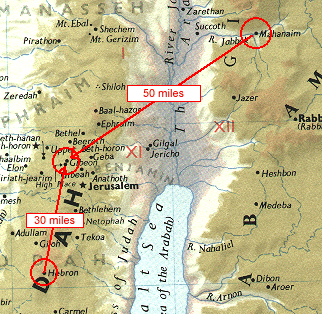
v.11-13 - A map shows the amount of planning this took. It is always worth reminding ourselves of the distances involved:
Peter [UK] Comment added in 2001 Reply to Peter
v.1 - In that David enquired where he should 'go up' we know that at this stage he did not know where his capital was to be. Jebus was still under the control of the inhabitants of the land - over 500 years after the nation entered the land under Joshua.
Peter Forbes [Mountsorrel (UK)] Comment added in 2001 Reply to Peter
v.3 - This is the first indication I have noticed - there may well have been others that I have missed - that the 600 men that travelled everywhere with David also had their wives and families with them.
Peter [UK] Comment added in 2002 Reply to Peter
2:8-17 Abner was Saul's cousin (1 Samuel 14:50)
Joab was David's nephew - he was the son of Zeruiah, David's sister (1 Chronicles 2:15-16)
So we see family rivalry in the way that Abner took Ishbosheth to be king. This family rivalry is seen throughout the life of David, even after he is king in Jerusalem.
Peter Forbes [Mountsorrel (UK)] Comment added in 2002 Reply to Peter
:5 We see a characteristic of David - his kindness and thoughtfulness - in that he sent to the men of Jabesh Gilead. We will notice other similar kindnesses throughout David's life. This is one of the characteristics of a man of God. The kindnesses done were not strictly necessary - but were truly acts of compassion.
Peter Forbes [Mountsorrel (UK)] Comment added in 2003 Reply to Peter
2:21-22 Abner was a cruel man who was self seeking - but seemed to have some degree of honour in that he was concerned what Joab, Asahel's brother, would say if Asahel was killed. But this was no virtue. He was supporting one who was not the Lord's anointed instead of supporting David.
Peter Forbes [Mountsorrel (UK)] Comment added in 2004 Reply to Peter
V.10 David, being aware that he was to be appointed king over Israel, neither could, or would force matters. He was content to wait God's time, and avoided any collision with the rival king, till, at the lapse of two years, hostilities were threatened from that quarter.
John Wilson [Toronto West (Can)] Comment added in 2004 Reply to John
We saw in yesterday's lamentation that David was able to say lovely things about Saul, his persecutor, so today we see David sending a "Thank you" to the men of Jabesh-gilead, who had retrieved Saul's body and buried it. "Thank yous" are extremely important.
David Simpson [Worcester (UK)] Comment added in 2004 Reply to David
2:1 With hindsight we might have concluded that David should have known that Jerusalem was the place where the kingdom would have its throne. However that was some time away. Saul appeared to have his palace at Gibeah in Benjamin. David knew that God was going to choose a place – Deut 12:11 – There were a number of locations with historical significance available to David. God chose Hebron, the place of the burial of Abraham Gen 49:30-31
Peter Forbes [Mountsorrel (UK)] Comment added in 2006 Reply to Peter
V.4 David was anointed with oil as he became king. David's first anointing was administered by Samuel (1Sam 16:13); his second anointing took place at this time; and his third anointing occurred later (2Sam 5:3). By contrast, Jesus, the greater David, was anointed once with the Holy Spirit and with power (Acts 10:38).
Michael Parry [Montreal (Can)] Comment added in 2006 Reply to Michael
2:4 It may well be that the men of Jabesh Gilead rescued Saul’s body because of the kindness that Saul had done to them – 1Sam 11
Peter Forbes [Mountsorrel (UK)] Comment added in 2007 Reply to Peter
2:8 David’s life since he was anointed by Samuel when Saul had been rejected has not been smooth and trouble free – even though he was promised the throne. And now, even though Saul is dead, problems persist with the behaviour of Abner.
Peter Forbes [Mountsorrel (UK)] Comment added in 2008 Reply to Peter
Vs.14-16 Abner proposed a fighting contest between young men of both sides. The king of the side that won, would, presumably, be proclaimed the legitimate reigning monarch. As it turned out, the contest ended in a dead heat (literally). This result inflamed both sides to enter into civil war.
Michael Parry [Montreal (Can)] Comment added in 2008 Reply to Michael
2:2 The two wives are both wives which David acquired during his fugitive years. He already had a wife – Mical the daughter of Saul -1Sam 18:27
Peter Forbes [Mountsorrel (UK)] Comment added in 2009 Reply to Peter
V.8 Abner, was Saul’s first cousin and head of his army. He despised David’s power and determined to set up a rival kingship to continue Saul’s line. Ish-bosheth is alternatively called Esh-Baal (1Chron 8:33). Mahanaim was east of the Jordan.
V.10 David was in Hebron for seven-and-a-half years (v.11). Ish-bosheth reigned for all that time. Perhaps the two years mentioned here refers to the time that Judah, alone, followed David, i.e. before the other tribes followed him.
V.14 Family loyalties were at stake here: Abner, cousin of Saul, head of Saul’s army versus Joab, nephew of David, head of David’s army.
V.23 The term under the fifth rib (KJV) means in the stomach.
V.26 Abner was saying, in effect: Joab, if you continue this civil war, then it is going to have a painful conclusion (for both sides).
V.27 Joab’s reply to Abner (v.26) was: Hey, if you had not provoked that earlier confrontation (v.14), then nothing else would have happened!
V.28 Joab prevented any escalation of hostility, but he was not about to let the death of Asahel go unpunished as we will see.
Vs.30,31 The casualty score: Team Abner 360; Team Joab 20.
Michael Parry [Montreal (Can)] Comment added in 2009 Reply to Michael
2:25-31 One imagines that if this truce had not been called Benjamin would have been devastated by Judah and those that followed David, though allowing Abner to live brought its own problems later in David’s reign. 2Sam 3:12
Peter Forbes [Mountsorrel (UK)] Comment added in 2010 Reply to Peter
2Sam 2:3 - "Hebron" (2275) means "seat of association, association, alliance". 2Sam 2:8 - "Ish-bosheth" (378) means "man of shame"; "Mahanaim" (4266) means "double camp, two camps". 2Sam 2:15 - the number "twelve" is thought by many to symbolize governmental perfection. 2Sam 2:16 - "Helkath-hazzurim" (2521) means "field of swords, field of daggers, field of hostilities, field of rock, smoothness of the rocks".
Charles Link, Jr. [Moorestown, (NJ, USA)] Comment added in 2010 Reply to Charles
David as a type of Christ (part 2 of 2 - for part 1 see 1Sam.17):
7. David first saved his own tribe of Judah (2Sam 2:1-4). So will Christ (Zech 12:7).
8. David united all Israel under one head (2Sam 5:1). Christ will do likewise (Eze 37:21-22).
9. David freed Jerusalem from the enemy (2Sam 5:6-7). Christ will challenge and destroy Israel's foes (Joel 3:16;Psa 110:1,5,6,7).
10. David extended his kingdom into an empire by bringing the surrounding nations into subjection to his rule (2Sam 8,10). The Lord will also demand dominion over the nations (Psa 72:11;Isa 60:12).
11. David established the true worship in Jerusalem (2Sam 6). Christ will banish error and legislate for truth (Isa 2:2-4).
12. David's victories paved the way for the peaceful reign of Solomon, and the Temple that he built. The Lord will do likewise (Hag 2:6-9).
The above is from The Story of the Bible by H.P. Mansfield, V.3, p.31-32.
Charles Link, Jr. [Moorestown, (NJ, USA)] Comment added in 2010 Reply to Charles
2:2 The men that were with David were those who had fled to him –1Sam 22:2- and become his army. One presumes that their families did not stay with them in the wilderness when David was fleeing from Saul. But now they are reunited with their families in Hebron.
Peter Forbes [Mountsorrel (UK)] Comment added in 2011 Reply to Peter
2:7 Saul was both their king and a descendant, probably, of the men of Jabesh Gilead. So they would possibly have had a greater feeling for him than any other city.
Peter Forbes [Mountsorrel (UK)] Comment added in 2012 Reply to Peter
14:17 Abner and Joab’s behaviour in this incident is appalling. David had been chosen by God, Ishbosheth had not. There should not even have been a discussion, let alone young men fighting each other.
Peter Forbes [Mountsorrel (UK)] Comment added in 2013 Reply to Peter
Signpost phrases: The fifth rib
God has written the Bible so that the more interesting and important themes are hidden below the surface. One way He uses to show us where these themes are hidden is by using signpost phrases. Just as a signpost is not important in itself, so these phrases merely point the way to important places in the Bible that ought to be read together. Take this phrase "fifth rib" as an example (v23), and put it into a Bible search program. You will find a group of closely related verses that exist only in the context of this war between Saul's house and David's house. What do you think the contexts of each of these verses tell us? Why has God pulled those incidents together for us?
Rob de Jongh [Mountsorrel (UK)] Comment added in 2013 Reply to Rob
2:5 David was in Hebron so to send messengers to Jabesh-Gilead was quite a journey as Jabesh-Gilead is on the East of Jordan near to the sea of Galilee.
Peter Forbes [Mountsorrel (UK)] Comment added in 2014 Reply to Peter
2:10 We learnt that Saul had three sons who were killed in Mount Gilboa - 1Sam 31:6 – so the mention here (and elsewhere) of Ishbosheth as Saul’s son indicates that Saul must have had at least four sons and that Ishbosheth had not been at the battle where his father and brothers were killed.
Peter Forbes [Mountsorrel (UK)] Comment added in 2015 Reply to Peter
2:5-7 We will see – 2Sam 9:1- that David seemed to go out of his way to show kindness to others. This is one such occasion.
Peter Forbes [Mountsorrel (UK)] Comment added in 2016 Reply to Peter
2:3 We might imagine that when David came to Hebron with his men and their families that there could well have been maybe 2,000 in total. Quite a company to take care for.
Peter Forbes [Mountsorrel (UK)] Comment added in 2017 Reply to Peter
2:1 The phrase “and it came to pass after this” or similar is used a number of time – 2Sam 2:1, 8:1, 10:1, 13:1, 15:1, 21:18 – in the Samuel account of David’s exploits. Each marks the beginning of a new section of his life.
Peter Forbes [Mountsorrel (UK)] Comment added in 2018 Reply to Peter
2:32 Asahel was the son of David’s sister –2Sam 2:18– so the seemingly incidental mention of him being buried in Bethlehem – David’s family town – provides credibility to the reliability of the historic record here.
Peter Forbes [Mountsorrel (UK)] Comment added in 2019 Reply to Peter
2:9 Notice the extent of the area that Abner sought to assign to Ishbosheth. It is in the north of the land primarily. And notice the area is called “all Israel”. We see here another indication of a divided kingdom in its formation.
Peter Forbes [Mountsorrel (UK)] Comment added in 2020 Reply to Peter
2:9 Notice the extent of the area that Abner sought to assign to Ishbosheth. It is in the north of the land primarily. And notice the area is called “all Israel”. We see here another indication of a divided kingdom in its formation.
Peter Forbes [Mountsorrel (UK)] Comment added in 2021 Reply to Peter
2:5 There is ample evidence to show that Saul’s maternal ancestry was in Jabesh Gilead. One might imagine, therefore, that the inhabitants of Jabesh Gilead would not, naturally, wish to follow David as king possibly preferring one of Saul’s descendants. David makes strenuous efforts to seek the peace of the inhabitants of that city. This is a characteristic we will see of David time and again during his reign. Rather than seeking conflict David sought reconciliation. A lesson for us.
Peter Forbes [Mountsorrel (UK)] Comment added in 2022 Reply to Peter
2:1 David had a home town – Bethlehem – which was in Judah. But rather than assume that as king he should go home to Bethlehem he left the matter in the hand of God.
Peter Forbes [Mountsorrel (UK)] Comment added in 2023 Reply to Peter
2:3 Notice that David came to the cities of Hebron. That is Hebron and the surrounding villages. This is how David and the company that were with him – probably about 2,000 – were absorbed into the area.
Peter Forbes [Mountsorrel (UK)] Comment added in 2024 Reply to Peter
v.5 - It is quite obvious that Israel were a constant disappointment to God [ch.2:32, 3:11-14, 7:24-26 etc.]. We tend to think we are different, but is this not a presumptuous thought? Let us make sure that we learn from their mistakes and not fall into the same condemnation. 1Thes.5:21, 2Thes.2:9-12, Rev.2:25.
Peter [UK] Comment added in 2001 Reply to Peter
v.11 - There were those in Jerusalem at the time of Jeremiah who were countering his words of judgement by saying that the woes that he was predicting would not come - hence 'peace, peace'. However the judgements did come. But spare a thought for Jeremiah who was speaking what was viewed as treason against the house of God.
Peter Forbes [Mountsorrel (UK)] Comment added in 2001 Reply to Peter
v.3 - Another of the constant reminders that the words of God present to us decisions which are no less than life or death.
Peter [UK] Comment added in 2002 Reply to Peter
8:10 The threat to 'give their wives unto others' quotes Deuteronomy 28:30 and as such Israel should have known that they were astray from His word - they were experiencing the curses that would flow upon those who were disobedient.
Peter Forbes [Mountsorrel (UK)] Comment added in 2002 Reply to Peter
:13 Jeremiah's assurance that his words 'shall not pass away' is the basis of Jesus' assurance about his words (Matthew 24:35 Mk 13:31 Luke 21:33)
Peter Forbes [Mountsorrel (UK)] Comment added in 2003 Reply to Peter
8:3 In the time of the siege of Jerusalem the prophet shows that the situation will be so dire that death will be preferred to life. This forms the basis for how it will be during the fifth seal (Rev 9:6)
Peter Forbes [Mountsorrel (UK)] Comment added in 2004 Reply to Peter
V.7 The instinct of the migratory birds leads them with unfailing regularity to return every spring from their winter abode (Song 2:12); but God's people will not return to Him even when the winter of His wrath is past, and He invites them back to the spring of His favour. Isaiah makes a similar comparison. Isa 1:3
John Wilson [Toronto West (Can)] Comment added in 2004 Reply to John
V.3 talks of those in Jerusalem preferring death rather than submission to a foreign power. The reaction to the inhabitants of Jerusalem by the invading Babylonians has been compared to those under siege in Constantinople by Islamic forces. Constantinople was under siege by the Saracens twice (668-675 AD and 715-718 AD) who were unable to take the city.
Those in Constantinople who would prefer death rather than being forced to become Muslims, had the Saracens been successful, is described in Rev 9:6. The city, after tribulation during the Crusades, was finally taken by the Ottoman Turks in 1453 AD.
V.22 Gilead was a territory east of the River Jordan which encompassed the northern portion of the tribe of Gad and the southern portion of the tribe of Manasseh (east). It was famous for its balm - an aromatic, medicinal preparation obtained from balsam tree resin (balm is a contraction of the word balsam).
The balm's healing property is referred to, ironically, by Yahweh. He is saying that once His judgement has been enacted, there is no preventative. Jeremiah uses this figure on three occasions: the fall of Jerusalem in this chapter; the pronouncement against Pharaoh Necho (Jer 46:11); the fall of Babylon (Jer 51:8).
Michael Parry [Montreal (Can)] Comment added in 2004 Reply to Michael
V.4 It is man's natural instinct, that if he falls, he will get up. If he turns away (that is if he wanders off the path) he will at least attempt to return to the point from which he wandered, so the prophet asks the question; Why will they not return? Jer 4:1
John Wilson [Toronto West (Can)] Comment added in 2005 Reply to John
Jer 8:6 says that God listened to what Israel were saying, and He didn't like what He heard. Our dear Lord God listens to us, too. I hope He is more pleased with us than He was with His chosen people.
David Simpson [Worcester (UK)] Comment added in 2005 Reply to David
8:1-2 There will come a time when, so to speak, the bones will come out of the grave – at the resurrection. However Jeremiah is presenting an altogether bleaker picture for his hearers to contemplate. Rather than a resurrection to glory he is predicting a time of even greater persecution than they were already suffering.
Peter Forbes [Mountsorrel (UK)] Comment added in 2006 Reply to Peter
8:14 The ‘gall’ that Israel were to be given to drink is not a literal description but rather a reminder of Deut 29:18 and is a feature that Jeremiah returns to in 9:15, 23:15
Peter Forbes [Mountsorrel (UK)] Comment added in 2007 Reply to Peter
8:12 The fact that the people were not ashamed is echoed in the contemporary prophet – Zeph 3:2-3
Peter Forbes [Mountsorrel (UK)] Comment added in 2008 Reply to Peter
Vs.1,2 In the Near East it was a common practice for conquering armies to unearth from graves, or extract from tombs, the skeletons of the kings, priests, and prophets of the conquered nations. Their bones would be spread out on the ground as a public display. This contemptuous act was meant to add insult to injury to the defeated nations.
Michael Parry [Montreal (Can)] Comment added in 2008 Reply to Michael
8:17 The people who are like serpent and ‘adders’ – RV – show the characteristics that David says are true of the wicked – Psa 58:4
Peter Forbes [Mountsorrel (UK)] Comment added in 2009 Reply to Peter
V.7 The animals are programmed to react to their built-in instincts. People have reasoning power and a free will. They can choose either good or evil. For God’s people to remain His people, they must choose His ways.
V.10 The price for not obeying Yahweh is always punishment of some sort.
V.11 People do not want to hear bad news. They will delude themselves, even in the face of evidence to the contrary, that everything will be o.k. The leaders in Jerusalem were saying that there will be peace, while Jeremiah, Yahweh’s prophet, was saying there will be destruction.
The same sentiments were in play in Jerusalem of the first century. Then, suddenly, in 70 AD the army of Titus wrought devastation on the city, and over 1,000,000 people we annihilated. And, the same thing will happen in end times when Israel will appear to be at peace. This will be an illusion as destruction will surely arrive (1Thess 5:3).
Michael Parry [Montreal (Can)] Comment added in 2009 Reply to Michael
We were on a trip to En-Gedi, the place where David and his men had hidden from Saul. Looking up we saw a flock of storks migrating. It was an amazing sight, as you can imagine, since these are very large birds. The leader of our group called to mind this verse "even the stork in the heavens knows her appointed times... but My people do not know the judgement of the LORD." (v7)
The stork has the most magnificent wingspan of all birds (Job 39:13) and have their homes in the highest trees (Psa 104:16-17) yet they need to leave their home when their time comes. So also Judah would have to leave their land to go into captivity for a time in Babylon because of their sin. Those who thought deeply about this prophecy would realise that it would only be a temporary situation. And so as we go through the rest of Jeremiah we will notice the phrase "the time" occurring again and again, speaking of their time of punishment. And likewise the time of restoration. Those who were wise would think about the stork and go willingly (27:11-13).
Rob de Jongh [Mountsorrel (UK)] Comment added in 2009 Reply to Rob
8:12 Here Jeremiah echoes his words of 6:15. Judah’s recurring problem was not that they sinned, but that they were not ashamed of their sins when they were highlighted.
Peter Forbes [Mountsorrel (UK)] Comment added in 2010 Reply to Peter
8:13 In speaking of the failure of the crops in the specific way in which he does Jeremiah is quoting Hab 3:17. Habakkuk, speaking before the Babylonian invasion, was wanted by God – Hab 1:6 - that the Chaldeans would come against Judah. Jeremiah is moved by God to make that point to the generation who were going to experience the Babylonian invasion.
Peter Forbes [Mountsorrel (UK)] Comment added in 2011 Reply to Peter
8:18 So distraught was Jeremiah a what he saw in Israel that he could not put it from his mind. Are we so troubled with the ways of the world
Peter Forbes [Mountsorrel (UK)] Comment added in 2012 Reply to Peter
8:3 That death would be chosen rather than life not only highlights the devastation nature of God’s judgements. It also shows that the people, even in dire circumstances, would not repent and turn to God.
Peter Forbes [Mountsorrel (UK)] Comment added in 2013 Reply to Peter
8:1-2 In 2Kin 23:16 we read of how Josiah actually did this to the bones of those who worshipped false Gods.
Peter Forbes [Mountsorrel (UK)] Comment added in 2014 Reply to Peter
8:7 When God says of the Jews that they “knew not the judgments of the Lord” this is not to say that they had no knowledge of what God had said. They had chosen to disregard what He had taught them.
Peter Forbes [Mountsorrel (UK)] Comment added in 2015 Reply to Peter
OUTLINE OF JEREMIAH
PART TWO -- THE PROPHECIES TO JUDAH (JEREMIAH 2:1 TO 45:5)
I. The Condemnation of Judah (Jeremiah 2:1 to 25:38)
C. Third Sermon - Judah's Hypocrisy in Worship and the Illusions of Temple Security (Jeremiah 7:1 to 10:25):
17. Jer 8:1-2 - some feel that this was thought to be a desecration of the defeated enemy and to their supposed spirits (Amos 2:1) as a result of conquest while others feel that was not so much the thought here, but rather the thought being of the wholesale desecration of the bones of ALL classes of worshippers in the presence of the sun, moon, and stars they uselessly worshipped these idols for protection instead of turning to God; Jeroboam with calf-worship in Bethel profaned the place where God revealed Himself to Jacob (Gen 28:10-16), and we have prophecy that upon the very same altar men's bones would burned by Josiah (1Kin 13:2) and this came to pass (2Kin 23:15-16) but apparently made no impression; V2 (Deut 4:19;Deut 28:61).
18. Jer 8:3 - they preferred death to life; V3 (Deut 28:66).
19. Jer 8:4-7 - a divine appeal against their free-will stubborness to repent while noting the God given and wiser instinctual better behavior of the lower creatures in the animal kingdom (Isa 1:3;Gen 6:17-20;2Pet 2:15-16); V5 God wants the people of Jerusalem to examine themselves and repent (and us Rom 15:4 to examine ourselves and repent); V6 no repentance as each pursues their own course of idolatry (what are our idols?).
Charles Link, Jr. [Moorestown, (NJ, USA)] Comment added in 2015 Reply to Charles
C. Third Sermon - Judah's Hypocrisy in Worship and the Illusions of Temple Security (Jeremiah 7:1 to 10:25):
20. Jer 8:8-13 - V8 there were scribes in Josiah's time (2Chron 34:13), and of course in Christ's (Matt 15:1-8); V9 even the "wise" were unwise (1Cor 1:18-27); V10 (Deut 28:30); V10 (NIV) "...all are greedy for gain; prophets and priests alike, all practice deceit"; V10 "covetousness<1215>" was universal among the priests and prophets of Jeremiah's day, which was the sin of Balaam and those in Isaiah's day too (Isa 56:9-12;Isa 5:23) and they were covetous in Christ's day (Luke 16:13-14); V10 thou shalt not covet (Exo 20:17;Exo 18:21;Psa 119:36;Prov 30:8-9;Luke 12:15;Col 3:5,8;Prov 23:4;Matt 6:19;Luke 18:24); VS 10-11 false prophets insisting Jerusalem was in no danger gave Jeremiah problems; V11 (NIV) "'Peace, peace,' they say, when there is no peace" (falsely telling the people what they wanted to hear was the result of covetousness and the last days would have similar talk 1Thess 5:2-6); V12 (echoing symbolism from the law Lev 14:42-45); V12 punishment as a result of having no shame (Jer 8:17); V13 (Matt 21:19).
21. Jer 8:14-17 - VS 14-15 (Deut 29:18;Matt 27:1-5;Heb 12:17 - the poisened water of V14 reminds of Marah in Exo 15:23); VS 16-17 cannot avert the inevitable doom (the serpents and "cockatrices<6848>" of V17 remind of Num 21:6;Psa 58:3-4;Matt 3:4-10;Matt 12:33-35;Matt 23:29-33;Acts 28:3-6).
Charles Link, Jr. [Moorestown, (NJ, USA)] Comment added in 2015 Reply to Charles
C. Third Sermon - Judah's Hypocrisy in Worship and the Illusions of Temple Security (Jeremiah 7:1 to 10:25):
22. Jer 8:18-22 - VS 18-19A (ESV) "My joy is gone; grief is upon me; my heart is sick within me. Behold, the cry of the daughter of my people from the length and breadth of the land: 'Is the Lord not in Zion? Is her King not in her?"' (this appears to be Jeremiah lamenting for his people); VS 19B (ESV) "Why have they provoked me to anger with their carved images and with their foreign idols?" (the Lord replies that He was provoked just as He was in Isaiah's day Isa 59:1-2);
V20 the people would realize Judah would be desolate and they are not saved; V21 Jeremiah is "hurt<7665>" and "black<6937>" perhaps echoing Christ (Matt 8:17;Isa 53:4;Luke 23:26-31); V22 there was plenty of "balm<6875>" in Gilead (Gen 37:25;Eze 27:17) - but the daughter of Zion didn't believe she was sick (Matt 9:13;Luke 8:43-48 -- there was little to no faith in Jeremiah's day and consequently there was no divine cure or divine balm in Jeremiah's day or 656 years later in 70AD).
Charles Link, Jr. [Moorestown, (NJ, USA)] Comment added in 2015 Reply to Charles
8:6 When God says “I hearkened and heard” we are reminded that God is always aware of what we say and think. This should cause us to think carefully about what we say and think.
Peter Forbes [Mountsorrel (UK)] Comment added in 2016 Reply to Peter
8:2 In speaking of the dead being like dung on the ground the prophet uses a similar phrase a number of times –Jer 9:22, 16:4, 25:3 and is reflected also in the contemporary prophet – Zeph 1:17. An awful picture of a polluted land
Peter Forbes [Mountsorrel (UK)] Comment added in 2017 Reply to Peter
8:21 We can easily pass over verses like this and miss the point that the prophet Jeremiah’s feelings for those he spoke against caused him to grieve over what was happening to them.
Peter Forbes [Mountsorrel (UK)] Comment added in 2018 Reply to Peter
8:5 there is a difference between the sin which happens almost accidentally and the persistent action. It seems that Israel’s problem in Jeremiah’s day was that they were “sold under sin” – Rom 7:14
Peter Forbes [Mountsorrel (UK)] Comment added in 2019 Reply to Peter
8:12 A “decent burial” seems to be something that we all want and an undisturbed grave. Here and in 9:22 and 16:4 Jeremiah presents an altogether picture. It is as if because the people had no regard for God He has no regard for their bones.
Peter Forbes [Mountsorrel (UK)] Comment added in 2020 Reply to Peter
8:3 the way in which the suffering that would be experienced would cause men to prefer to die is echoed in Rev 9:6 which speaks of the judgments of God on those who are not His servants.
Peter Forbes [Mountsorrel (UK)] Comment added in 2021 Reply to Peter
8:5-9 The reason for Israel’s “backsliding” is spelt out clearly. Amazingly the nation contrasted the animal creation which responded to its innate instincts. The problem seen in the nation was that they thought that they were “wise” and so did not need instruction. They thought they knew God’s law imputing vanity to God and His scribes.
Herein is the danger. Our own “wisdom” informed by the thinking of godless men can cause us to question the credibility of things such as the literality of Creation.
Peter Forbes [Mountsorrel (UK)] Comment added in 2022 Reply to Peter
“How do ye say, We are wise, and the law of the LORD is with us? Lo, certainly in vain made he it; the pen of the scribes is in vain.” 1611 KJV
In the NIV we read: “How can you say, ‘We are wise, for we have the law of the LORD,’ when actually the lying pen of the scribes has handled it falsely? The comment on this verse is: “law of the LORD… word of the LORD. Misinterpreting and manipulating the first (the written law of Moses) leads to rejection of the second (God’s truth as found in the law and proclaimed by his servants the prophets).”
The ARAMAIC ANCIENT TEXT OF THE PESHITTA reads: “How do you say, We are wise, and the law of the LORD is with us? Lo, surely the lying pen of the scribes has made it for falsehood.” The comment on this verse is: “The scribes have interpreted it falsely, and written wrong comments on it.”
Clarke’s Commentary: “Verse 8. The pen of the scribes is in vain.] The deceitful pen of the scribes. They have written falsely, though they had the truth before them. It is too bold an assertion to say that ‘the Jews have never falsified the sacred oracles;’ they have done it again and again. They have written falsities when they knew they were such.” Originally, the commentaries were published in six volumes from 1810 – 1826.
The definition of “vain,” as defined in https://www.yourdictionary.com/vain/ is: “Effecting no purpose; pointless, futile. Vain toil; a vain attempt. Having no real substance, value, or importance; empty; void; worthless; unsatisfying. Without force or effect; futile, fruitless, unprofitable, unavailing, etc. A vain endeavor…” The Hebrew word that describes this is riyq, # <7385>, but this is not what Jeremiah used.
“Vain,” sheqer, is # <8267>, and defined in Strong’s Concordance as: “an untruth; by implication, a sham… lying.” This describes more the Hebrew word, kazab! James Strong had to have known that the scribes were “lying,” so, why did he use sheqer as “vain” while describing kazab? Because, “vain” appeared in the 1611 KJV. “The Exhaustive Concordance of the Bible, generally known as Strong's Concordance, is a Bible concordance, an index of every word in the King James Version (KJV), constructed under the direction of James Strong.” https://en.wikipedia.org/wiki/Strong%27s_Concordance/ Strong’s Concordance was first published in 1890. Had he familiarized himself with Adam Clarke’s Commentary, he may have chosen his words more wisely.
The definition of “lying,” as defined in https://www.dictionary.com/browse/lying/ is: “Noun: the telling of lies, or false statements; untruthfulness…: Adjective: telling or containing lies; deliberately untruthful; deceitful; false: a lying report.”
Lying, or “to lie,” is # <3576>, kazab, “to deceive, liar, lie, lying” and here, too Strong adds “be in vain!” They are two very separate words with two separate meanings, two separate interpretations, which he bunched together as being synonymous! So, just because Strong’s Concordance says so, doesn’t make it so. This is why digging into the meaning of words is so critical, especially when apparent contradictions occur (cf. Prov 25:22).
To be vain in noun or an adjective is one thing, to lie in noun or an adjective is quite another! James Strong has done this with other words, too, and caused confusion! Example: Job 41:9. “The hope of him is in vain [futile]…” Here Strong has for vain, # <3576>, kazab [deceive, lie]!
From the definitions, we are able to discern the big difference between, “vain” and “lying!” Likewise, the difference between cheat and deceive is: “deceive is to trick or mislead while cheat is to violate rules in order to gain advantage from a situation.” https://wikidiff.com/deceive/cheat/ Vain, lying, and deceive, cheat are not synonymous words and are to be interpreted according to what they truly mean in context, not manipulated and misinterpreted just because the KJV 1611 words differ, and has it so!
Valerie Mello [in isolation, TN, USA] Comment added in 2022 Reply to Valerie
8:6 Sin and falling short of what is expected of us by our heavenly Father is inevitable. |What he is looking for in us is repentance. He is listening and waiting like He was with Israel. Hopefully our response is better than that of the nation of Israel.
Peter Forbes [Mountsorrel (UK)] Comment added in 2023 Reply to Peter
8:8-9 the sort of behaviour that the prophet speaks of here is a way of thinking that Paul reproves- Rom 2:17. It is possible for any servant of God to think like this – a self-satisfied confidence in our own ideas rather than following exactly what God requires.
Peter Forbes [Mountsorrel (UK)] Comment added in 2024 Reply to Peter
v.6 - If we weigh this statement carefully against the rest of scripture, it is much more than a piece of moral advice about practical living. It refers to our relationship with the Lord, our covenant relationship into which we entered at baptism, which we cannot undo. Prov.2:17, Mal.2:14, Mark 10:9.
Peter [UK] Comment added in 2001 Reply to Peter
v.6 - Notice it is God who does the joining. We might think of marriage as a union between the man and woman at their agreement. However Jesus shows that the actual joining is of God. This must be because marriage patterns the relationship we have with Jesus - as his bride. That is of God. We are called by him, not of ourselves. [1 Corinthians 6:20]
v.21 - We may have difficulties with the concept of being 5046 'perfect' Look at the way the word is used elsewhere in Scripture. [Matthew 5:48 19:21 Romans 12:2 1 Corinthians 2:6 13:10 14:20 Ephesians 4:13 Philippians 3:15 Colossians 1:28 4:12 Hebrews 5:14 9:11 James 1:4,17,25 3:2 1 John 4:18]
Peter Forbes [Mountsorrel (UK)] Comment added in 2001 Reply to Peter
19:18 Notice 'thou shalt not covet' is omitted from the list of prohibitions that Jesus quotes from the law of Moses - he knew the young man's problem though the man did not know it himself.
Peter Forbes [Mountsorrel (UK)] Comment added in 2002 Reply to Peter
:30 In saying 'the first shall be last and the last first' Jesus introduces a concept which he weaves into a parable.
Peter Forbes [Mountsorrel (UK)] Comment added in 2003 Reply to Peter
There are a few statements of Jesus, similar to v23-24, where he makes the point that it is difficult to inherit the kingdom of God. Other examples are: Luke 14v25-27; 14v33. On the surface, these statements could make us feel very inadequate, and quite afraid of rejection. But did Jesus mean what we think he meant?
Jesus gives us a big clue in this chapter. We realise that he wasn’t actually saying that it's difficult to inherit the kingdom of God, but impossible! It is IMPOSSIBLE for a camel to go through the eye of a needle! (v26). This is an extremely important distinction, because it makes us wonder, as the disciples did, “who then can be saved?” (v25). The answer is “with men this is impossible; but with God all things are possible”.
It was impossible for that rich man to enter the kingdom of God. His question to Jesus had been “what must I do to INHERIT the kingdom of God?”. He believed that one might inherit it, or earn it, through ones good works. This man’s works were admittedly very good, and Jesus loved him for it (Mark 10v21), but his trust in his own works was misguided (James 2v10). He needed, just like us, to benefit from the miraculous but un-earnable salvation that Jesus was about to bring into being through his sacrifice. This is what Jesus referred to when he said “with God all things are possible”.
Rob de Jongh [Mountsorrel (UK)] Comment added in 2003 Reply to Rob
19:24-25 The disciples incredulity demonstrates that they had the problem that many of us have – they were respecters of persons. The gospel is a great leveller. We must realise that and put it in to practice.
Peter Forbes [Mountsorrel (UK)] Comment added in 2004 Reply to Peter
V.21 We can make a comparison here; Abraham, and the young man: The sacrifice that Abraham was asked to make was by far the most enormous. Gen 22 By means of his willingness to make the sacrifice, Abraham proved the genuine character of his faith. He believed God, and he reckoned it to Him for righteousness. James 2:21-23 The rich young ruler, though asked to make a much smaller, but still considerable sacrifice, refused, proving he did not have the same faith. Abraham placed his trust in God; the young man, in his riches. 1Tim 6:17
John Wilson [Toronto West (Can)] Comment added in 2004 Reply to John
Vs.13,14 Some people claim that these verses allow for children who have died to be saved. This is a sweet sentiment but it is not supported by scripture. Scripture says, clearly, that belief and baptism are necessary for salvation (Mark 16:16). This is predicated upon a free-will choice from an understanding mind. Children are hardly able to make that choice.
The Lord is not advocating salvation for children but rather pointing out an acceptable attitude for believers. Unless one is prepared to adopt a child-like faith (unquestioning trust and humility), then one will not obtain salvation (Matt 18:3,4).
V.30 actually begins Matthew Ch.20.
Michael Parry [Montreal (Can)] Comment added in 2004 Reply to Michael
V.12 From a spiritual point of view it is better to remain single. But not many can follow that path. The apostle Paul did, but he realized that for others (probably most): it is better to marry than to burn (1Cor 7:9). Nevertheless he concluded that: ...if you do marry, you have not sinned...but those who marry will face many troubles in this life...(1Cor 7:28).
Marriage is a God-given institution and should be respected (Heb 13:4). However, things can and do go radically wrong sometimes. The Lord wants married couples to remain together, but if adultery occurs, the marriage bond is essentially broken. True, the offended party can agree to forgive the offending party and choose to remain in the relationship. However, if the offended party cannot reconcile, he or she can dissolve the marriage.
But, can he or she re-marry? Does the offended party have to remain celibate and burn? The Lord seems to suggest that, under these circumstances, it is permissible to re-marry (Matt 19:9). This so-called exceptive clause tilts towards mercy. The offended party can decide to remarry or to remain single - that is his or her choice. Of course, the least complicated state would be to remain single. Whatever the decision, others should check their mercy meter and not stand in judgement.
Michael Parry [Montreal (Can)] Comment added in 2005 Reply to Michael
19:27 Peter's response 'we have left all...' indicates that Peter felt that he had done what the young ruler had not done.
Peter Forbes [Mountsorrel (UK)] Comment added in 2006 Reply to Peter
V.21 Here was the true test for the young man. The difference between the observance of the commandments of God, and the putting of them into real life. Christ here shows him the difference. In spite of just obedience to the laws of God, the young man knew something was missing, or he would have never come to Christ with the question. The young man had to make a decision that involved life everlasting.
John Wilson [Toronto West (Can)] Comment added in 2006 Reply to John
V.3 Two prominent rabbis had established schools just prior to the time of Christ. One was Shammai, and the other was Hillel. Shammai had a strict interpretation of the Law, while Hillel was much more liberal. Both rabbis had their own following.
Thus, we see the Pharisees coming to Jesus, testing him the question of divorce. Would he endorse Shammai who said that divorce was only valid if sexual immorality had occurred; or would he side with Hillel who allowed many reasons for divorce, some frivolous?
Jesus, the greatest rabbi of all-time, endorsed neither but went straight to the scriptures. His first words of reply were: Have ye not read. The Lord's foundation was always the Word of God - which should be ours, also.
By the way, it was Hillel who won the historical battle in that his liberal ideas largely formed the direction which Judaism has taken until today.
Michael Parry [Montreal (Can)] Comment added in 2006 Reply to Michael
19:13 Children are brought to Jesus but it was Jesus who had sought for a child – Matt 18:2. Jesus was not simply patting children’s heads. He was acknowledging that those who came to God must be like a child. The coming of the children was, we might say, an enacted parable.
Peter Forbes [Mountsorrel (UK)] Comment added in 2007 Reply to Peter
19:21 The direction that the young man was given by Jesus was exactly what the twelve had done. Each one of them had left everything and followed Jesus. You would think that the answer to the twelve would have been obvious; that they would be granted a place in the kingdom. Peter seems not to have been entirely certain about this (19:27). The Master had also declared that with men it is impossible to enter into the kingdom, but that it is through God's grace one obtains salvation. V.23,24,26
John Wilson [Toronto West (Can)] Comment added in 2007 Reply to John
Matt 19:10 Whilst the record here reads as if the disciples’ question was asked immediately we learn from Mark 10:10 that the disciples waited until they were alone with Jesus in the house. We often see this with the disciples, especially in Mark. The disciples, seeking clarification, return to a topic to learn more of Jesus. Are we as diligent to learn of him?
Peter Forbes [Mountsorrel (UK)] Comment added in 2008 Reply to Peter
19:8 Whilst the religious leaders seemed to see a conflict between Genesis 1 and Moses’ comment in Deut 24:1 Jesus highlights the reason for their problem. It was not Scripture but their own way of thinking. I say ‘their’ because the provision made in Deuteronomy 24 was because of the hardness of heart of all those who are unwilling to accept the Divine principle
Peter Forbes [Mountsorrel (UK)] Comment added in 2009 Reply to Peter
Vs.23,24 The picture of a camel going through an actual eye of a needle does not seem to make sense. However, if the eye of a needle is referring to a narrow aperture through a rock, then perhaps it does. Imagine a camel loaded with goods in transit through a rocky region (not uncommon in the time and place of Jesus). Somewhere along the way, the path encounters a narrow passage through the rock face. It is not possible for the camel to go through fully loaded. First, one must unload the camel and squeeze it through the opening and then reload it on the other side.
The Lord is telling his disciples (and us) that in order for a rich man to enter the kingdom he must first divest himself of his wealth. In fact this figure follows from Jesus' advice to the young man (v.21).
Does that mean we should give everything we have away?
That's a choice, of course, but the not the Lord's categorical demand. He does not say that a rich man will not enter the kingdom - he says hardly. Riches can be dangerous if they are misused or become a focus of our confidence (idolatry) (Matt 6:24; 1Tim 6:17,18). But shared, selflessly, for the greater good, they can honour the Lord (2Cor 9:7; Acts 2:44,45).
Michael Parry [Montreal (Can)] Comment added in 2009 Reply to Michael
19:10-12 The disciples saw the force of Jesus’ comment and saw a difficulty – they might marry a woman and find that they could not live with her. Jesus highlights that the principle is clear but men differ among themselves.
Peter Forbes [Mountsorrel (UK)] Comment added in 2010 Reply to Peter
v1-2. Did these people follow all the way from Galilee to Judea? How far do you think it is? And how many of them were impeded in their journey by the sicknesses that Jesus healed?
Rob de Jongh [Mountsorrel (UK)] Comment added in 2010 Reply to Rob
19:13-14 The rebuke of the disciples seems to indicate that the disciples had not understood what Jesus had told them in chapter 17 about receiving as little children.
Peter Forbes [Mountsorrel (UK)] Comment added in 2011 Reply to Peter
“What therefore God hath joined together, let not man put asunder. They say unto him Why did Moses then command to give a writing of divorcement, and to put her away? He saith unto them, Moses because of the hardness of your hearts suffered you to put away your wives: but from the beginning it was not so. And I say unto you, Whosoever shall put away his wife, except it be for fornication, and shall marry another, committeth adultery: and whoso marrieth her which is put away doth commit adultery.”
This passage is not saying man cannot, but "let not." Forgiveness is always the best way to go.
“Asunder” is Strong’s # <5562>, choreo, and means to “depart or separate.” What the Lord is saying here is, as the apostle Paul understood it, that a woman should not “depart” (choreo, <5562>) from her husband. But if she does “depart”(choreo, <5562>) she must remain unmarried (because she left and was not divorced), or else be reconciled to her husband. And the husband should not put away (aphiemi, <863>) his wife (1Cor 7:11-12). “Asunder” does not mean divorce as so often taught!
“Hardness of heart” was not in divorcing, but in just sending the women away, though it can be both. From this, it should not be construed that divorce is a sin. What causes divorce, though, always involves sin. God introduced divorce and He would not have introduced sin to fight sin! If divorce were a sin and God allowed it for whatever reason, then God was legalizing sin! This is not what Christ said. Rather, God through Moses, showed His mercy in providing a writ of divorcement that, “she may go and be another man’s wife (Deut 24:1-2) Unlike today, women needed men for their livelihood.
“From the beginning it was not so.” The Pharisees tempting Jesus in hopes of trapping him asked him if a man could put away (apoluo) his wife for any reason. Jesus, knowing their hearts, did not answer their question. Instead, Jesus’ reply went back to when God created marriage before sin entered into the world. God did not design marriage to end in separation or divorce. God instituted the death penalty for first-degree murder. From the beginning this was not so, either, for God created us to live together in harmony. But for the hardness of men’s hearts, it became a very necessary judgment to curb such violent crimes. Moses’ precept in giving a writ of divorcement did not follow the "very good" order of creation that was set up at the beginning (Gen 1; 2), but became necessary after sin entered the world (Gen 3). Lamech was the first to introduce bigamy (Gen 4:19), and separations became increasingly rampant. Furthermore, God permitted polygamy/bigamy, though it was not so from the beginning! Abraham, Jacob, David, and Solomon all had multiple wives, and God in speaking to the prophet, Nathan said that He gave David his wives, etc. and "if that had been too little..." He would have given him more (2Sam 12:7-8)! Once this Law was given over 400 years after the patriarchs, you could no longer just send away your wives and re-marry. Ezra commanded that all the foreign wives be sent away “according to the law” of Deut 24:1-4 (Ezra 10:3)! You had to give them a divorce.
The phrases, “put away,” or “put her away” is correctly translated, apoluo, “to send away.” In verse 7, “writing of divorcement,” apostasion is correctly translated. Jesus did not say whosoever shall give his wife a bill of divorce (apostasion, <647>) and marry another commits adultery, but whosoever shall put away (apoluo, <630>) his wife (except for fornication) and shall marry another commits adultery (see Mark 10:10-12; Luke 16:18)!
“Except it be for fornication.” See my note on Matt 5:31-32.
Valerie Mello [in isolation, TN, USA] Comment added in 2011 Reply to Valerie
19:22 That the man had ‘great possessions’ and was unwilling to part with them is an indication that he did not believe what Jesus said – Matt 6:19 – in the Sermon On The Mount. Where do we stand on this issue?
Peter Forbes [Mountsorrel (UK)] Comment added in 2012 Reply to Peter
19:16 This account is the only one recording the requirement that possessions should be sold in which the one who came to Jesus asked what ‘Good thing’ he needed to do. Jesus addressed the man’s specific problem, rather than giving a general statement applicable to all that would follow him.
Peter Forbes [Mountsorrel (UK)] Comment added in 2013 Reply to Peter
Wes Booker [South Austin Texas USA] Comment added in 2013 Reply to Wes
19:21 In telling the young man to “sell” all his possessions Jesus is returning to something he has said already in Matt 13:44,46. Earlier Jesus, in parables, was teaching the importance of self sacrifice. Now Jesus shows us a practical application of the principle he spoke of in the parables.
Peter Forbes [Mountsorrel (UK)] Comment added in 2014 Reply to Peter
“The Pharisees also came unto him, tempting him, and saying unto him, Is it lawful for a man to put away his wife for every cause?”
Jesus in reply to the Pharisees’ question (vv. 4-6) quoted Gen 2:24 to show them it was not lawful to put away a wife for just any reason. He brings up three very significant points which God gave from the beginning for a successful marriage. Point 1: leaving (parents) speaks of the priority of marriage over parent/child relationships. Point 2: cleaving (to the wife), which means to pursue hard to stick to/with the wife. Point 3: becoming one flesh, which speaks of the Divine purpose of marriage.
We must have total commitment to make the marriage last, and it is this commitment that enables love to continue, not vice versa. Without a total commitment by either partner, the marriage will eventually disintegrate. It is about “If you leave me, I’m going with you,” meaning that the principal aspect is to make up, not break up.
Becoming “one flesh” is much more than the physical act of love. It speaks of absolute openness and oneness without which the physical aspect of marriage loses its meaning and degenerates into the mere gratification of the flesh. “One flesh” is about appreciating the need for loving communication and sensitive loyal confrontation without any inhibitions that would prevent complete openness. Communication must not be rooted in selfishness, or ego trying to prove who is right. We are to attack the problem, not each other. These three combined acts of total commitment Scripture shows makes the couple, “one.” How sad in this day and age many choose the easy way out of a marriage allowing 10% of their problems override their 90% successes!
Jesus in going back to Gen 2:24 did not teach that God prohibited separation or divorce, but rather God’s instruction on how to keep our marriages together. The Pharisees were separating and divorcing for “every cause,” but God said and Christ pointed out to them that from the very beginning it was God’s intent for the husband to “cleave,” or pursue hard to stick to his wife, which is what the word means. It was never stipulated in the beginning that a husband/wife could not terminate the marriage, but stipulated that we are to make it work, and work hard at it. Because of the hardness of the Pharisees’ hearts, they did not strive to make their marriage work, but rather chose separation, later divorce for any and every cause. This aspect of separating or divorcing for any cause was never so, and this gives credence to the so-called, “exceptive clause,” as read in verse 9 and Matt 5:32.
Valerie Mello [in isolation, TN, USA] Comment added in 2014 Reply to Valerie
19:20 The man’s response is like that of the one in Luke 10:29. He sought to highlight the rightness of his own position
Peter Forbes [Mountsorrel (UK)] Comment added in 2015 Reply to Peter
19:19 In telling the one who had come to Jesus that if he wanted to be ‘perfect’ Jesus is reminding of his words in the Sermon On The Mount – Matt 5:48
Peter Forbes [Mountsorrel (UK)] Comment added in 2016 Reply to Peter
TO SUCH AS THESE
"The kingdom of heaven belongs to such as these." (Matt 19:14).
If I were to judge by the Christians I know who are highly respected, famous or whose reputation precedes them, these are the qualities I would see: The kingdom of heaven belongs to people who are highly intelligent, very talented, know their Bibles really well, who travel a lot, and preach God's word eloquently and without fear.
If I look around churches I could say the kingdom of heaven belongs to people who are well dressed, drive nice cars, and who attend Sunday services.
The context for those the kingdom of heaven belongs to comes from Jesus when he says,"Let the little children come to me and do not hinder them, for the kingdom of heaven belongs to such as these."
When I look around at my church, or any other church, and especially at myself, do I see the characteristics of little children in myself and the other believers I observe?
Do I see a simple, childlike trust in a strong and good Father God? Do I see a humble acceptance that what He says is right, with no questions asked? Do I see an eagerness to be with God and Jesus more than anyone else? Do I see us call and run to God the moment anything looks out of control? Do I see joy, smiles, fun and a love of life? The kingdom of heaven belongs to such as these.
Robert Prins [Auckland - Pakuranga - (NZ)] Comment added in 2016 Reply to Robert
19:3 Once again the Pharisees have travelled a long way from Jerusalem to Galilee for the sole purpose of attempting to entrap Jesus with their questions.
Peter Forbes [Mountsorrel (UK)] Comment added in 2017 Reply to Peter
In the March 1884 Christadelphian magazine, reprinted in the CHRISTADELPHIAN FAMILY JOURNAL September 1926, quotes the following from Robert Roberts: "B.B.--Divorce is inadmissible according to the law of Christ, except in the case he mentions in Matt. xix. 9. Where this case arises, and the parties are divorced, they are at liberty to marry again, both by human law and divine. Objection may be well meant, but is without ground." It is amazing that those who choose Robert Roberts over Dr. Thomas' teaching on divorce and remarriage never use this quote!
Valerie Mello [in isolation, TN, USA] Comment added in 2017 Reply to Valerie
“… let not man put asunder.”
Asunder, chorizo # <5563>, “to go away, separate.” It is derived from # <5562> choreo .
This is so clear, yet time and time again asunder is used to indicate “divorce.” To separate is not to divorce, and those who advocate separation only are twisting the Word and put themselves in direct opposition to God and Christ. To make their stand of “no divorce under any circumstances” fit, they would have to deny the Exceptive Clause and/or Pauline Privilege despite the fact the Paul mentions the privilege given is a command from the Lord - not to separate… but (1Cor 7:10,11,15,27,28), and by its denial make themselves also Partial Inspirationists, believing some parts of God’s word are not authoritative or God-breathed (cf. 2Tim 3:16,17; Rev 22:19). Please read notes on 1Cor 7:27,28 Feb 24th readings).
“Instead of Scripture dictating what human thoughts ought to be, human thoughts are elevated by partial inspirationists to the position of deciding what is human and what is divine in the records. A partly divine and partly human Bible would only be of value if the human mind were sufficiently enlightened and infallible to distinguish between the human and divine parts.” www.wrestedscriptures.com/
It is in the context of separation that Jesus pointed out that it was because of hardened men merely separating from (putting away) their wives, that the law of Deut 24:1-4 was given. Christ is consistent in his teaching on this issue; his teaching fits all of Scripture. (Please read notes on Deut 24, May 7th readings). Scripture must be compared with Scripture – all of Scripture both the Old and New Covenants. When this is not done, we come up with all sorts of contorted conclusions and so quick to condemn those who do not uphold such erroneous teachings to the point of even ascribing all sorts of motives and slanders. To disbelieve any part of Scripture is to disbelieve God!
Valerie Mello [in isolation, TN, USA] Comment added in 2017 Reply to Valerie
“And every one that hath forsaken houses, or brethren, or sisters, or father, or mother, or wife, or children, or lands, for my name’s sake…”
Forsaken is the Greek word, aphiemi # <863> and comes from # <575>, apo, which in turn comes from # <577>, apobalio and means to “put away, denotes separation, cessation, departure, to throw off, cast away.” They are connected. Forsaken is the same word translated as left in Mark 10:28 and Luke 18:29. Context is so important and when we fail to put this verse with Christ’s words in the right context, we would have to conclude that Christ contradicted himself in Matt 19:6, “let not man put asunder”!
Asunder, is the Greek word, choreo, # <5562> and comes from # <5561>, chora, (derived from # <5490>, a chasm), from which comes chorizo, # <5563>. They are connected and means “to go away, depart, put asunder, separate” and thus create a “chasm, gulf” in the marital relationship.
Aphiemi and choreo mean the same thing, the only difference being choreo is more intense in the sense that it specifies that in separating from a spouse, they have in addition also created a” chasm,” or “gulf” very hard to cross.
This brings me to 1Cor 7:10,11,15, in which the apostle Paul uses the word depart in context to marital relationships: not to depart (v. 10), but if she departs (v. 11), if the unbeliever departs (v. 15). Depart in all three instances here is the Greek word, chorizo, # <5563>, the same word Christ used in Matt 19:6, “put asunder." It is not a prohibition against divorce, as shown further on, though never the preferred option. Scripture interprets Scripture, as shown here and in Matt 19:29; Mark 10:29; Luke 18:29 wherein a spouse may leave for the sake of the Truth!
Paul took it further in 1Cor 7:6, and this is not to be considered less inspired by the Holy Spirit (cf. Matt 18:18). While the command is not to separate, couples were separating, and if they stayed separated, they are to remain single (1Cor 7:11), or be reconciled (1Cor 7:11), or if that is not possible, they could remarry (1Cor 7:15), based on the Exceptive Clause (Matt 5:32; Matt 19:9 -note the implication of being twice repeated!) and the Pauline Privilege (1Cor 7:15). This is consistent with what Paul further says in1Cor 7:26-28 and consistent with Deut 24:1-4
1Cor 7:17 states: “Art thou bound (knit # <1210>) unto a wife? Seek not to be loosed (break up, destroy, dissolve # <3089>). Are thou loosed (loosening, spec. divorced # <3080>), seek not a wife. BUT if thou marry thou hast not sinned.” Compare this with Christ’s words in Matt 18:18, “Verily I say unto you, Whatsoever ye shall bind (knit # <1210>) on earth shall be bound (knit # <1210>) in heaven: and whatsoever ye shall loose (to loosen, dissolve # <3089>) on earth shall be loosed (loosen, dissolved # <3089>) in heaven.”
Dissolved is the same word, luo, used in 2Pet 3:11,12. In addition the Concordance directs us to compare luo with # <4486>, rhegnumi, “to break, wreck, or crack, i.e. (espec) to sunder (by separation of parts.)” To deny the Holy Spirit apostle’s words do not mean what they plainly say and had the authority to say, is to deny Christ gave Paul that privilege!
When marital problems occur, which they invariably will, we are not to encourage separation, but rather work with the couple to make their marriage work. This, of course, is subject to two things: 1) both spouses want the marriage to work. 2) The ecclesia must be a spiritual one rich in the Word. (Col 3:16). A cruel spouse, is not a follower of Christ, no matter what s/he may claim, and a contentious ecclesia is not a spiritual Christ-like ecclesia and certainly not what we have been called to. Yahweh has called us to peace (1Cor 7:15), which would not be possible under such conditions.
Valerie Mello [in isolation, TN, USA] Comment added in 2017 Reply to Valerie
“… but from the beginning it was not so.”
In Gen 2:22-24, we read about our first couple with the admonition to cleave to one another. (Please read my notes on Gen 2, Jan 1, 2017).
When sin entered Yahweh’s creation, fallen nature decided two wives are better than one, and so Yahweh made provision for “one beloved, and another hated” (Deut 21:15).
Another provision was made if the husband claimed his wife was not a virgin on their wedding night, and if her father couldn’t produce the “tokens of her virginity,” then she was to be stoned at the door of her father’s house (Deut 22:13-21).
If a man forced a maid to lie with him, Yahweh made provisions for that too. He had to marry her, or if the father refused, he was to pay the price for virgins (Exo 22:16,17; Deut 22:28,29). Protection was provided for the daughter.
If a man went to war and saw among the captives a woman he wanted for a wife, he could have her, but if later he didn’t delight in her, he could let her go (Deut 21:10-13). This provision protected the foreign wives who were captured as prisoners of war.
David could buy himself a wife, King Saul’s daughter, for 200 Philistine foreskins (1Sam 18:26-28). Yahweh also gave David Saul’s wives (2Sam 12:7,8).
We have gone from one, to two, to many wives! When David sinned in the matter of Bathsheba and Uriah, David’s wives were taken from him (2Sam 12:11). It was Absalom who went in unto his father’s concubines in the sight of all Israel (2Sam 16:21,22).
Abiyah, the King of Judah married 14 wives (2Chron 13:21). While it is recorded of him that his heart was not perfect before Yahweh, like David his father (1Kin 15:3), yet Yahweh decreed that Abiyah be given a decent burial because something good was found in him (1Kin 14:13).
King Solomon had 700 wives and 300 concubines (1Kin 11:3).
Yahweh instructed Hosea to take a wife of whoredom (Hos 1:2,3) and he bought Gomer (Hos 3:2).
The original design for marriage changed dramatically after the fall and for which Yahweh subsequently made provisions and protections. Deut 24:1-4 also being a case in point wherein protection was provided for the unloved wife. “For I am the LORD (Yahweh), I change not; therefore ye sons of Jacob are not consumed” (Mal 3:6; James 1:17). Yahweh is as merciful today as He was then.
Marriage was meant to be a lifetime of love. The above examples are so remote from the ideal, but it reveals how important it was for Yahweh to provide provisions for a fallen world we all live in (cf. 2Tim 3:16). Moses, Jesus and the apostle Paul recognized a range of marital conditions that are worse than divorce. Physical and verbal abuse can do to a marriage what rape and murder does to an individual! Some may argue, that this does not happen among the disciples of Christ, but it does, and those guilty cheapen the value of marriage Yahweh and Christ placed on it. A true disciple of Christ would never destroy lives and the marriage. Yes, some divorces are wrong, but some are necessary, and all are sad. Such don’t need to be ostracized, criticized and condemned. What they need is our love and empathy for their pain, their broken lives, and their broken dreams. This is to manifest the spirit of Christ.
Valerie Mello [in isolation, TN, USA] Comment added in 2017 Reply to Valerie
Matt 19:5,6
“…For this cause shall a man leave father and mother, and shall cleave to his wife: and they twain shall be one flesh? Wherefore they are no more twain, but one flesh. What therefore God hath joined together, let not man put asunder.”
Asunder is an Old English word dating back to the 14C, and means “apart,” or “break into parts.” It can be used literally or figuratively, as in families torn asunder by tragedies.
In verse 5, we read that a union of a married couple is no more two flesh, but “one flesh.” Many limit this word asunder to something that happens in a divorce, but in actual fact, a sister or brother who commits adultery has already severed or torn asunder the one-flesh principal in joining themselves to another and becoming one flesh with their illicit partner (cf.1Cor 6:16).
The one flesh relationship is to mirror God and Christ’s relationship with the ecclesia (cf. Eph 5). Oneness, more often than not, has been limited to merely the physical, but God’s oneness includes a spiritual one as taught by the apostle Paul. Just the physical one-flesh relationship is a relationship without holiness. Marital relationships are never to involve a third party.
To cleave is stick to their partner, honour them and be committed to them. The spouse is their priority.
To leave family does not mean to ignore them. What it does mean is not allowing them to influence or meddle in the marriage, which ultimately could have devastating effects. Many marriages have broken up because a spouse leaned more toward family than to their spouse! They have also broken the spiritual type because they left and did not cleave, breaking the type of the union God wants us to have with Him (cf. Deut 13:4). When we cleave to God, we submit to His authority over us; we follow Him closely, we obey His commands. There are many blessings when we follow God’s plan, and anything short of it is not Biblical oneness and brings with it many sorrows.
Valerie Mello [in isolation, TN, USA] Comment added in 2017 Reply to Valerie
“… with God all things are possible.”
While God can do anything, God will not do things that would be against His holy will, or contrary to His purpose. Having said this, I would like to present the following incidence.
I received an email last year about a young man who was on his way to be baptized when he was killed in a car crash. His parents were devastated, and very concerned about his rejection at the Judgment seat, as he was not baptized. The brother that wrote to me wanted to know how to comfort his parents in this sort of situation?
I wrote back with words to this effect: Since this young man was on his way to be baptized when he was killed, I believe God would take his obedience into consideration. We know he will be raised from the dead, but it won’t be to immortality. So, what would become of him? After prayerful consideration, it came to me that this young man may very well be raised to be a mortal subject in the Millennium; that God may well have another purpose for him.
Since then, I read in the Christadelphian, 1890, p. 60 that Brother Robert Roberts called such questions as “Untaught Questions,” as there is no Biblical teaching on this. He wrote: “… Do not withdraw from a brother thinking it possible his dead children might, like Jairus’s daughter, be permitted, when Christ is on the earth, to waken again to mortal life, if he recognize that man is mortal because of sin, and that there is no way of salvation but enlightened faith in Christ, and obedience to his commandments. He indulges a thought beyond what is written, but does not deny the faith of Christ.”
Valerie Mello [in isolation, TN, USA] Comment added in 2017 Reply to Valerie
Re: The indissolubility of a marriage
In July 1927, Brother K.R. Macdonald of New Zealand while acknowledging the authenticity of Brother Robert’s writings in the Journal claimed that at some point Robert Roberts changed his mind over a certain divorce case that arose in Melbourne. Brother Macdonald gave an extract from the Melbourne intelligence of August 1898 and said, “from which we naturally conclude brother R.R. concurred.” A “natural conclusion” is not evidence. “When evidence is produced such conclusions may prove to be very ‘unnatural conclusions.”
From this intelligence, Brother Macdonald gathered that brother Roberts “was in Melbourne at the time.” The truth of the matter is that “Brother Roberts did not reach Melbourne until May 6th, and was away again by May 25th… The intelligence was not signed by brother Roberts, but by brother Robertson, who appears to have been a believer in the indissolubility of marriage in cases of broken wedlock, which brother Roberts was not.” Christadelphian Family Journal, September 1927, p. 109 (Emphasis added)
This is what Brother Roberts wrote in his Diary as read in the Christadelphian 1898, p. 377: “We returned to Melbourne on Friday, May 6th. The Melbourne meetings are well maintained. Some pain has been caused by the shocking misbehaviour of one brother and the highly unscriptural action of another in connection with it in seeking redress in the divorce court. The incident has discouraged the brethren somewhat. They have not, however, the cause for shame that they would have if they tolerated or countenanced such infractions of the divine law. When brethren confess their sins and forsake them, they are entitled to forgiveness; but when they defend and vindicate them, they stand in the way of their own mercy.” (Emphasis added).
The comment written by the editor of the Christadelphian Family Journal in October 1927, p. 151 in reply to a letter received states: “It is a pernicious practice to attribute unfaithful views to brethren without evidence. Right-minded brethren will be exact in this matter. They will give the name, the date, the document, the page, and the actual words. Where these are missing the ‘information’ is suspicious, and should be left severely alone. If brethren would study what God requires in the matter of truthfulness they would not level unsupported charges against their brethren. Bring for your evidence that brother Roberts was speaking of an innocent partner seeking divorce in the notorious Melbourne case… It is astounding that so many perversions of Christ’s teaching to his disciples should exist when his words are so simple and plain…” (Emphasis added)
Again, the editor of the Journal in reply to a correspondent on this issue wrote in June 1929, p. 471: “There is not the slightest ground for saying that brother Roberts changed his mind before he died as regards Christ’s teaching on divorce (Matt. V. 32; xix. 9). Bro. Roberts’s condemnation of that wicked and notorious Australian divorce case would be shared by all. But his condemnation did not rest upon an innocent partner seeking release from a vilely immoral one. Let those brethren who quote the Melbourne case give full particulars of it, and it will be seen how greatly they misrepresent our brother.” (Emphasis added)
Valerie Mello [in isolation, TN, USA] Comment added in 2017 Reply to Valerie
19:4-6 It is evident that Jesus is basing his whole argument on the reliability of the Genesis account. We should reflect on this if we ever consider thinking of the Genesis creation account as of little value and substance in the Christian gospel. Jesus’ use of it here demonstrates that it is fundamental in establishing principles.
Peter Forbes [Mountsorrel (UK)] Comment added in 2018 Reply to Peter
19:1 “Beyond Jordan” is telling us that Jesus crossed into the territory East of Jordan. An obvious point but we should appreciated that are was not really classed as part of Israel by the religious leaders.
Peter Forbes [Mountsorrel (UK)] Comment added in 2019 Reply to Peter
19:4-5There are some that would have us believe that there are two accounts of creation in Genesis 1 & 2. However the way in which Jesus quotes from Gen 1:1,27 and 2:24 shows that Jesus saw the Genesis account as one complete whole.
Peter Forbes [Mountsorrel (UK)] Comment added in 2020 Reply to Peter
19:24 If it is easier for a camel than a rich man then the camel must represent the poor who, despite this still being `impossible’ from man’s perspective, enter the Kingdom. A poor person associated with camels was John the Baptist: “And the same John had his raiment of camel’s hair” (Mt. 3:4). And he had been a living example of the saying, “With men this is impossible; but with God all things are possible” (Mt. 19:26) for his birth had been, from a man’s perspective, impossible: “And, behold, thy cousin Elisabeth, she hath also conceived a son in her old age: and this is the sixth month with her, who was called barren. For with God nothing shall be impossible” (Lk. 1:36-37).
Nigel Bernard [Pembroke Dock UK] Comment added in 2020 Reply to Nigel
19:4 This is the fourth time the marker “when Jesu had finished …”. The others areMatt 7:28, Matt 10:1, Matt 13:53, Matt 26:1:. Phrases which clearly mark specific sections in Matthew’s gospel record.
Peter Forbes [Mountsorrel (UK)] Comment added in 2021 Reply to Peter
“And I say unto you, Whosoever shall put away his wife, except it be for fornication, and shall marry another, committeth adultery and whoso marrieth he which is ‘shvikta’ (undivorced) does commit adultery.”
Literal translation from Aramaic
“The Aramaic word ‘shvikta’ means ‘an undivorced woman.’ A woman whose husband has not given her divorce papers. The Aramaic for divorced is ‘shrita,’ which means the one on whom the sacred bond has loosened.
The law of Moses permitted divorces on moral and criminal grounds. Nevertheless as the statutes of women in the East are inferior to those of men, men often tire of their wives and let them go but do not bother to obtain decrees of divorce. In this case, Jesus only condemned those who took advantage of the laxity of the law. He only attacked those who married women who were not actually divorced by law.”
A KEY TO THE ORIGINAL GOSPELS, George M. Lamsa, p. 98
Under Pagan Greco-Roman rule, separation was taken to be like a divorce, “divortium.” This was the common practice during the time of Christ, which he condemned. It was not a valid legally obtained divorce; the husband would just send his wife away. No grounds were even necessary! However, if either one remarried, it was an adulterous union because the marriage bond was never legally absolved or loosed (cf. 1Cor 7:39). Thus, anyone who remarried based on the Pagan practice of separation is divorce became adulterers.
https://penelope.uchicago.edu/Thayer/E/Roman/Texts/secondary/SMIGRA*/Divortium/
Valerie Mello [in isolation, TN, USA] Comment added in 2022 Reply to Valerie
TWO FAITH LESSONS
There are two important aspects of faith that come out from Matthew 19.
The first is the lesson Jesus gave his disciples about children. Child-like people will be in the kingdom of God. Jesus said, "Let the little children come to me and do not hinder them, for to such belongs the kingdom of heaven." (Matt 19:14). Children follow and imitate their parents closely. They trust every action of their parents. If anything is outside the child's control, they will run to their parents, knowing that Mum or Dad can make everything better. That's the sort of faith God wants us to have with him.
The second example is from the rich young man. He ticked all the boxes from a self control point of view. He had kept the law faultlessly. But when Jesus challenged him to sell all and to give to the poor, he could not bring himself to trust God that much when the security of his finances was taken away. This makes us ask the question of ourselves: What are we holding on to that gets the trust that we should be placing in God?
Faith requires a child-like trust, and a close following of God and Jesus. We need to trust that God cares and will look after us no matter what else we lose.
Robert Prins [Auckland - Pakuranga - (NZ)] Comment added in 2022 Reply to Robert
19:7 From time to time we may hear believers talking about “problems” with scripture. That is they have seen a passage that raises difficulties in their own mind. In reality the problem is never with what scripture says. The problem always rests with the one raising the question. It is the questioner who lacks the understanding.
This is not a little technical problem. It is fundamental for those who would learn of God. The one who trembles at God’s word – Isa 66:2 – will always see his own lack of understanding as the problem and see scripture as having the answer.
Peter Forbes [Mountsorrel (UK)] Comment added in 2022 Reply to Peter
19:22 Notice that the young man was “sorrowful”. There is no doubt that he wanted to follow Jesus but the cost was too high. We should not think that once we have committed ourselves to following Jesus at baptism that the challenge is now removed. It is an ongoing requirement to forsake anything that gets in the way of our commitment to hm.
Peter Forbes [Mountsorrel (UK)] Comment added in 2023 Reply to Peter
19:5 When we read Gen 2:24 we might think it was Adam who spoke about the reason for leaving father and Mother. However the way in which Jesus quotes that passage, having spoken of what God did indicates that it was God that made the statement in Gen 2:24. It was not simply a man’s observation of What God had done. Rather it was the implications that God said flowed from the joining of man and woman in marriage.
Peter Forbes [Mountsorrel (UK)] Comment added in 2024 Reply to Peter