 loading...


AUDIO

Visit ThisIsYourBible.com

v.11 - This concept of God repenting him that he had done certain things [here, v.35, Gen.6:6, etc] is one which I am sure we have all struggled with from time to time. If it were not for Ps.110:4 and similar passages, we may feel that he would even repent that he had made you and me. Men may let us down (and do regularly) but God's covenant is truly binding on both sides.
Peter [UK] Comment added in 2001 Reply to Peter
v.22 - A recurring theme in the Scriptures is the fact that Yahweh does not want animal sacrifices. This is not to be taken to indicate that he did not institute sacrifices. He did, but they were added to remind Israel of their sinfulness, and not primarily as a means of pleasing Yahweh. [Jeremiah 7:21 - 23] However Israel saw the offering of sacrifices as a virtue in themselves and forgot that the offering of the sacrifice was an advertisement of their sinfulness. Samuel had to reprove Saul on this point. Saul spared the Amalekites, in direct contravention of the word of Yahweh on the flimsy pretext that the people saved the animals alive to offer to the Lord. Saul lost the throne because he saw a virtue in sacrifice rather than obedience. [1Samuel 15:22 - 24] This principle can be seen in other parts of Scripture [Psalm 51:16 17 Proverbs 21:3 Isaiah 1:11 - 17 Hosea 6:6 Amos 5:21 - 24] Jesus reinforced this point be appealing to some of those Scriptures to show that the leaders of his day had also missed the point. [Matthew 9:13 12:7 23:23] However David understood that Yahweh wanted obedience. [Psalm 40:6 - 8] David was a pattern of what Jesus was to be like [Hebrews 10:5 - 9] Nor is the principle unrelated to our walk in Christ as we are to be living sacrifices [Romans 12:1 - the end of the letter] Our obedience is to the constraints of the gospel, some of which are laid out in the remainder of the letter.
Peter Forbes [Mountsorrel (UK)] Comment added in 2001 Reply to Peter
v.3 - The instruction Saul is given here is not just for him in his circumstances in his day but for all of us. To follow God effectively, we must each utterly destroy that in our lives which might turn us from Him.
Peter [UK] Comment added in 2002 Reply to Peter
15:3 The command to go and utterly destroy Amalek was a consequence of the comment (Exodus 17:14) which was a direct result to the way that they had treated Israel in the wilderness. Therefore Saul should have been even the more zealous to perform the word of God. Hence his disobedience is even more astonishing.
Peter Forbes [Mountsorrel (UK)] Comment added in 2002 Reply to Peter
GO ALL THE WAY
It is easy to fall into the same trap as Saul when what we want conflicts with what God wants. Saul was given instructions as to what God wanted him to do. It wasn't as if Saul completely rebelled, rather, he just carried out Gods instructions as far as he thought he needed to (or maybe, wanted to). In other words, what Saul did was to water down God's commandments until it suited himself, without completing the work God had given him to do. Then Saul justified himself by giving upright sounding reasons to cover his lack of obedience.
So instead of totally destroying the Amalekites, as he was commanded to do, he saved the best with the excuse that he was going to sacrifice it to God. When Saul's excuse failed to convince Samuel, he made more excuses, blaming his men for his actions.
The lesson for us is that we must do what is completely right - even if we don't like it or think it is needed. Only doing part of what we should is as bad as rebellion. And we can't fool God when it comes to making excuses for our action or lack of action. He knows the real motives of our heart, no matter how fine our excuses might sound. When we obey, let's go the whole way and complete the work God has given us.
Robert Prins [Auckland - Pakuranga - (NZ)] Comment added in 2002 Reply to Robert
:7 This is the only mention geographically, of Havilah outside Genesis 2 - which is before the flood. So we ask. Are the place names that are given in early Genesis as they were after the flood or is Havilah in the days of Saul in the same place as it was before the flood?
Peter Forbes [Mountsorrel (UK)] Comment added in 2003 Reply to Peter
15:9 Sparing Agag in battle - a problem here - was also seen in the people (Num 31:13-15) when the Midianitish women were spared. Saul, with this Biblical example, should have known better. Obeying the word of God precisely rather than allowing human feelings to get in the way is difficult. We are no different.
Peter Forbes [Mountsorrel (UK)] Comment added in 2004 Reply to Peter
V.22 Please God with sacrifices? Why not please Him with obedience. What good are these formalities if you have no real intention to do His will? It is obedience that matters; far more than all the multitude of offerings one can talk about.
John Wilson [Toronto West (Can)] Comment added in 2004 Reply to John
Saul was a liar and a cheat. His crimes were against God. The huge lesson we should take from this
chapter is in 1Sam 15:22: "To obey is better than sacrifice, and to hearken than the fat of rams."
David Simpson [Worcester (UK)] Comment added in 2004 Reply to David
V.3 Yahweh's instructions to Saul via Samuel were very clear. But, Saul disobeyed: his rebellion was equated with witchcraft that carried a death penalty; while his arrogance was likened to idolatry (v.23; Exo 22:18).
We should learn from Saul's mistakes not take Yahweh's instruction lightly. Paul tells us that witchcraft and idolatry are works of the flesh (Gal 5:20). Furthermore he equates idolatry with covetousness (Col 3:5). And so, we must be careful to obey the Word so that the Lord can say about us what he said about the ecclesia at Philadelphia (Rev 3:8).
Michael Parry [Montreal (Can)] Comment added in 2004 Reply to Michael
V.33 Every year as read this chapter, We are impressed with Samuel, as he called to have Agag brought before him, and then went about fulfilling the commandment of God to slay him. What a lesson in obedience for the Children of Israel and for us to day.
John Wilson [Toronto West (Can)] Comment added in 2005 Reply to John
How do we make sense of what Samuel did to Agag?
If we are followers of the living God of Abraham, Isaac, and Jacob, the Father of Jesus Christ, and we take His word the bible as being our whole guide to life, where do verses 31-33 fit in to our lives? Samuel, God's chosen spiritual leader, hacked a man to pieces.
How often have we taken a moral from an old testament story and applied it in our lives? How often have we copied the act of someone in scripture and assumed it was right in God's sight simply because it was right on that occasion in scripture? Surely this incident demonstrates that we have to be very diligent in studying the context of the examples we see in scripture. Through misinterpretation of scripture, Christians have in the past justified persecuting other men and women, and could do again.
Samuel's act of devotion was in obedience to God's commandment that a nation be utterly destroyed. God who can see into the heart and mind of every man had found only evil in this nation of Amalekites. Thus, having been given the commandment to destroy them utterly, Saul should have simply got on with it trusting that God knew what He was doing, rather than trusting his own instincts. Samuel's action was as a direct result of Saul's insistence that Samuel "return with me, that I may worship the LORD your God". Samuel was demonstrating graphically that one cannot worship God unless one does His will first. Saul thought that to worship God was to approach before His altar, whereas Samuel demonstrated that it was by obedience to His word, however unsavoury that act may seem at the time. Don't forget though that Saul had been anointed King for the express reason to protect Israel against invaders, of whom the Amalekites were the worst.
And so it is with us. No matter what we do in acts of worship, praise, or devotion, it is all meaningless and useless if we do not read and keep the word of the LORD (Prov 8:12-15, 28:9, Ecc 12:13). We should also be aware, as Saul should have been, that the way of the LORD is often the opposite of the way we feel is most logical (1Cor 3:18-20). However, for the Christian violence is always wrong (see Luke 13:14). God hates violence so much that He was forced to start again with His creation because of their dreadful violence to one another (Gen 6:7-13).
Rob de Jongh [Mountsorrel (UK)] Comment added in 2005 Reply to Rob
15:1 Notice the emphasis ‘hearken’ ‘voice’ ‘words’ – Saul was not a listener! Are we?
Peter Forbes [Mountsorrel (UK)] Comment added in 2006 Reply to Peter
15:2 Saul seemed to have forgotten what Amalek had done and what God had commanded – Exo 17:8, Deut 25:17-19
Peter Forbes [Mountsorrel (UK)] Comment added in 2007 Reply to Peter
15:3 If Saul had kept this commandment then we would not have had the odd claim by the Amalakite that he had killed Saul – 2Sam 1:8
Peter Forbes [Mountsorrel (UK)] Comment added in 2008 Reply to Peter
V.8 Agag (meaning fiery) was a title of the kings of the Amalekites, just as Pharaoh was a title for the kings of Egypt. Amalekites were often called Agagites such as Haman (Est 3:1,10; 8:3,5). Had Saul followed Yahweh's commands, Haman would not have existed.
Michael Parry [Montreal (Can)] Comment added in 2008 Reply to Michael
15:4 The comment that Saul ‘numbered;’ the people indicates that he thought the battle was his and not God’s. God can save by few or many. As Jonathan had already said - 1Sam 14:6
Peter Forbes [Mountsorrel (UK)] Comment added in 2009 Reply to Peter
V.6 The Kenites were a branch of the Midianites that derived from Midian, a son of Abraham by Keturah (Gen 25:1,2). Jethro, Moses father-in-law was a Kenite (Judg 1:16). The Amalekites were a Hamitic people who had been troublesome to Israel ever since it left Egypt (Exo 17:8).
V.24 Saul chose to listen to, and obey the voice of the people rather than listen to, and obey the voice of Yahweh. This caused Saul’s rejection by Yahweh (v.26).
We are faced with the same choice: if we listen to God’s voice (through His Word, the Bible), and obey, we shall live (forever); but if we listen to the voice of men (the world), and follow their path, we will die (forever).
V.33 Samuel was a Levite. He was not of the sons of Aaron, and yet he offered sacrifices to Yahweh (e.g. 1Sam 7:9). Samuel portends the Redeemed of Christ who will be priests in the Kingdom (Rev 1:6; 5:10). The brethren of Christ, both Jew and Gentile, are called from all parts of the world. Those accepted at the judgment will become the Redeemed. This special priest order will help Jesus put down the enemies of Yahweh, just as Samuel dispensed with Agag.
Michael Parry [Montreal (Can)] Comment added in 2009 Reply to Michael
15:6 We see a nice characteristic of Saul here in the way he treated the Kenites We see that it was not just that Moses’ father in law among the Kenites had been supportive of Israel. For it was through the Kenites that Sisera was slain – Judg 4:17
Peter Forbes [Mountsorrel (UK)] Comment added in 2010 Reply to Peter
1Sam 13:13 - Samuel reminds Saul that the Lord has been his (Saul's) God. 1Sam 15:30 - but here we find a rejected Saul sadly referring to God as being Samuel's ("your God" NIV) God - not unlike the Israelites who also disappointed God (1Sam 12:19,20,25).
We have a paradox with "repent"[Heb. "nacham" (5162) various meanings including "repent, suffer grief, be consoled, be comforted, to be sorry, regret, to sigh, be moved to pity, to avenge", etc.]. 1Sam 15:29,35 - v.29 reads "...the Strength of Israel will not lie nor repent: for he is not a man, that he should repent." But six verses later we read v.35 "...the Lord repented that he had made Saul over Israel." There is no inconsistency here, it just depends which particular sense of the word "nacham" is being referred to in each case. For example, perhaps v.29 refers to "be consoled, be comforted, change his mind" while v.35 could refer to "suffered grief".
Charles Link, Jr. [Moorestown, (NJ, USA)] Comment added in 2010 Reply to Charles
1Sam 15:26-28 just as the "skirt"<3671> of Saul's "mantle"<4598> was "rent"<7167> so the kingdom of Israel would be rent from Saul --- Saul started out humble but evolved into being prideful and vainly jealous about what women sung about David (1Sam 9:21;11:13;13:3-4;15:10-12;18:6-9) --- 1Sam 24:4,11,12,20 David "cut off"<3772> the "skirt"<3671> of Saul's "robe"<4598> which reminded Saul the kingdom of Israel would be "rent"<7167> from him --- 1Sam 28:5-19 Saul enquires of the witch of Endor (Deut 18:10 "divination"<7081> - 1Sam 15:23 "witchcraft"<7081>) and identifies Samuel covered in a "mantle"<4598> who says the kingdom will be "rent"<7167> from his hands, given to David and that Saul along with his sons will die the next day --- 1Sam 31:8-10 "cut off"<3772> "his"(emphasizing Saul's not Jonathan's) head and stripped off "his" armour --- 1Sam 14:6;18:1-4;13:19-22;20:20-22;Eph 6:10-17 Jonathan humbled himself before God honouring David by willingly giving his "robe"<4598> "girdle"<2296> and even his sword (a rare item), we also have a mention of three arrows perhaps reminding us of the 3 day wounds of Christ (prior to the resurrection/escape) and "darts"(<956> one meaning is "arrows" so it could have application to the Old Test "arrows" - Eph 6:16) associated with evil and spiritual armour --- 2Sam 6:1-2,14-22 David brought the ark while dancing with joy before God "girded"<2296> with a linen "ephod"<646> not concerned about appearances or his dignity but about humbling himself before God while "the daughter of Saul", like her father, was more concerned about appearances and what people might think --- John 13:2-10 in a similar fashion Christ laid aside "his garments"<2440> except for a (linen) "towel"<3012> (somewhat similar to David's righteous though humble linen ephod) and humbly washed the disciples feet --- Jonathan and David now sleep awaiting the time when they will be permanently better clothed (1Cor 15:53-57;Rev 3:5;7:9-14).
Some of the above was gleaned from a Dec. 26, 2010 talk given by Jay Mayock, Jr.
Charles Link, Jr. [Moorestown, (NJ, USA)] Comment added in 2010 Reply to Charles
15:8 Amalek was to be utterly destroyed –Exo 17:14 - Saul should have known this but extends his mercy to him, thus incurring the wrath of God. Saul, once again, shows his unsuitability to be Israel’s spiritual leader.
Peter Forbes [Mountsorrel (UK)] Comment added in 2011 Reply to Peter
“And Samuel came no more to see Saul until the day of his death; for Samuel mourned for Saul: and the LORD (Yahweh) repented that he had made Saul king over Israel.”
We read in 1Sam 19:24, “And he (Saul) stripped off his clothes also, and prophesied before Samuel in like manner…”
These passages do not meet the criteria of a contradiction. A contradiction requires an affirmation and denial of the same proposition. The first passage says "Samuel came no more to see Saul," but this is not the same as saying Samuel saw Saul no more. When Saul prophesied before Samuel, the narrative tells us it was Saul who “went” to Samuel in Ramah where he lived (1Sam 19:22-23), and not Samuel to see Saul.
Valerie Mello [in isolation, TN, USA] Comment added in 2011 Reply to Valerie
15:28 Saul is told that it is a ‘neighbour’ who will be king after him. The witch at Endor echoes this sentiment, mentioning David by name. 1Sam 28:17
Peter Forbes [Mountsorrel (UK)] Comment added in 2013 Reply to Peter
1 Sam. 15:35.
Wes Booker [South Austin Texas USA] Comment added in 2013 Reply to Wes
15:2 We should be comforted that God “remembered …” Our God is not forgetful. He does not overlook things He has said. Whilst we are unreliable He is totally faithful to us.
Peter Forbes [Mountsorrel (UK)] Comment added in 2014 Reply to Peter
15:21 This is the second time in a short space of time that Saul has blamed the people for his actions. The previous one is in 1Sam 13:11
Peter Forbes [Mountsorrel (UK)] Comment added in 2015 Reply to Peter
15:8 Given that Saul should have slain all the Amalakites it is ironic that it is an Amalakite who claimed to have killed Saul –2Sam 1:8
Peter Forbes [Mountsorrel (UK)] Comment added in 2016 Reply to Peter
Peter Forbes [Mountsorrel (UK)] Comment added in 2017 Reply to Peter
15:9 It is a matter of perspective. Agag was “vile" in God’s eyes, but clearly not in Saul’s.
Peter Forbes [Mountsorrel (UK)] Comment added in 2018 Reply to Peter
15:29 When Samuel speaks of God as a God and not a man who will not lie he is reminding Saul of what was said in Num 23:18
Peter Forbes [Mountsorrel (UK)] Comment added in 2019 Reply to Peter
Peter Forbes [Mountsorrel (UK)] Comment added in 2020 Reply to Peter
Peter Forbes [Mountsorrel (UK)] Comment added in 2021 Reply to Peter
15:3 Whilst Saul did not keep this word and kill all of the Amalekites and their possessions he did kill all the inhabitants of Nob and their possessions – 1Sam 22:19 – Whilst Saul did not keep God’s commandments he was willing to indulge himself in his own quest for status and power.
Peter Forbes [Mountsorrel (UK)] Comment added in 2022 Reply to Peter
15:4 “telaim” is the “Telem” of Josh 15:24. A town in the territory of Judah.
Peter Forbes [Mountsorrel (UK)] Comment added in 2023 Reply to Peter
15:2-3 The instruction fro Samuel, based on what God had said in Exo 17:14 could not have been clearer. However Saul only listened to part of what Samuel had said. When the battle was won he forgot the words “utterly destroy …”. This is, in reality, half hearted service to Yahweh. Saul thought it acceptable to modify what he had been told at the mouth of a prophet of God.
We cannot pick and choose what parts of the gospel requirements that are laid upon us that we will keep and what parts we will ignore.
Peter Forbes [Mountsorrel (UK)] Comment added in 2024 Reply to Peter
v.10 - This is the state from which we have been called to the light of the gospel. Let us be sure that this is not us. Constant daily contact with and meditation on the Word will ensure that we remain within our calling - the right light [ch.2:5] not the wrong light [ch.50:11]. See also 1John 1:7, Rev.21:24.
Peter [UK] Comment added in 2001 Reply to Peter
v.2 - Continuing the theme of release from bondage and the day of atonement Yahweh explains that despite His outstretched arm to save the sins of the people had separated the people from Him. Notice the order. We are separated from Him, not the other way round.
Peter Forbes [Mountsorrel (UK)] Comment added in 2001 Reply to Peter
v.9 - The language here is in stark and direct contrast to that of ch.9:2. Constantly God's word reminds us of the side of the fence on which we should abide. Daily our reading of it reminds us of the attitudes that God will and will not accept.
Peter [UK] Comment added in 2002 Reply to Peter
There is an amazing contrast in this chapter.
59:7 has men running to shed blood
59:20 has the redeemer coming and turning ungodliness away.
The contrast marks the needs of man and the wonderful provision of our Father.
Peter Forbes [Mountsorrel (UK)] Comment added in 2002 Reply to Peter
:2 It is our actions that estrange us from God, not the other way round. So we have caused the breach but God is seeking the reconciliation!
Peter Forbes [Mountsorrel (UK)] Comment added in 2003 Reply to Peter
59:10 In saying 'We grope for the wall like the blind' Isaiah is quoting the curse of Deut 28:29
Peter Forbes [Mountsorrel (UK)] Comment added in 2004 Reply to Peter
V.10 "grope" The Hebrew GASHASH 1659 means to feel about. There are other instances in scripture which help us to relate to what the prophet is saying.
|
Isaac
|
|
|
Sampson
|
|
|
Saul
|
.
John Wilson [Toronto West (Can)] Comment added in 2004 Reply to John
V.2 Israel has been separated from God through sin. Because of sin, Israel would grope around like a blind man (v.10). Jesus illustrates this condition when he healed the blind man in John 9:5-7. Here the man would have to grope half-way around town to the pool of Siloam (see my comment for John 9 on Oct.17). The only way to have sin removed is through the Lord Jesus (v.20).
Michael Parry [Montreal (Can)] Comment added in 2004 Reply to Michael
Isa 59:16-21 is a remarkable passage. The Lord God realised that there was no one in the world who could help His people, but Him. So He sent His Son. “His arm brought salvation”. From a very similar passage in Isa 63:1-6, and from another reading of today’s verses, especially Isa 59:17, it’s possible to read these ideas as being Jesus who saw that there was no other man, and so He (Jesus) put on righteousness as a breastplate. Whichever way we choose to interpret these verses, they are still wonderful. God worked through Jesus.
David Simpson [Worcester (UK)] Comment added in 2005 Reply to David
V.17 - believers can also follow this example of putting on the armour of righteousness 1Thess 5:8.
V.15,20,21 - we look forward to the light of Christ's return to Zion/Jerusalem to redeem those who repent, both Jew and Gentile, in the millennial age of truth and justice Rom 11:25-27; Isa 60:1,2,3,11,12,14,15,19,20,21.
Charles Link, Jr. [Moorestown, (NJ, USA)] Comment added in 2006 Reply to Charles
When things are going really badly for us it is well worth having a read of this and the previous chapter. Chapter 59 starts with the statement that God isn't handicapped from saving us, neither is He deaf to our requests. The reader is supposed to ask the question "so why isn't my prayer for help being answered?" (58:3). The answer comes in v2 "your iniquities have separated you from your God; and your sins have hidden His face from you".
Sometimes this exact thing will happen to us, just as it did to Israel. We may think that we've got everything right, just as they did (58:2-3), but often we have to admit that we've let our good intentions slip, and we're merely paying God lip-service rather than serving him by loving our neighbour. If this is the case, it is entirely right that God should bring some trauma into our lives in order to alert us to the fact. This is what He did time and again with Israel.
Early detection of such an occurrence in our lives can save us a lot of heartache. The grass which bends with the wind is not broken by it. Likewise if we bend in the storm and repent of our half heartedness before God, He will relent just as He promised for Israel (58:8-9). Once we turn to him and confess, trying to get our feet back into the right paths, "then you shall call and the LORD will answer; you shall cry, and He will say, "Here I am".
Rob de Jongh [Mountsorrel (UK)] Comment added in 2006 Reply to Rob
59:9-12 Notice how the prophet associated himself with the people using the words ‘us’, ‘we’ and ‘our’.
Peter Forbes [Mountsorrel (UK)] Comment added in 2007 Reply to Peter
59:2-3 Notice the repeated use of ‘you’ and ‘your’ it is really important to ‘own’ our own responsibilities. It is all too easy, encouraged by the way in which people in positions of importance in the world duck their responsibilities, to try to blame others for our shortcomings or inactivity.
Peter Forbes [Mountsorrel (UK)] Comment added in 2008 Reply to Peter
59:17 The armour that the prophet speaks of can be found on the soldier of Christ – Eph 6:14-18, 1Thess 5:8
Peter Forbes [Mountsorrel (UK)] Comment added in 2009 Reply to Peter
PREPARING TO PRAY
I had decided that today would be a good day to fast and pray. This was probably motivated more from selfish reasons, as my son was to go into hospital today for a knee operation and I felt I needed to pray particularly for him. So when I woke up this morning and turned to read Isaiah 59, I was very pleased to read the words: "Surely the arm of the LORD is not too short to save, nor his ear too dull to hear." (Isa 59:1) This was just the encouragement I thought I needed. But then I was brought back to reality as I read the next verse. "But your iniquities have separated you from your God; your sins have hidden his face from you, so that he will not hear." (v.2)
It was then that I realised that I needed to spend time getting myself right with God first before any prayers could be really effective. We can't expect God to listen to us if we have chosen to separate ourselves from God and have not made the effort to get right with him again. He is a God of love, but he is also a God of justice who wants his people to be responsive to him. So let's not stay separated from God, but repent and come to him in humility.
Robert Prins [Auckland - Pakuranga - (NZ)] Comment added in 2009 Reply to Robert
V.5 If someone fosters sin, it will turn around and bite (kill) him/her at some point.
V.17 For spiritually protective dress, see Eph 6:14-17.
V.18 When Jesus returns, He will judge every man according to his deeds (Rom 2:6); His fiery indignation shall devour His adversaries (Heb 10:27); His enemies in the isles afar off will not escape (Eze 39:6).
V.19 Yahweh’s Name shall be known from one end of the earth to the other in the time to come (Isa 45:6; Eze 26:23; Mal 1:11).
Vs.20,21 Jesus is the Redeemer of both Natural Israel and Spiritual Israel (Rom 11:26; 1Pet 1:2).
Michael Parry [Montreal (Can)] Comment added in 2009 Reply to Michael
God's ear had been closed to Israel's prayers because their sins had come between Him and them (v2). Hezekiah realised this was the case because he could see that the curses of Deuteronomy 28 were coming upon the people (see 2Chron 29:5-9 in fulfilment of Deut 28). God in His mercy provided Hezekiah as a mediator to come between God and the people (v16 and 2Chron 29:10) which role was later taken on by Jesus, through whom we can go to that same God in prayer (1Tim 2:5-8). This is an enormous privilege we should make constant use of.
Rob de Jongh [Mountsorrel (UK)] Comment added in 2009 Reply to Rob
Charles Link, Jr. [Moorestown, (NJ, USA)] Comment added in 2009 Reply to Charles
59:14 Truth is the bedrock upon which judgement and justice stand. Often we try to make decisions based upon part knowledge. We may even withhold parts of the truth as we feel that a decision has to be made and all the facts will hinder that decision making. It is fundamental that all the facts are known – the truth – about a matter before decisions are taken if those decisions are to be just.
Peter Forbes [Mountsorrel (UK)] Comment added in 2010 Reply to Peter
59:1-2 As God was not saving Israel they may have thought that God was unable to deliver. God points out that he is not limited but the sins of the people constrain what he is willing to do.
Peter Forbes [Mountsorrel (UK)] Comment added in 2011 Reply to Peter
59:16 Isaiah is here speaking of the fact that man could not bring salvation – so God would give Jesus. The phrase “no man” is quoted in Rev 5:3 to introduce Jesus as the lamb of God.
Peter Forbes [Mountsorrel (UK)] Comment added in 2012 Reply to Peter
59:20-21 This wonderful picture of a redeemed nation of Israel is confirmed by the way that Paul – Rom 11:26-27 – quotes this passage. So we are left in no doubt ‘all Israel’ will be saved.
Peter Forbes [Mountsorrel (UK)] Comment added in 2013 Reply to Peter
59:2 It is because our sins have separated us from God that we need a mediator (of the new covenant) 1Tim 2:5. Notice the direction of the mediation – We are in need so God acts.
Peter Forbes [Mountsorrel (UK)] Comment added in 2014 Reply to Peter
59:2 It is important to recognise that it is our sins that have separated us from God and that it is He who has reconciled us to Him as is shown in 2Cor 5:18
Peter Forbes [Mountsorrel (UK)] Comment added in 2015 Reply to Peter
1. Isa 59:1-8 - such iniquity makes God's salvation impossible.
2. Isa 59:1-2 - God is willing to bless if only men will let Him; V1 "the arm of the Lord is not too short to save"; V2 your (Israel's) iniquities have separated you from your God.
3. Isa 59:2-4 - social decay; V3 various sins specified.
4. Isa 59:7 - rushing into sin.
5. Isa 59:8 - they don't know the path of peace.
6. Isa 59:9-15 - repentance at last (Rom 3:19-20).
7. Isa 59:9 - justice is far from us...we look for light, but all is darkness.
8. Isa 59:10 - darkness and blind groping describes Israel in their spiritual desolation (not unlike a blind Samson making a sure grip on the pillars of the Philistine temple Judg 16:25-30; not unlike Isaac groping to feel pseudo-Esau Gen 27:1,19-29); stumble at noon as at night (Luke 23:44); as dead men (exposes the sinfulness of Israel as unworthy of forgiveness on that day of forgiveness).
9. Isa 59:11 - we look for justice, but find none; we look for salvation/deliverance but it is far away.
10. Isa 59:12 - as for our iniquities, we know them.
Charles Link, Jr. [Moorestown, (NJ, USA)] Comment added in 2015 Reply to Charles
11. Isa 59:16-21 - salvation at last.
12. Isa 59:15-16,20 - the divine remedy promised from the beginning; Jesus is the arm of the Lord bringing salvation for him; Jesus is the intercessor redeemer.
13. Isa 59:16-20 - it seems Isaiah is using the Assyrian army debacle (2Kin 19:35) as a picture in history already past, in order to portray the yet greater deliverance which the Messiah/Jesus Christ will bring to Zion; VS 16-17 (note this is in the past tense); VS 18-21 (note this is in the future tense).
14. Isa 59:17 - equipment of the priest; Christ put on the armor and helmet of salvation and no sin could penetrate it (John 8:46); Eph 6:10-17 (as noted by Eph.6:12, this is an ideolgical not physical fight).
15. Isa 59:18-19 - the day of the Lord and the city of light (Eze 38:1-3;Eze 39:1-8;Acts 1:9-11;Zech 14:1-5;Zech 12:10;Rev 21:1-5,21-27;Matt 5:5;Rev 5:10).
16. Isa 59:20-21 - the promise of the Messiah and his future work on earth in fulfilling the new covenant (Gal 3:8,16,26-29;Luke 22:19-20;Gen 12:1-3,7;Gen 13:14-17 (resurrection and eternal life); Gen 15:3-5;Gen 17:19-21;Gen 22:15-18).
Charles Link, Jr. [Moorestown, (NJ, USA)] Comment added in 2015 Reply to Charles
59:2 An example of a nation’s sins separating themselves from God is seen in the way that God forsook His temple in the days of Zedekiah – Eze 8:6
Peter Forbes [Mountsorrel (UK)] Comment added in 2016 Reply to Peter
59:2-12 It was because of the unwillingness of the Jewish leaders to observe and implement the law of Moses that the people stumbled along blindly. Clear Bible teaching is essential if people are to worship God properly. Without such instruction men and women cannot know how to behave.
Peter Forbes [Mountsorrel (UK)] Comment added in 2017 Reply to Peter
Isa 59:17 Total Dedication To God's Work
Nick Kendall [In Isolation] Comment added in 2017 Reply to Nick
59:2 It was Israel’s sins that separated them from God. A later prophet- Eze 14:5 – explains that their sins were associated with idol worship.
Peter Forbes [Mountsorrel (UK)] Comment added in 2018 Reply to Peter
59:7 The swiftness to she innocent blood is seen in the Jewish leaders – Luke 22:6– when Judas told them he was willing to betray Jesus.
Peter Forbes [Mountsorrel (UK)] Comment added in 2019 Reply to Peter
59:13 The evil thinking “from the heart” contrasts markedly with how we should behave as shown Rom 6:17, Eph 6:6
Peter Forbes [Mountsorrel (UK)] Comment added in 2020 Reply to Peter
59:16 The man at the pool in Bethesda had “no man” – John 5:7 – which even focusses our minds on God’s provision of Jesus as the saviour.
Peter Forbes [Mountsorrel (UK)] Comment added in 2021 Reply to Peter
59:17 The description of the way in which the deliverer is given, in part, describes the believer – Eph 6:14-17 – but there is an element of clothing here which is not part of the apparel of a believer. It is being clothed with “the garments of vengeance” – these belong to the lord at the time of his return to set up the kingdom on earth.
Peter Forbes [Mountsorrel (UK)] Comment added in 2022 Reply to Peter
59:1-2 We might ask “Does God forgive unrepentant sinners?”
The answer is clearly he does not. It is our behaviour that limits what God is able to do for us. His character is such that his righteousness is seen in the forgiveness of sins that are repented of – 1John 1:9
Peter Forbes [Mountsorrel (UK)] Comment added in 2023 Reply to Peter
59:18 God is just. He will render according to a man’s behaviour. This is such a simple point that we might forget it. There are two sides to the matter. He recompense to the wicked is sure as is the recompense to the godly. Whenever we read of God’s righteous judgment on the wicked we are assured by thinking about God’s character that the blessings on the righteous is as certain.
Peter Forbes [Mountsorrel (UK)] Comment added in 2024 Reply to Peter
4 v. 4 - Let us remember that when Jesus was tempted he turned to the scriptures to answer his temptations. Remember that we are exhorted many times to do the same. Rom.15:4, Eph.6:17, John 6:63.
Peter [UK] Comment added in 2001 Reply to Peter
3 v.2 - The phrase 'kingdom of heaven' is unique to Matthew's gospel and is found in the following places [Matthew 3:2 4:17 5:3 10 19 20 7:21 8:11 10:7 11:11 12 19:12 14 23 20:1 13:11 13:24 31 33 44 45 47 52 16:19 18:1 3 4 23 22:2 23:13 25:1 14] We realise that when John came preaching repentance and the kingdom of God he only had the Old Testament and the revelation that he received as a prophet to guide his understanding of what he was preaching about. We might ask 'how much did he understand?' He was able to declare that Jesus was the 'lamb of God that taketh away the sins of the world' [John 1:29] But we do know that the prophets, and the angels for that matter, had a limited knowledge of the purpose of God and had a desire to know more. [1 Peter 1:10 - 12]
4 v.3 - 'if thou be the son of God' as a temptation is seen also at the end of Jesus' life. [Matthew 4:3 6 27:40] This marks the point that whilst the devil left him for a season [Luke 4:13] He was continually being tempted. It might be that we are not told about the continuing stresses that Jesus was under but we are told about the work that he did that we might understand that we should not dwell on our own problems but rather concentrate on the problems of others. 'If' is the recurring word in the temptations. as if Jesus is questioning his own position with each of the trials.
4 v.13 - And so Jesus, and presumably his family, moved to Capernaum from Nazareth. See also [Matthew 9:1] Family tree of Joseph and Mary [taken in part from The Easter Enigma - John Wenham - A fascinating book]
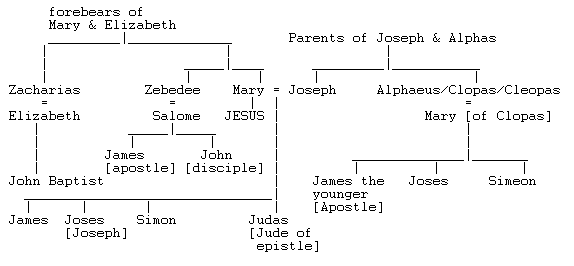
Peter Forbes [Mountsorrel (UK)] Comment added in 2001 Reply to Peter
|
this is my beloved son
|
Psa 2:7 | |
|
in whom I am well pleased
|
Isa 42:1 |
The way in which Matthew links these two Old Testament passages gives us an insight into how we should relate Isaiah 42 to Psalm 2.
4:8 The 'high mountain' of the temptations contrasts with the 'high mountains' (Rev 21:10). It was the joy of the kingdom which strengthened Jesus in the temptations.
Peter Forbes [Mountsorrel (UK)] Comment added in 2002 Reply to Peter
THE FRUIT OF REPENTANCE
When the Pharisees and Sadducees came to John to be baptised by him, John had a strong message for them. He said, "You brood of vipers! Who warned you to flee from the coming wrath? Produce fruit in keeping with repentance. And do not think you can say to yourselves, 'We have Abraham as our father.' I tell you that out of these stones God can raise up children for Abraham. The axe is already at the root of the trees, and every tree that does not produce good fruit will be cut down and thrown into the fire."
In their baptisms they declared that they had decided to change their way of life and were now going to turn back to God. But what John told them was to make sure that their decision showed in their actions. It is no use looking at our heritage and thinking that can save us - we must be God's people both in word and in actions. If we say we are going to be God's people but then don't act like it, we end up just like a good looking fruit tree that only has bad fruit. Let us not get caught in the same trap. Stop pretending and produce good fruit.
"IF YOU HAVE REALLY TURNED FROM YOUR SINS TO DO, PRODUCE FRUIT THAT WILL PROVE IT"
There is only one way to tell if a person has really changed. It is not by what they say or preach. It is not by what they do when they can be seen in public or when they think that someone is looking. The way to tell is if a person has really changed is if they have changed in their whole life - little private things as well as the big public things, when they can't be caught out no matter where or when you try to catch them, when the attitudes and opinions of others change toward them.
The people John the Baptist was speaking to came to repent for their sins. If we have accepted Christ then we need to have repented from our sins too. There are too many people who say they are Christians and who have not changed the way they live. They may go to church on Sunday and say grace before their meals, but then they go out and get drunk, read pornographic magazines, are ruthless in business, or beat their children and wives. Would Christ accept that?
Now that we have turned our faces from our sins, let us produce good fruit to prove that we have changed. Produce good fruit first in the small private areas of life and then in public where everyone can see. Be consistent.
Robert Prins [Auckland - Pakuranga - (NZ)] Comment added in 2002 Reply to Robert
ch 3 - If we were seeking to advertise something special we would doubtless select a prominent place to stand and speak. Not so John. He was down by Jordan away from centres of population. Why? God is not looking for 'passers by' to accept His call. He is seeking those who will be willing to put some effort into learning about Him.
4:9 Whilst the 'devil' offered Jesus 'all the kingdoms of the world' they were already his for the asking (Psalm 2:8). Likewise we have wonderful things promised to us so let us not be deceived by the apparent benefits of things we might think we can have now. Eve and then Adam made that mistake.
Peter Forbes [Mountsorrel (UK)] Comment added in 2003 Reply to Peter
ch.3 - Here we find that as soon as John sees the Pharisees, he addresses their worst fears about the coming King, which is that “he will burn up the chaff with unquenchable fire” v 12, a fulfilment of what we saw yesterday. He warns them that the axe is laid at the tree which does not bear fruit. The fact that the scribes and Pharisees tried to kill Jesus right from birth, even though they knew and believed the prophecies regarding him, shows us quite the depth of their wickedness, and quite how much they feared his power. This sort of wickedness is shown over and over again in scripture by those who deliberately sought to fight against God’s purpose, even though they knew and believed the prophecies. We have for example Jezebel and Athaliah who, knowing of the promise of God to keep a descendant of David on the throne continually, tried many times over to wipe out all traces of that kingly seed. How fitting then that we find the men in Jesus’ time who have the same mindset, trying to do exactly the same thing to the one who was the final promised “son of David”! See 2Kings 11:1-3.
A further point to ponder:
Salvation for mankind was not to come through mankind, but through God. God signified this by claiming Jesus as His son in verse 17. John said that the baptism of Christ was different to his, because Christ was the son of God, and he wasn't (John 3:30-31).
ch.4 - Why did Jesus go to “Galilee of the Gentiles”, as soon as he heard that John was in prison? What changed with the passing away of John? Similarly in John 4:1 Jesus departs to Galilee and Samaria once the Pharisees realise he is has more followers than John. Is Jesus signifying that it is now time to go to the gentiles, because God’s stiff necked people have had their chance? Again in verse 24, “his fame went throughout Syria”. Most of the prophecies of Christ speak of him going to the gentiles.
A further point to ponder:
What do you think was going through the dizzy, hazy, spinning mind of Jesus after forty days in the wilderness? Stones! How marvellous a proof of the devil being ones own thoughts it is, that all his temptations involve stones, tripping over them, or falling over!
Rob de Jongh [Mountsorrel (UK)] Comment added in 2003 Reply to Rob
3:12 In speaking of the chaff being burnt up John is quoting Mal 4:1 where Malachi says that the stubble represents those that ‘do wickedly’ so the Pharisees would doubtless see the force of John’s point. They were not just passive observers of the baptisms. Their inactivity was actually ‘doing’. It was doing wickedly. How often is our inactivity wickedness?
4:3 ‘If thou be the son of God’ is cast in Jesus’ teeth again (Matt 27:40) – so when we read "the devil ‘departed from him for a season." (Luke 4:13) we see that Jesus' temptations continued right through his ministry.
Peter Forbes [Mountsorrel (UK)] Comment added in 2004 Reply to Peter
The concluding verses of Chapter 3 and the first verses of chapter 4 show an extremely close connection.
|
John " saw the Spirit of God descending like a dove and lighting on Him"
|
Then Jesus was led up of the spirit
|
||
|
And lo, a voice from heaven saying, "This is my beloved Son
|
If thou be the Son of God
|
John Wilson [Toronto West (Can)] Comment added in 2004 Reply to John
4:2 After being weakened by forty days' fasting Jesus faced temptation. His trial was a great internal struggle pitting the flesh against the spirit. Jesus knew the unlimited power He had at His command (John 3:34). And yet, He resisted His desires in obedience to His Father. He did this in refuting the devil (fleshly desires) by the Word of God. Thus, the last king kept the Yahweh's Word whereas the first king (Saul) did not.
Michael Parry [Montreal (Can)] Comment added in 2004 Reply to Michael
3:7 The phrase 'wrath to come' is picked up by Paul 1Thess 1:10in a way which shows that repentance and baptism is the way that deliverance is obtained.
4:21 James and John may well have been mending their nets because of the draught of fishes of Luke 5:6
Peter Forbes [Mountsorrel (UK)] Comment added in 2006 Reply to Peter
3:9 In warning the Jewish leaders not to lay claim to Abraham John saw the potential which was manifest – John 8:33 - when these same individuals were reasoning with Jesus some time later.
Peter Forbes [Mountsorrel (UK)] Comment added in 2007 Reply to Peter
3:4 John's garment, woven from camel's hair, reminds us somewhat of Elijah's mantle. when we compare this verse with 2Kin 1:8 we can clearly see that there is very little similarity.
John Wilson [Toronto West (Can)] Comment added in 2007 Reply to John
4:11 When we see that ‘angels ministered unto him’ we appreciate that Psa 91:11– quoted by ‘the devil’ was actually true. But it was fulfilled in a different way to the way in which the flesh thought about it.
Peter Forbes [Mountsorrel (UK)] Comment added in 2008 Reply to Peter
Some people believe that Jesus faced an external tempter. They believe that this was Satan, a supernatural being (fallen angel), the universal agitator of evil.
If Satan exists, he (?) would have been created by Yahweh. Divine angels, by nature, are immortal. Thus, Satan, a supposed fallen divine angel, would be immortal. That would mean that evil would exist forever. But, that is not in Yahweh's plan.
The faithful followers of Jesus will live forever in peace (Rev 21:4). But all evil, including death itself will be abolished (Rev 20:10,14).
The word Satan, which Bible translators chose to capitalise and personify, is nothing more than the innate human tendency to be oppositional to God's laws - the flesh opposing the Spirit.
And so, each person is tempted internally by his/her own desires and not by an external agent. Jesus, being a man and having a human nature, weakened by forty days of fasting, was tempted internally. He overcame each temptation by refuting it with the power of the scripture.
Michael Parry [Montreal (Can)] Comment added in 2008 Reply to Michael
3:5 In preaching ‘in the wilderness’ - Matt 3:1– john did not make himself easily accessible. Those who wanted to hear his message had to put some effort into the process and go out to hear him. We should not only be willing to listen to the message of the gospel when it is convenient and easy. We should be willing to put ourselves out to hear the message of the gospel.
Peter Forbes [Mountsorrel (UK)] Comment added in 2009 Reply to Peter
The Devil And Satan - part 1 of 3 [lesson 12 of 20 from Outline of Basic Bible Teachings by Wes Booker (for part 2 see July 15, Matthew 16)]
I. The Devil
A. "Devil" is translated from two different Greek words, "daimon" and "diabolos": 1.) Daimon = demon (modern versions) = different kinds of diseases and illnesses in the New Testament 2.) Diabolos = a New Testament word. Literally 'traducer, one who defames or slanders'. Translated "false accuser; slanderer". Comes from two Greek words - "dia" = through, and "ballo" = throw. The idea is one who strikes through with words, i.e. a false accuser or slanderer. "Devil" is NEVER found in the Old Testament, and "devils" is only found four times - each refers to idols.
B. Serpent - mentioned in the Old Testament - Gen 3. It was a beast which God made - Gen 1:24-25. It was part of the "very good" creation. According to popular theology, either (1) the devil became a serpent, or (2) the devil entered into and / or controlled the serpent. There are problems with both views. The serpent becomes a symbol for sin in the Bible - Matt 23:33;Matt 3:7.
C. Heb 2:14 - important points: 1.) Christ had the same nature as all men; see also Heb 2:17;4:15 2.) If Jesus destroyed the devil through his death, then why is the devil still around tempting people to sin? 3.) Also, how can a supernatural fallen angel devil be "destroyed"? "Destroy" translated abolish, do away, cease, etc. 4.) But if "the devil" = sin nature, then Jesus could destroy it through a perfect life, a sacrificial death, and resurrection to eternal life. 5.) The devil has the power of death. Other verses say that sin has the power of death. Therefore the devil = sin, and is a personification of sin nature - Rom 6:23;8:3;1John 3:8;James 1:14-15;Heb 9:26
D. Devil (diabolos) is also used of Judas Iscariot (John 6:70-71) and of women and men - 1Tim 3:11;2Tim 3:3;Titus 2:3 = slanderer, false accuser
E. If the devil is a personification of sin, then why did New Testament writers choose to personify it? Sometimes New Testament writers personified "sin" - Rom 6:6-20. Also other attributes of human nature are personified - wisdom (Prov 8), love (1Cor 13).
Charles Link, Jr. [Moorestown, (NJ, USA)] Comment added in 2009 Reply to Charles
3:7 John's indictment of Israel's leadership echoes the indictment we just read in Isa 59:5.
John exclaims that the Pharisees and Sadducees were a generation of vipers.
This is one of the two classes of people that have populated (and continue to populate) the earth since the beginning:
The seed of the woman - those who have chosen to follow God on His terms.
The seed of the serpent - those who have chosen to follow their own fleshly desires.
The Pharisees and Sadducees were supposed to be the knowledgeable, religious leaders of the Jews. And yet they were in error from both the true understanding of God's plan and in correct conduct.
The lesson for us is that if we desire to serve God, then we must make sure of what He wants. This can only be obtained by reading His Word, the Bible.
We must not give credence to those who claim to be religious authorities until we have checked out what they say against the Bible (See Acts 17:10,11).
4:4,7,10 Jesus countered His temptations by reflecting on God’s Word. This is the most powerful instrument for overcoming the flesh (Heb 4:12).
4:11 When Jesus’ temptation was over, angels ministered to him. Those angels are available to the true followers of Jesus also (Heb 1:14).
4:23 When Jesus preached, His message always concerned the gospel of the kingdom. And yet, the kingdom is the very fact that Christendom denies.
Michael Parry [Montreal (Can)] Comment added in 2009 Reply to Michael
4:23 The religious leaders and seat of religion in Israel was to be found in Jerusalem. So Jesus went about Galilee preaching. His message was for the people who saw a need rather than those who thought that they did not have any need for salvation.
Peter Forbes [Mountsorrel (UK)] Comment added in 2010 Reply to Peter
3:7 Confession of personal sins is far from the minds of the Pharisees and Sadducees. Hence John’s reproof of them.
Peter Forbes [Mountsorrel (UK)] Comment added in 2011 Reply to Peter
4:3 ‘If thou be the son of God’ is a direct challenge to what God had said to Jesus in Matt 3:17. Jesus’ thought pattern was that having heard the statement he considered the implications of that – and resisted the wrong thought.
Peter Forbes [Mountsorrel (UK)] Comment added in 2012 Reply to Peter
3:16 From the way in which the record reads we may conclude that the opening of heaven and the spirit descending was seen only by Jesus. This was a private revelation of the father to His son indicating His pleasure in Jesus submission to baptism.
Peter Forbes [Mountsorrel (UK)] Comment added in 2013 Reply to Peter
SHINE
When Jesus began the Sermon on the Mount, one of the first things he said was that we need to shine our light of good deeds before men. (Matt 5:14-16). As he said that, those who heard him could have thought back to what they had seen of Jesus over the previous week, and they would know that what he said was what he did.
This is what they saw: "Jesus went throughout Galilee teaching in their synagogues, preaching the good news of the kingdom, and healing every disease and sickness among the people. News about him spread all over Syria, and people brought to him all who were ill with various diseases, those suffering in severe pain, the demon possessed, those having seizures, and the paralysed, and he healed them." (Matt 4:23-24)
Jesus did much more than teach the kingdom of God - he showed it. His compassion for the people shone out in his healings. We might not be able to heal people as Jesus did, but we can still shine and show God's compassion toward the people around us in our love and compassion toward them. Let's give people a taste of God's kingdom by showing them the love of Christ. We can preach, but let's show it even more powerfully by combining it with action.
Robert Prins [Auckland - Pakuranga - (NZ)] Comment added in 2013 Reply to Robert
Matt 3:16-17;4:3,6;1Cor 14:33 - Jesus is the Son of God; is that a confusing or mysterious concept?
Charles Link, Jr. [Moorestown, (NJ, USA)] Comment added in 2013 Reply to Charles
4:12 John had said that Jesus would increase and he would decrease John 3:30. The imprisonment coinciding with the beginning of Jesus’ ministry is the beginning of this change.
Peter Forbes [Mountsorrel (UK)] Comment added in 2014 Reply to Peter
3:11 John’s baptism served the same purpose as the baptism which Jesus would require. It is “repentance”.
Peter Forbes [Mountsorrel (UK)] Comment added in 2015 Reply to Peter
Alex Browning [Kitchener-Waterloo] Comment added in 2015 Reply to Alex
4:19 The Prophet – Hab 1:14– describes men as fish who have no leader which seems to be the basis for Jesus’ comment here.
Peter Forbes [Mountsorrel (UK)] Comment added in 2016 Reply to Peter
4:16 Whereas Matthew says “sat” The Isaiah quotation –Isa 9:2 has “walked” so we see the journey from standing to look to sitting down to be involved in an activity rather like Psa 1:1
Peter Forbes [Mountsorrel (UK)] Comment added in 2017 Reply to Peter
3:13-15 John’s response to Jesus indicates clearly that John knew the significance of Jesus’ appearance. In fact he at this time calls him “the lamb of God” John 1:29
Peter Forbes [Mountsorrel (UK)] Comment added in 2018 Reply to Peter
“And he saith unto them, Follow me, and I will make you fishers of men.”
In the first two chapters of Genesis we read of everything being very good with Adam and Eve commanded to have righteous dominion over Yahweh’s creation. In the last two chapters of Revelation this righteous dominion will be restored. Everything in-between is a fallen world. Yahweh, therefore, made provisions for a now sinful mankind that we may live acceptably in His sight. We cannot go back to what once was; all we have is the present and what we do in the present will determine our future.
To acceptably follow Christ, we must be converted, born again (Matt 18:3; John 3:7), in that we are to strive to be what we were initially created to be. We need to trade our old sin nature for the new nature in Christ, and this change can only be accomplished with faith (Eph 4:24; cf. Heb 11:6; James 2:26). It begins in the heart and radiates outwardly to affect everything we think, say, and do (cf. Matt 15:19; Mark 7:21 cp. Matt 12:35; Luke 6:45; Rom 8:6,7). If the heart is transformed, the actions will follow. It is to be converted from sin-filled to God-filled (Eph 3:19).
When Christ saw the apostle Peter fishing by the shores of Galilee, Christ said, “Follow me, and I will make you fishers of men.” This same scene was replayed three years later (Luke 5:1-11). The resurrected Christ saw Peter and some of the other apostles again by the shores of Galilee, Genneserat being one of its shores, fishing for fish, and not for men. Before Christ was arrested, Peter was the boldest of all the disciples, but his weakness was shown in his denying the Christ. No doubt Peter was very discouraged with himself and fell back (Luke 5:8). To reinstate Peter, he needed to be converted. Christ asked him one question, “Do you love me?” That’s all he needed to ask him, and this is what we need to ask ourselves when we fall. All the issues of life come from the heart (Prov 4:23). Every issue is a heart issue, so Christ goes to the heart of the matter, and the “stone” becomes a “rock” (Matt 16:18). The way Christ worked with Peter, he works with us.
After Pentecost, we see Peter and the apostles like we have never seen them before, abounding in the work of the Lord! Their love for God and the Messiah, and strengthened by the Holy Spirit, motivated them not to fulfil merely their duty, but to labour abundantly and gladly in service to their Lord. They are converted! May we take this lesson to heart: It is not about who we were before, but who we are now, not what we did before, but what we do now. As with Peter, so with us.
We, too, have been called to be about our “Father’s business.” Without doubt, most of us have suffered many disappointments along the way when hope deferred often makes the heart sick (Prov 13:12), but, as Christ’s disciples, we must keep undimmed in our hearts the hope of one day meeting our Messiah, and hear his proclamation, “Well done, thou good and faithful servant” (Matt 25:21).
Do we love Christ? If we love (agape) him, we will follow him in obedience (cf. 1Cor 11:1), and when we fail along our long and arduous journey, and fail we will, we have this assurance that Christ is our Sin-covering (Rom 3:24-26; Heb 9); therefore, not living in the past, but in the present, keeping our hearts with all diligence preparing for the glorious Hope that awaits us.
Valerie Mello [in isolation, TN, USA] Comment added in 2018 Reply to Valerie
3:5 when we read of those from “Jerusalem” going out to see John we should appreciate that this included the Jewish leaders. Verse:7 is the evidence for this.
Peter Forbes [Mountsorrel (UK)] Comment added in 2019 Reply to Peter
4:20 the willing ness of Peter and Andrew was because they had already learnt about Jesus’ calling from John the Baptist – John 1:36-41,
Peter Forbes [Mountsorrel (UK)] Comment added in 2020 Reply to Peter
3:2 The phrase “kingdom of heaven” is unique to Matthew (see Bro. Peter Forbes, 2001, below). There are many connections between Matthew and Daniel and referring to the kingdom in this way is one of them. Daniel spoke to Nebuchadnezzar of how he would come to know that “the heavens do rule” (Dan. 4:26), where perhaps we would expect ‘God does rule’, and Nebuchadnezzar later referred to God as, “the King of heaven” (Dan. 4:37).
Nigel Bernard [Pembroke Dock UK] Comment added in 2020 Reply to Nigel
4:17 Jesus both takes up the words of John the Baptist from 3:2 – and also gives them to his disciples when they were sent out to preach – 10:7.
Peter Forbes [Mountsorrel (UK)] Comment added in 2021 Reply to Peter
4:11-12 Often there are mixed emotions in our lives. On this occasion Jesus must have felt joy that he had resisted the temptations but it seems as he left the wilderness he learnt the sad news that his cousin John was imprisoned for preaching truth to Herod. Jesus would have understood that the battle was not over and that persecution lay ahead of him.
Peter Forbes [Mountsorrel (UK)] Comment added in 2022 Reply to Peter
In today’s 4th chapter of Matthew we read of a very thought provoking event: this occurred before Jesus began his ministry. It is a challenge to understand it correctly! The chapter begins by telling us “Then Jesus was led up by the Spirit into the wilderness…” Led by the Spirit!? So it was God’s will that this event happened. It took place in the wilderness away from people. The reason why the Spirit led him there was “to be tempted by the devil.”
What is the devil? Well first we note that there were 3 types of temptation that Jesus rejected! His “answer” in v. 4 is to state “It is written, ‘Man shall not live by bread alone, but by every word that comes from the mouth of God.'” We can see what that means for us today – we have that “word” in our hands, the source of ‘strength’ for our hearts to enable us to effectively resist inclinations to think or do anything that is ungodly.
But it is not sufficient to simply resist – we must think positively – in an ungodly world. We must feel ‘inspired’ by the future God’s word reveals, as we have been reading in Isaiah – and the lessons of failure – as shown by Saul when he became king..
How did Matthew come to write this account of his Master’s temptation? It is not until we come to his Matt 9:9 that we read of him being called to follow Jesus. So Jesus must have told him – and no doubt the other disciples too! And what was the method that Jesus often used in teaching? Parables! It is obvious that v.8 is not literal, it tells us, “Again, the devil took him to a very high mountain and showed him all the kingdoms of the world and their glory.” No such mountain exists! Satan told Jesus, “All these I will give you, if you will fall down and worship me.” [v.9] What is Satan the symbol of? The temptation to serve self – before (or as well as) serving God!
Judas gave in to the temptation to serve self. Jesus said, “Did I not choose you, the Twelve? And yet one of you is a devil.” John 6:70 Jesus was surrounded by those with such minds. The start of this same chapter tells us of the feeding of the 5,000 – look how the people reacted! The people declared, “”This is indeed the Prophet who is to come into the world!” [v.14]
What happened next! ‘Perceiving then that they were about to come and take him by force to make him king, Jesus withdrew again to the mountain by himself.” But Jesus had come to be king! But this was a temptation to do the right thing – the wrong way! Let us reflect on all the forms of temptation surrounding us today! Truly “man shall not live (eternally) by what this world provides with all its’ opportunities; let us make sure we live ” by every word that comes from the mouth of God.'”
Bro D.Caudery
For more resources on today’s readings visit. https://christadelphianvideo.org/christadelphian-daily-readings
Stuart-Caleb Art Courtonel [Rugby] Comment added in 2022 Reply to Stuart-Caleb Art
4:12-17 It appears that Jesus took the imprisoning of John the Baptist as the marker that he was to begin his ministry. But notice, like John, his work started outside of Jerusalem – in the Galilee.
Peter Forbes [Mountsorrel (UK)] Comment added in 2023 Reply to Peter
4:12 Whilst the record here in MATHEW reads as if Jesus hearing about John’s imprisonment followed close on the end of the temptations in the wilderness there must be a time gap – of unspecified length between the end of the temptations and John’s imprisonment because Jesus had performed miracles whilst John was still a free man – John 3:1,24
Peter Forbes [Mountsorrel (UK)] Comment added in 2024 Reply to Peter